National Institute for Health and Welfare (THL), Department of Infectious Disease Surveillance and Control, Gastrointestinal Infections Unit, Helsinki, Finland.
Trials. 2010 Jun 4;11:69. doi: 10.1186/1745-6215-11-69.
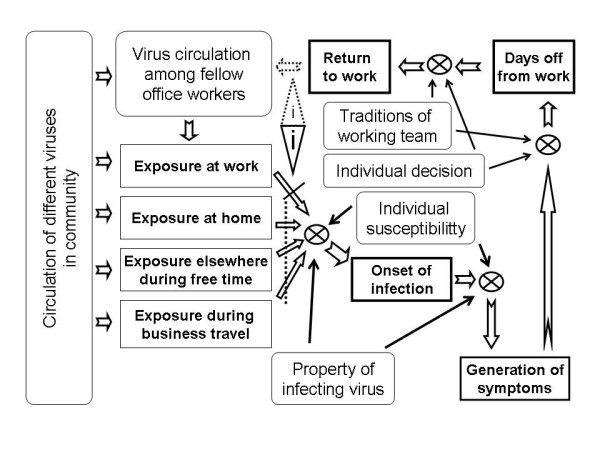
Acute infectious diseases are major causes of short periods of days off from work, day care and school. These diseases are mainly caused by viruses and hands have a key role in their transmission. Thus, hypothetically, they can be controlled with means of intensified hand hygiene. In this study we aim to elucidate the effect of acute infectious diseases on the work contribution in common office work and study the influence of improved hand hygiene on possible reduction of infectious disease episodes and days off from work due to acute infectious diseases.
The voluntary participants have been recruited from six companies in the Helsinki region. The designated 21 study clusters were identified as operationally distinct working units each containing at least 50 people. The clusters were matched and randomized based on results of a pre-trial contagion risk survey. Improved hand hygiene is being executed with guided hand-washing with soap and water in one intervention arm and with alcohol based hand rubbing disinfectant in the other. Participants in both arms have received guidance on how to avoid infections and how to implement contagion stopping habits. A control arm is acting as before regarding hand hygiene. Data collection for evaluation of the efficacy of the interventions is based on self-reporting through weekly electronic reports. The questionnaire is enquiring about possible respiratory or gastrointestinal symptoms during the preceding week, and requests a daily report of presence of symptoms and working capacity. Etiology of the symptoms is not searched for individually, but contribution of different viruses is evaluated by sentinel surveillance, where occupational health clinics located in the premises of the participating companies collect specimens from employees visiting the clinic. Common causative agents of the diseases are being searched for using real-time PCR techniques. The duration of the intervention will be 16 months. Primary endpoints of the study are the number of reported infection episodes in a cluster within a time frame of 100 reporting weeks and the number of reported sick leave episodes in a cluster within a time frame of 100 reporting weeks.
ClinicalTrials.gov Identifier: NCT00821509.
急性传染病是导致工作日、日托和学校缺勤的主要原因。这些疾病主要由病毒引起,手在其传播中起着关键作用。因此,从理论上讲,可以通过加强手部卫生来控制这些疾病。本研究旨在阐明急性传染病对一般办公室工作的工作贡献的影响,并研究改善手部卫生对减少因急性传染病而导致的疾病发作和缺勤天数的影响。
从赫尔辛基地区的六家公司招募了自愿参与者。指定的 21 个研究集群被确定为每个集群至少包含 50 人的操作上不同的工作单位。根据预试验传染风险调查的结果,对集群进行了匹配和随机分组。在干预组的一侧,通过用肥皂和水引导洗手,在另一侧用酒精基手揉搓消毒剂来执行改善手部卫生。两组参与者都接受了关于如何避免感染以及如何实施传染停止习惯的指导。对照组在手部卫生方面的做法与以前相同。干预效果评估的数据收集是基于通过每周电子报告进行自我报告。问卷询问了前一周可能出现的呼吸道或胃肠道症状,并要求每天报告症状和工作能力。未单独寻找症状的病因,但通过哨点监测评估不同病毒的发病情况,参与公司内的职业健康诊所从访问诊所的员工中收集样本。使用实时 PCR 技术搜索疾病的常见病原体。干预时间将持续 16 个月。该研究的主要终点是在 100 次报告周的时间框架内,每个集群报告的感染发作次数,以及在 100 次报告周的时间框架内,每个集群报告的病假发作次数。
ClinicalTrials.gov 标识符:NCT00821509。