Institute of Hygiene and Environmental Medicine, Walter-Rathenau-Strasse 49 A 17487 Greifswald, Germany.
BMC Infect Dis. 2010 Aug 24;10:250. doi: 10.1186/1471-2334-10-250.
The economical impact of absenteeism and reduced productivity due to acute infectious respiratory and gastrointestinal disease is normally not in the focus of surveillance systems and may therefore be underestimated. However, large community studies in Europe and USA have shown that communicable diseases have a great impact on morbidity and lead to millions of lost days at work, school and university each year. Hand disinfection is acknowledged as key element for infection control, but its effect in open, work place settings is unclear.
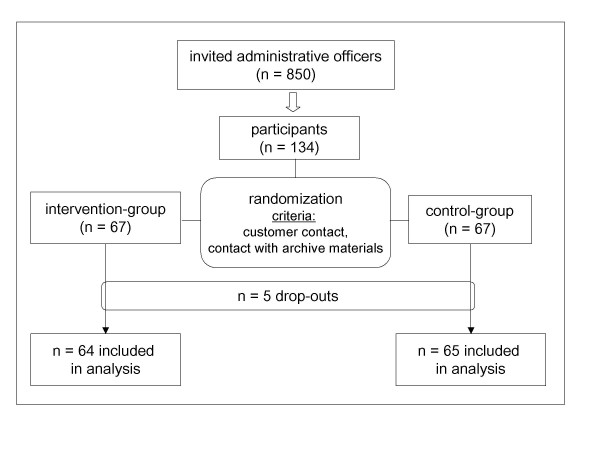
Our study involved a prospective, controlled, intervention-control group design to assess the epidemiological and economical impact of alcohol-based hand disinfectants use at work place. Volunteers in public administrations in the municipality of the city of Greifswald were randomized in two groups. Participants in the intervention group were provided with alcoholic hand disinfection, the control group was unchanged. Respiratory and gastrointestinal symptoms and days of work were recorded based on a monthly questionnaire over one year. On the whole, 1230 person months were evaluated.
Hand disinfection reduced the number of episodes of illness for the majority of the registered symptoms. This effect became statistically significant for common cold (OR = 0.35 [0.17 - 0.71], p = 0.003), fever (OR = 0.38 [0.14-0.99], p = 0.035) and coughing (OR = 0.45 [0.22 - 0.91], p = 0.02). Participants in the intervention group reported less days ill for most symptoms assessed, e.g. colds (2.07 vs. 2.78%, p = 0.008), fever (0.25 vs. 0.31%, p = 0.037) and cough (1.85 vs. 2.00%, p = 0.024). For diarrhoea, the odds ratio for being absent became statistically significant too (0.11 (CI 0.01 - 0.93).
Hand disinfection can easily be introduced and maintained outside clinical settings as part of the daily hand hygiene. Therefore it appears as an interesting, cost-efficient method within the scope of company health support programmes.
ISRCTN96340690.
由于急性传染性呼吸道和胃肠道疾病导致的旷工和生产力下降所造成的经济影响通常不在监测系统的关注范围内,因此可能被低估。然而,欧洲和美国的大型社区研究表明,传染病对发病率有很大影响,导致每年有数百万人失去工作、上学和上大学的时间。手部消毒已被确认为感染控制的关键因素,但在开放的工作场所环境中的效果尚不清楚。
我们的研究采用前瞻性、对照、干预对照组设计,评估工作场所使用基于酒精的手部消毒剂对传染病的流行病学和经济影响。在格赖夫斯瓦尔德市的市政府机构中,志愿者被随机分为两组。干预组的参与者提供酒精类手部消毒剂,对照组则不变。通过每月一次的问卷,在一年的时间里记录呼吸道和胃肠道症状以及工作日数。总共评估了 1230 个人月。
手部消毒减少了大多数登记症状的疾病发作次数。这种效果在普通感冒(OR=0.35[0.17-0.71],p=0.003)、发热(OR=0.38[0.14-0.99],p=0.035)和咳嗽(OR=0.45[0.22-0.91],p=0.02)方面具有统计学意义。干预组的参与者报告了大多数症状的病假天数较少,例如感冒(2.07%对 2.78%,p=0.008)、发热(0.25%对 0.31%,p=0.037)和咳嗽(1.85%对 2.00%,p=0.024)。对于腹泻,缺勤的优势比也具有统计学意义(0.11[0.01-0.93])。
手部消毒可以很容易地在临床环境之外引入和维持,作为日常手部卫生的一部分。因此,它作为公司健康支持计划范围内的一种有趣且具有成本效益的方法出现。
ISRCTN96340690。