Laboratory of Immunology, National Institute of Allergy and Infectious Diseases, National Institutes of Health, Bethesda, Maryland 20892, USA.
Nature. 2010 Jun 17;465(7300):942-6. doi: 10.1038/nature09076. Epub 2010 Jun 6.
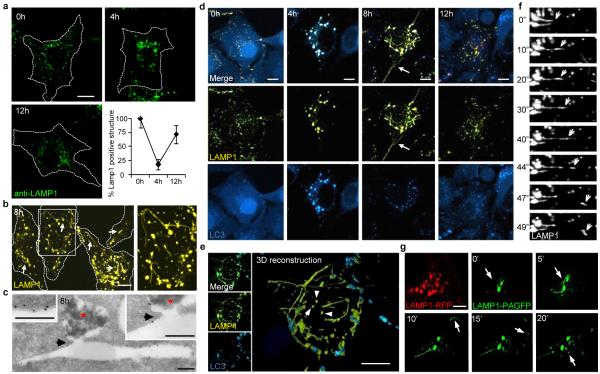
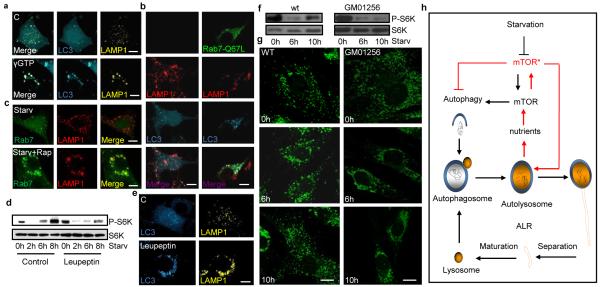
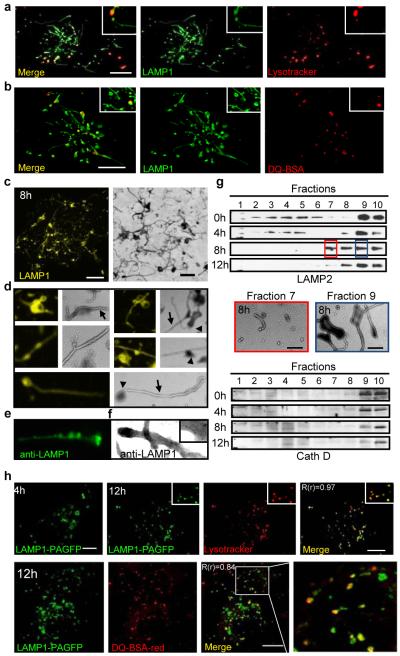
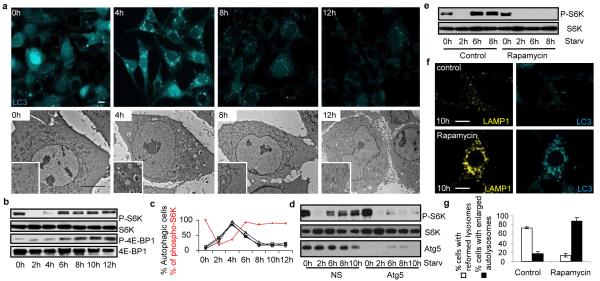
Autophagy is an evolutionarily conserved process by which cytoplasmic proteins and organelles are catabolized. During starvation, the protein TOR (target of rapamycin), a nutrient-responsive kinase, is inhibited, and this induces autophagy. In autophagy, double-membrane autophagosomes envelop and sequester intracellular components and then fuse with lysosomes to form autolysosomes, which degrade their contents to regenerate nutrients. Current models of autophagy terminate with the degradation of the autophagosome cargo in autolysosomes, but the regulation of autophagy in response to nutrients and the subsequent fate of the autolysosome are poorly understood. Here we show that mTOR signalling in rat kidney cells is inhibited during initiation of autophagy, but reactivated by prolonged starvation. Reactivation of mTOR is autophagy-dependent and requires the degradation of autolysosomal products. Increased mTOR activity attenuates autophagy and generates proto-lysosomal tubules and vesicles that extrude from autolysosomes and ultimately mature into functional lysosomes, thereby restoring the full complement of lysosomes in the cell-a process we identify in multiple animal species. Thus, an evolutionarily conserved cycle in autophagy governs nutrient sensing and lysosome homeostasis during starvation.
自噬是一种进化上保守的过程,通过该过程细胞质蛋白和细胞器被分解代谢。在饥饿时,蛋白 TOR(雷帕霉素的靶标),一种营养响应激酶,被抑制,这诱导自噬。在自噬中,双层膜自噬体包裹并隔离细胞内成分,然后与溶酶体融合形成自溶酶体,自溶酶体降解其内容物以再生营养物质。目前的自噬模型以自噬体货物在自溶酶体中的降解为终点,但对营养物质响应的自噬的调节以及自溶酶体的后续命运知之甚少。在这里,我们表明在大鼠肾细胞中自噬的起始过程中抑制 mTOR 信号,但在长期饥饿时重新激活。mTOR 的再激活是自噬依赖性的,需要自溶酶体产物的降解。增加的 mTOR 活性减弱自噬并产生原溶酶体小管和小泡,从小溶酶体中挤出并最终成熟为功能溶酶体,从而恢复细胞中完整的溶酶体库——我们在多种动物物种中鉴定出的过程。因此,自噬中的一个进化上保守的循环在饥饿期间调节营养感应和溶酶体稳态。