Ng Horng Yih, Wu Yuan Seng, Biswas Mohitosh, Sim Maw Shin
Department of Pharmaceutical Life Sciences, Faculty of Pharmacy, Universiti Malaya, 50603, Kuala Lumpur, Malaysia.
Department of Biomedical Sciences, Sir Jeffrey Cheah Sunway Medical School, Faculty of Medical and Life Sciences, Sunway University, Sunway City, Malaysia.
Biogerontology. 2025 Aug 2;26(4):153. doi: 10.1007/s10522-025-10296-x.
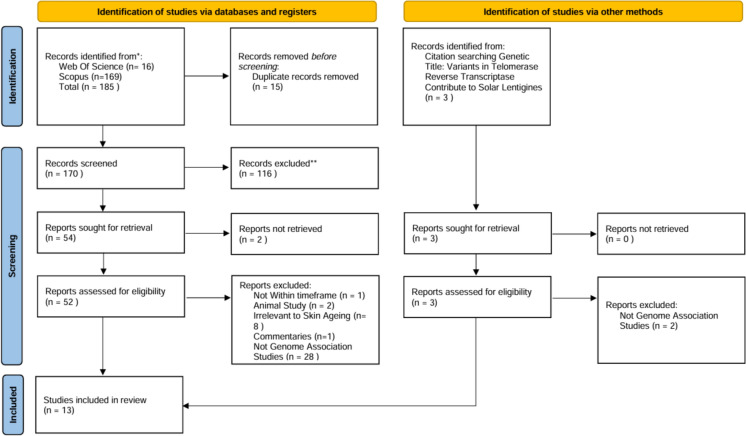
Skin ageing is a multifaceted process influenced by both intrinsic genetic factors and extrinsic environmental exposures. This review explores the genetic variants and molecular mechanisms underlying skin ageing phenotypes, while identifying gaps in current research to inform future studies. A systematic search of the Scopus and Web of Science databases was conducted, with articles screened based on criteria including a focus on human genetic association studies and indexing in either Scopus or the Institute for Scientific Information (ISI) Web of Science. The quality of included studies was assessed using the Q-Genie tool. Thirteen studies met the inclusion criteria, collectively analysing 115 single nucleotide polymorphisms (SNPs) across 99 genes. The OCA2 gene emerged as the most frequently investigated, consistently linked to hyperpigmentation. Overall, findings indicate that skin ageing phenotypes are associated with genes involved in collagen metabolism, melanogenesis, oxidative stress, and mechanical properties of the skin. Notably, SPATA33 rs35063026 and IRF4 rs12203592 polymorphisms exhibit pleiotropic effects, contributing to both wrinkling and pigmentation changes. Interestingly, some variants, such as SPTLC1 rs7042102 and REEP3 rs11961184, display paradoxical effects, underscoring the complexity of genetic modulation. Genes implicated in extracellular matrix (ECM) degradation, such as SMYD3, and those responsive to environmental pollutants, like CYP1A1, were associated with increased skin sagging. Conversely, variants in genes such as COL1A2 and COL13A1, which support ECM integrity and skin resilience, were linked to protective effects. Despite these insights, many genetic associations remain poorly understood, highlighting substantial gaps in knowledge and the need for more comprehensive genetic research into skin ageing.
皮肤老化是一个多方面的过程,受到内在遗传因素和外在环境暴露的影响。本综述探讨了皮肤老化表型背后的基因变异和分子机制,同时确定了当前研究中的空白,以为未来的研究提供参考。我们对Scopus和科学网数据库进行了系统检索,根据包括侧重于人类基因关联研究以及在Scopus或科学信息研究所(ISI)科学网中被索引等标准筛选文章。使用Q-Genie工具评估纳入研究的质量。13项研究符合纳入标准,共分析了99个基因中的115个单核苷酸多态性(SNP)。OCA2基因是研究最频繁的基因,一直与色素沉着过度有关。总体而言,研究结果表明,皮肤老化表型与参与胶原蛋白代谢、黑素生成、氧化应激和皮肤机械性能的基因有关。值得注意的是,SPATA33 rs35063026和IRF4 rs12203592多态性表现出多效性,导致皱纹和色素沉着变化。有趣的是,一些变异,如SPTLC1 rs7042102和REEP3 rs11961184,显示出矛盾的效应,凸显了基因调控的复杂性。与细胞外基质(ECM)降解有关的基因,如SMYD3,以及对环境污染物有反应的基因,如CYP1A1,与皮肤松弛增加有关。相反,支持ECM完整性和皮肤弹性的基因,如COL1A2和COL13A1中的变异,与保护作用有关。尽管有这些见解,但许多基因关联仍知之甚少,突出了知识上的重大空白以及对皮肤老化进行更全面基因研究的必要性。