Department of Medical Genetics, Cambridge Institute for Medical Genetics, Wellcome Trust/MRC Building, Hills Road, Cambridge, CB2 0XY, UK.
Nat Cell Biol. 2011 Apr;13(4):453-60. doi: 10.1038/ncb2204. Epub 2011 Mar 13.
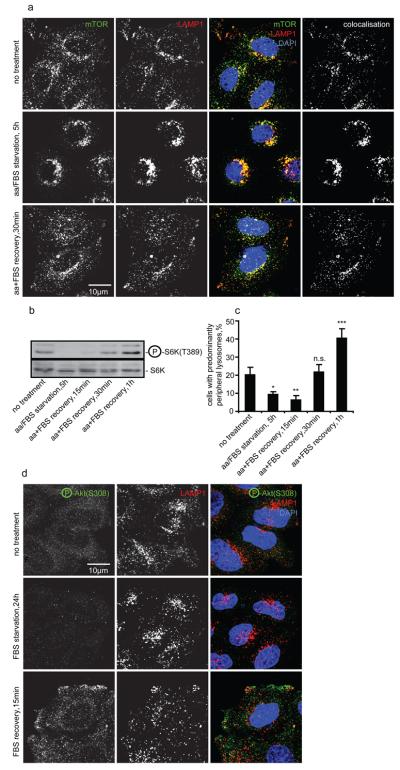
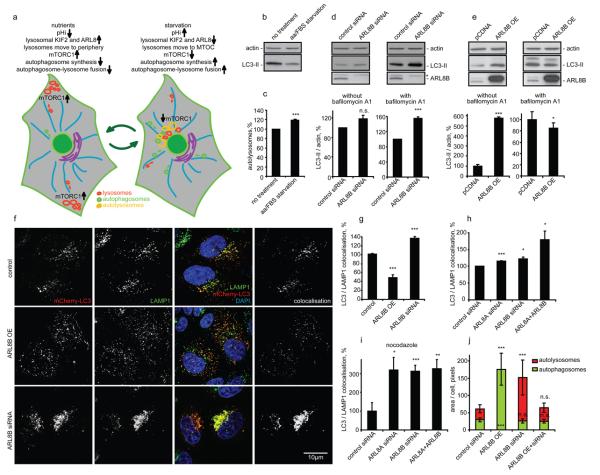
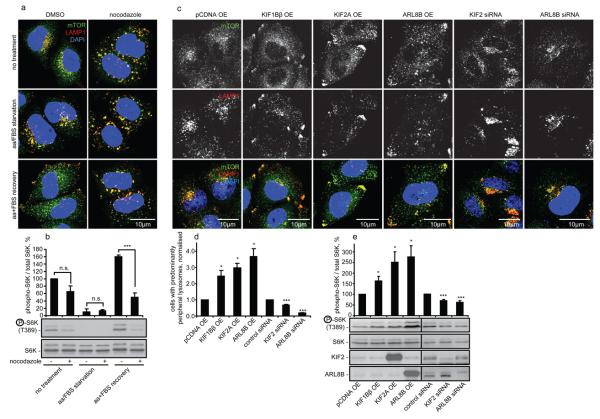
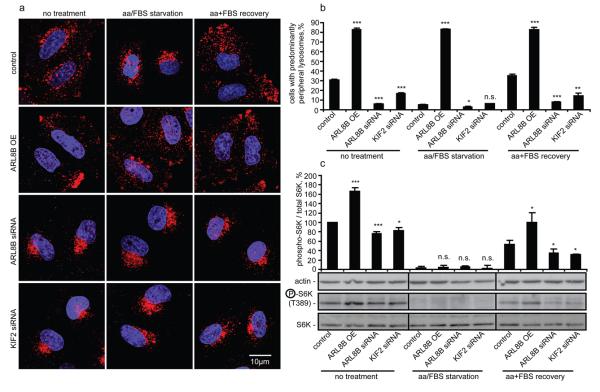
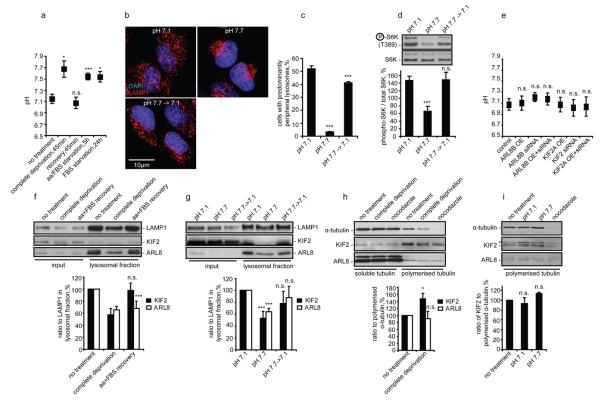
mTOR (mammalian target of rapamycin) signalling and macroautophagy (henceforth autophagy) regulate numerous pathological and physiological processes, including cellular responses to altered nutrient levels. However, the mechanisms regulating mTOR and autophagy remain incompletely understood. Lysosomes are dynamic intracellular organelles intimately involved both in the activation of mTOR complex 1 (mTORC1) signalling and in degrading autophagic substrates. Here we report that lysosomal positioning coordinates anabolic and catabolic responses with changes in nutrient availability by orchestrating early plasma-membrane signalling events, mTORC1 signalling and autophagy. Activation of mTORC1 by nutrients correlates with its presence on peripheral lysosomes that are physically close to the upstream signalling modules, whereas starvation causes perinuclear clustering of lysosomes, driven by changes in intracellular pH. Lysosomal positioning regulates mTORC1 signalling, which in turn influences autophagosome formation. Lysosome positioning also influences autophagosome-lysosome fusion rates, and thus controls autophagic flux by acting at both the initiation and termination stages of the process. Our findings provide a physiological role for the dynamic state of lysosomal positioning in cells as a coordinator of mTORC1 signalling with autophagic flux.
mTOR(哺乳动物雷帕霉素靶蛋白)信号和巨自噬(以下简称自噬)调节许多病理和生理过程,包括细胞对营养水平变化的反应。然而,调节 mTOR 和自噬的机制仍不完全清楚。溶酶体是一种动态的细胞内细胞器,它既参与 mTORC1 信号的激活,又参与自噬底物的降解。在这里,我们报告溶酶体定位通过协调早期质膜信号事件、mTORC1 信号和自噬,将合成代谢和分解代谢反应与营养可用性的变化联系起来。营养物质激活 mTORC1 与其存在于靠近上游信号模块的外周溶酶体有关,而饥饿导致溶酶体在细胞内 pH 变化的驱动下发生核周聚集。溶酶体定位调节 mTORC1 信号,进而影响自噬体的形成。溶酶体定位也影响自噬体-溶酶体融合速率,从而通过作用于自噬过程的起始和终止阶段来控制自噬通量。我们的发现为溶酶体定位的动态状态作为 mTORC1 信号与自噬通量的协调者在细胞中的生理作用提供了依据。