School of Biological Sciences, University of Liverpool, Liverpool, United Kingdom.
PLoS One. 2010 May 28;5(5):e10889. doi: 10.1371/journal.pone.0010889.
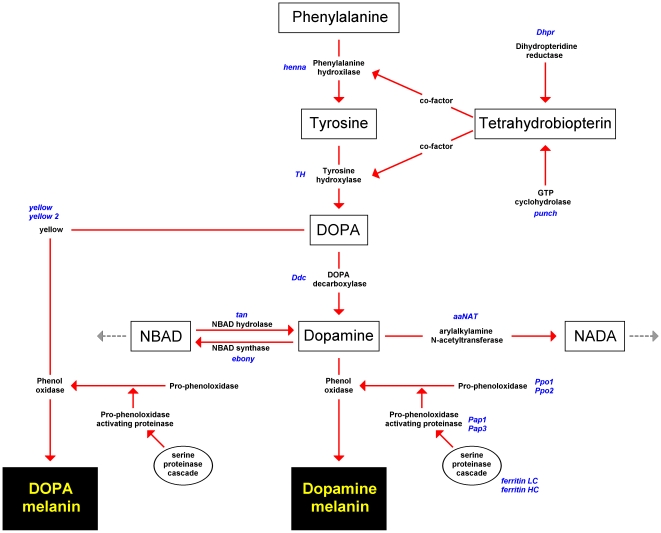
Industrial melanism in the peppered moth (Biston betularia) is an iconic case study of ecological genetics but the molecular identity of the gene determining the difference between the typical and melanic (carbonaria) morphs is entirely unknown. We applied the candidate gene approach to look for associations between genetic polymorphisms within sixteen a priori melanisation gene candidates and the carbonaria morph. The genes were isolated and sequence characterised in B. betularia using degenerate PCR and from whole-transcriptome sequence. The list of candidates contains all the genes previously implicated in melanisation pattern differences in other insects, including aaNAT, DOPA-decarboxylase, ebony, tan, tyrosine hydroxylase, yellow and yellow2 (yellow-fa). Co-segregation of candidate gene alleles and carbonaria morph was tested in 73 offspring of a carbonaria male-typical female backcross. Surprisingly, none of the sixteen candidate genes was in close linkage with the locus controlling the carbonaria-typical polymorphism. Our study demonstrates that the 'carbonaria gene' is not a structural variant of a canonical melanisation pathway gene, neither is it a cis-regulatory element of these enzyme-coding genes. The implication is either that we have failed to characterize an unknown enzyme-coding gene in the melanisation pathway, or more likely, that the 'carbonaria gene' is a higher level trans-acting factor which regulates the spatial expression of one or more of the melanisation candidates in this study to alter the pattern of melanin production.
工业黑化在胡椒蛾(Biston betularia)中是生态遗传学的一个标志性案例研究,但决定典型和黑化(carbonaria)形态之间差异的基因的分子身份完全未知。我们应用候选基因方法,寻找十六个先验黑化基因候选物内的遗传多态性与 carbonaria 形态之间的关联。使用简并 PCR 从 B. betularia 中分离和序列表征基因,并从全转录组序列中分离和序列表征基因。候选基因列表包含以前在其他昆虫的黑化模式差异中涉及的所有基因,包括 aaNAT、DOPA-脱羧酶、乌木、tan、酪氨酸羟化酶、黄色和黄色 2(yellow-fa)。在 73 个 carbonaria 雄性-典型雌性回交后代中测试候选基因等位基因和 carbonaria 形态的共分离。令人惊讶的是,十六个候选基因中没有一个与控制 carbonaria-典型多态性的基因座紧密连锁。我们的研究表明,“carbonaria 基因”不是经典黑化途径基因的结构变异体,也不是这些酶编码基因的顺式调控元件。这意味着我们要么未能表征黑化途径中未知的酶编码基因,要么更有可能的是,“carbonaria 基因”是一个更高层次的反式作用因子,它调节本研究中一个或多个黑化候选基因的空间表达,从而改变黑色素产生的模式。