Corbie-Smith Giselle, Akers Aletha, Blumenthal Connie, Council Barbara, Wynn Mysha, Muhammad Melvin, Stith Doris
Project GRACE, USA.
AIDS Educ Prev. 2010 Jun;22(3):184-202. doi: 10.1521/aeap.2010.22.3.184.
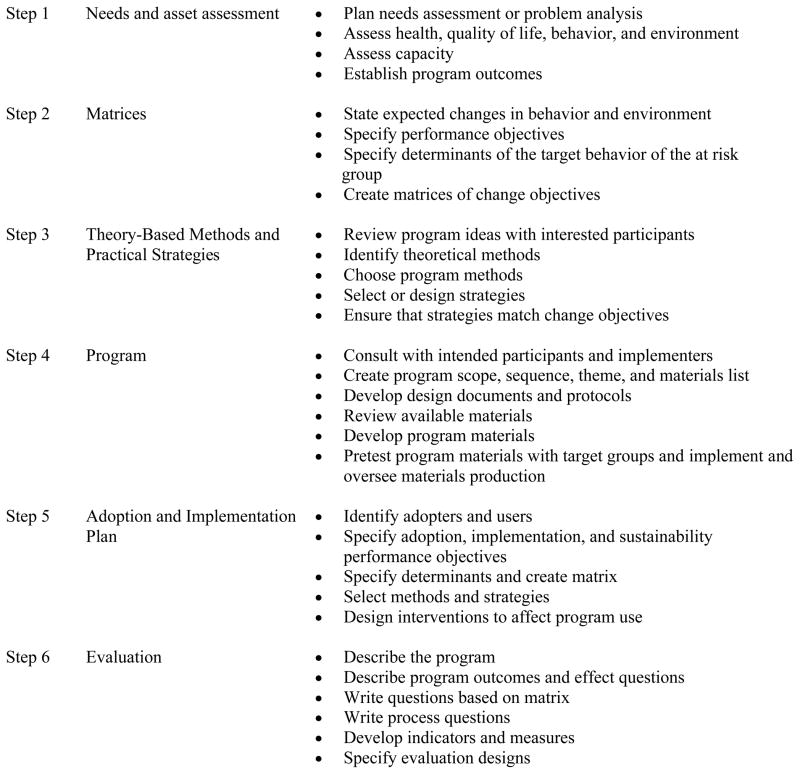
Southeastern states are among the hardest hit by the HIV epidemic in this country, and racial disparities in HIV rates are high in this region. This is particularly true in our communities of interest in rural eastern North Carolina. Although most recent efforts to prevent HIV attempt to address multiple contributing factors, we have found few multilevel HIV interventions that have been developed, tailored or tested in rural communities for African Americans. We describe how Project GRACE integrated intervention mapping (IM) methodology with community-based participatory research (CBPR) principles to develop a multilevel, multigenerational HIV prevention intervention. IM was carried out in a series of steps from review of relevant data through producing program components. Through the IM process, all collaborators agreed that we needed a family-based intervention involving youth and their caregivers. We found that the structured approach of IM can be adapted to incorporate the principles of CBPR.
美国东南部各州是该国受艾滋病毒疫情影响最严重的地区之一,该地区艾滋病毒感染率的种族差异很大。在我们感兴趣的北卡罗来纳州东部农村社区尤其如此。尽管最近预防艾滋病毒的努力试图解决多个促成因素,但我们发现,针对非裔美国人的农村社区,很少有多层次的艾滋病毒干预措施得到开发、量身定制或测试。我们描述了“GRACE项目”如何将干预映射(IM)方法与基于社区的参与性研究(CBPR)原则相结合,以开发一种多层次、多代人的艾滋病毒预防干预措施。IM从审查相关数据到生成项目组成部分分一系列步骤进行。通过IM过程,所有合作者一致认为,我们需要一种以家庭为基础、涉及青少年及其照顾者的干预措施。我们发现,IM的结构化方法可以进行调整,以纳入CBPR的原则。