Vanderbilt Institute for Global Health, Vanderbilt University School of Medicine, Nashville, TN, 37203 USA.
BMC Int Health Hum Rights. 2010 Jun 8;10:15. doi: 10.1186/1472-698X-10-15.
A legacy of colonial rule coupled with a devastating 16-year civil war through 1992 left Mozambique economically impoverished just as the human immunodeficiency virus (HIV) epidemic swept over southern Africa in the late 1980s. The crumbling Mozambican health care system was wholly inadequate to support the need for new chronic disease services for people with the acquired immunodeficiency syndrome (AIDS).
To review the unique challenges faced by Mozambique as they have attempted to stem the HIV epidemic, we undertook a systematic literature review through multiple search engines (PubMed, Google Scholar, SSRN, AnthropologyPlus, AnthroSource) using Mozambique as a required keyword. We searched for any articles that included the required keyword as well as the terms 'HIV' and/or 'AIDS', 'prevalence', 'behaviors', 'knowledge', 'attitudes', 'perceptions', 'prevention', 'gender', drugs, alcohol, and/or 'health care infrastructure'.
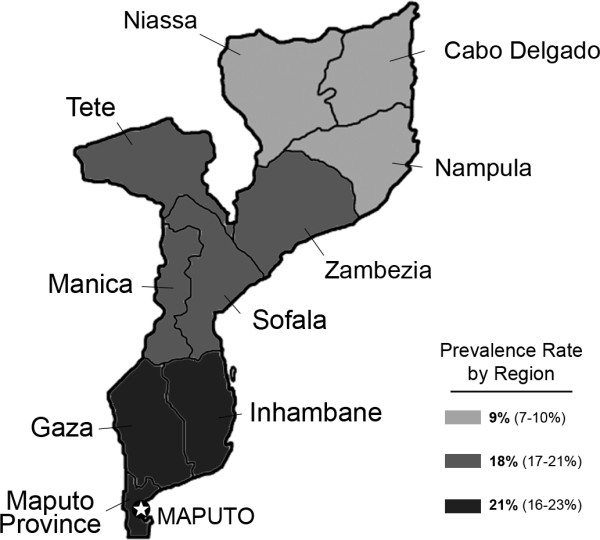
UNAIDS 2008 prevalence estimates ranked Mozambique as the 8th most HIV-afflicted nation globally. In 2007, measured HIV prevalence in 36 antenatal clinic sites ranged from 3% to 35%; the national estimate of was 16%. Evidence suggests that the Mozambican HIV epidemic is characterized by a preponderance of heterosexual infections, among the world's most severe health worker shortages, relatively poor knowledge of HIV/AIDS in the general population, and lagging access to HIV preventive and therapeutic services compared to counterpart nations in southern Africa. Poor education systems, high levels of poverty and gender inequality further exacerbate HIV incidence.
Recommendations to reduce HIV incidence and AIDS mortality rates in Mozambique include: health system strengthening, rural outreach to increase testing and linkage to care, education about risk reduction and drug adherence, and partnerships with traditional healers and midwives to effect a lessening of stigma.
殖民统治的遗留问题加上 1992 年结束的毁灭性的 16 年内战,使莫桑比克在 20 世纪 80 年代末艾滋病毒(HIV)在南部非洲蔓延之际经济贫困。摇摇欲坠的莫桑比克医疗体系完全无法满足新的慢性病服务需求,以支持艾滋病毒感染者和艾滋病患者。
为了审查莫桑比克在试图遏制 HIV 流行时所面临的独特挑战,我们通过多个搜索引擎(PubMed、Google Scholar、SSRN、AnthropologyPlus、AnthroSource)进行了系统文献综述,将莫桑比克作为必需的关键词。我们搜索了包含必需关键词以及“HIV”和/或“AIDS”、“流行率”、“行为”、“知识”、“态度”、“看法”、“预防”、“性别”、药物、酒精和/或“医疗保健基础设施”的任何文章。
联合国艾滋病规划署 2008 年的流行率估计将莫桑比克列为全球第八大受 HIV 影响最严重的国家。2007 年,36 个产前诊所地点的 HIV 流行率测量范围从 3%到 35%;全国估计为 16%。有证据表明,莫桑比克的 HIV 流行具有异性恋感染为主、世界上卫生工作者最严重短缺、普通民众对 HIV/AIDS 的知识相对较差以及与南部非洲的对照国家相比,艾滋病毒预防和治疗服务的获取滞后等特征。教育系统薄弱、贫困程度高和性别不平等进一步加剧了 HIV 的发病率。
为降低莫桑比克的 HIV 发病率和艾滋病死亡率,建议采取以下措施:加强卫生系统、向农村地区扩大检测和提供护理服务、开展减少风险和药物依从性的教育,以及与传统治疗师和助产士合作,以减少污名化。