School for Health, University of Bath, Bath BA2 7AY.
BMJ. 2010 Jun 8;340:c2161. doi: 10.1136/bmj.c2161.
To measure the short term impact on hospital admissions for myocardial infarction of the introduction of smoke-free legislation in England on 1 July 2007.
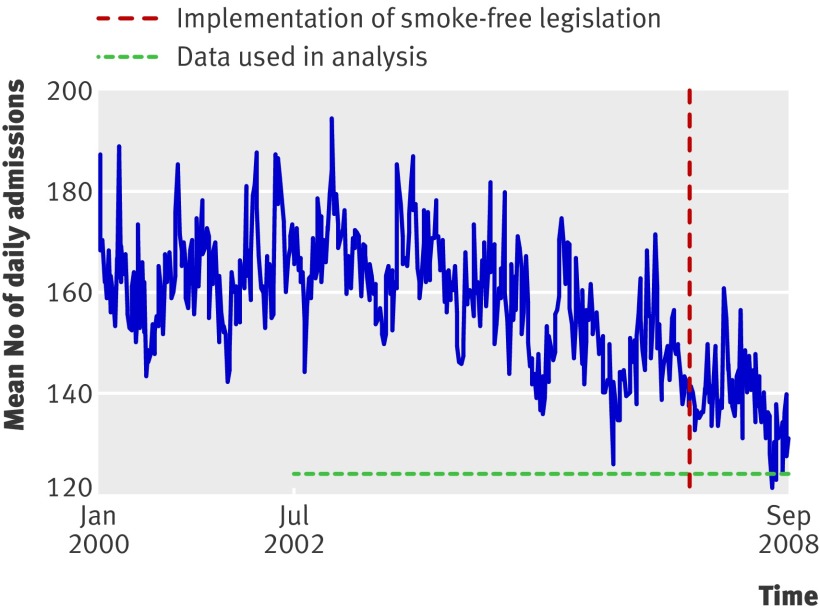
An interrupted time series design with routinely collected hospital episode statistics data. Analysis of admissions from July 2002 to September 2008 (providing five years' data from before the legislation and 15 months' data from after) using segmented Poisson regression.
England. Population All patients aged 18 or older living in England with an emergency admission coded with a primary diagnosis of myocardial infarction.
Weekly number of completed hospital admissions.
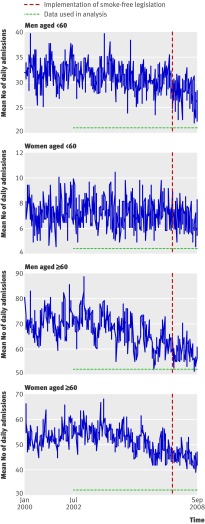
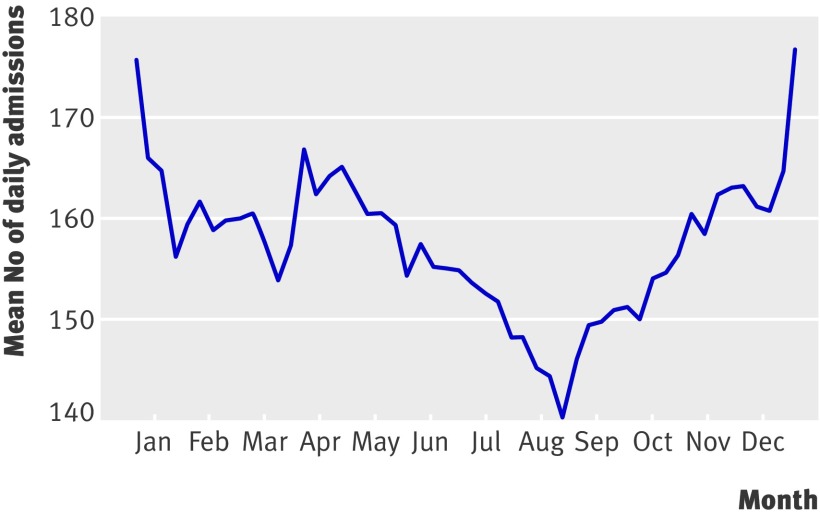
After adjustment for secular and seasonal trends and variation in population size, there was a small but significant reduction in the number of emergency admissions for myocardial infarction after the implementation of smoke-free legislation (-2.4%, 95% confidence interval -4.06% to -0.66%, P=0.007). This equates to 1200 fewer emergency admissions for myocardial infarction (1600 including readmissions) in the first year after legislation. The reduction in admissions was significant in men (3.1%, P=0.001) and women (3.8%, P=0.007) aged 60 and over, and men (3.5%, P<0.01) but not women (2.5% P=0.38) aged under 60.
This study adds to a growing body of evidence that smoke-free legislation leads to reductions in myocardial infarctions. It builds on previous work by showing that such declines are observed even when underlying reductions in admissions and potential confounders are controlled for. The considerably smaller decline in admissions observed in England compared with many other jurisdictions probably reflects aspects of the study design and the relatively low levels of exposure to secondhand smoke in England before the legislation.
衡量英格兰 2007 年 7 月 1 日实行无烟立法对心肌梗死住院人数的短期影响。
采用常规收集的医院病例统计数据的时间序列中断设计。对 2002 年 7 月至 2008 年 9 月(提供立法前五年和立法后 15 个月的数据)的住院人数进行分段泊松回归分析。
英格兰。人群所有年龄在 18 岁或以上,居住在英格兰,因编码为原发性心肌梗死的急诊入院。
每周完成的住院人数。
在调整了季节性和季节性趋势以及人口规模的变化后,实施无烟立法后,心肌梗死的急诊入院人数出现了微小但显著的下降(-2.4%,95%置信区间-4.06%至-0.66%,P=0.007)。这相当于立法后第一年因心肌梗死急诊入院人数减少了 1200 人(包括再次入院的人数为 1600 人)。60 岁及以上男性(3.1%,P=0.001)和女性(3.8%,P=0.007)以及男性(3.5%,P<0.01)但女性(2.5%,P=0.38)的入院人数减少有统计学意义。
本研究为越来越多的无烟立法可导致心肌梗死减少的证据提供了补充。它建立在以前的工作基础上,表明即使在控制了住院人数下降和潜在混杂因素的情况下,这种下降仍然存在。与许多其他司法管辖区相比,英国观察到的入院人数下降幅度较小,这可能反映了研究设计和立法前英国二手烟暴露水平相对较低的方面。