Radboud University Nijmegen Medical Centre, Nijmegen, The Netherlands.
Arthritis Care Res (Hoboken). 2010 Jun;62(6):842-7. doi: 10.1002/acr.20123.
In order to improve adherence to treatment guidelines and performance indicators advocating tight control of disease activity in rheumatoid arthritis (RA), it is important to gain insight into the factors influencing rheumatologists' decisions whether or not to escalate care. Our objective was to determine the influence of specific attributes relative to a validated measure of disease activity (the Disease Activity Score [DAS]) on rheumatologists' decisions to escalate care.
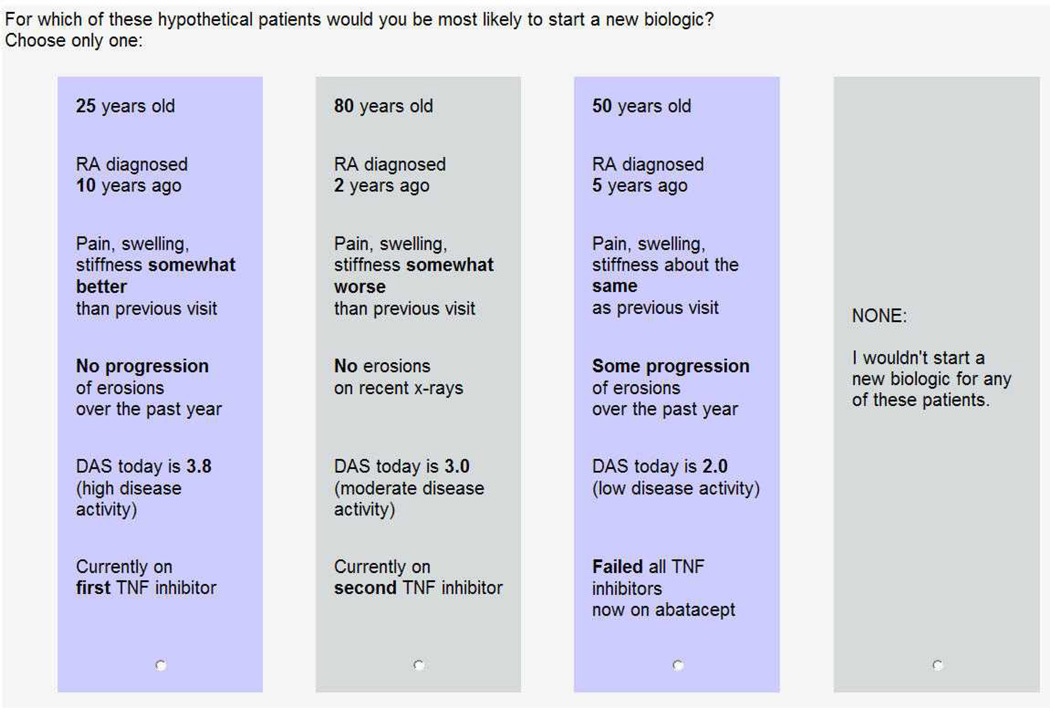
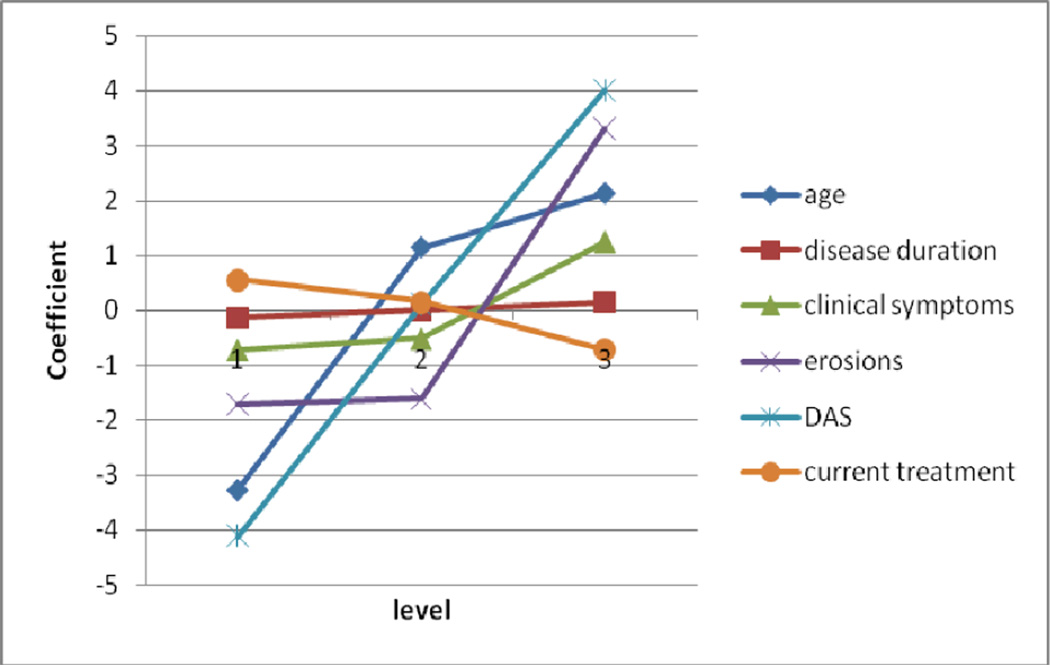
We used a computer-based choice-based conjoint analysis survey to determine the relative importance of 6 attributes on rheumatologists' decisions related to escalation of care in RA. We administered the survey in a convenience sample of rheumatologists attending the 2008 American College of Rheumatology Annual Scientific Meeting. Utilities were calculated using hierarchical Bayes modeling, and these results were used to calculate the relative importance of each attribute.
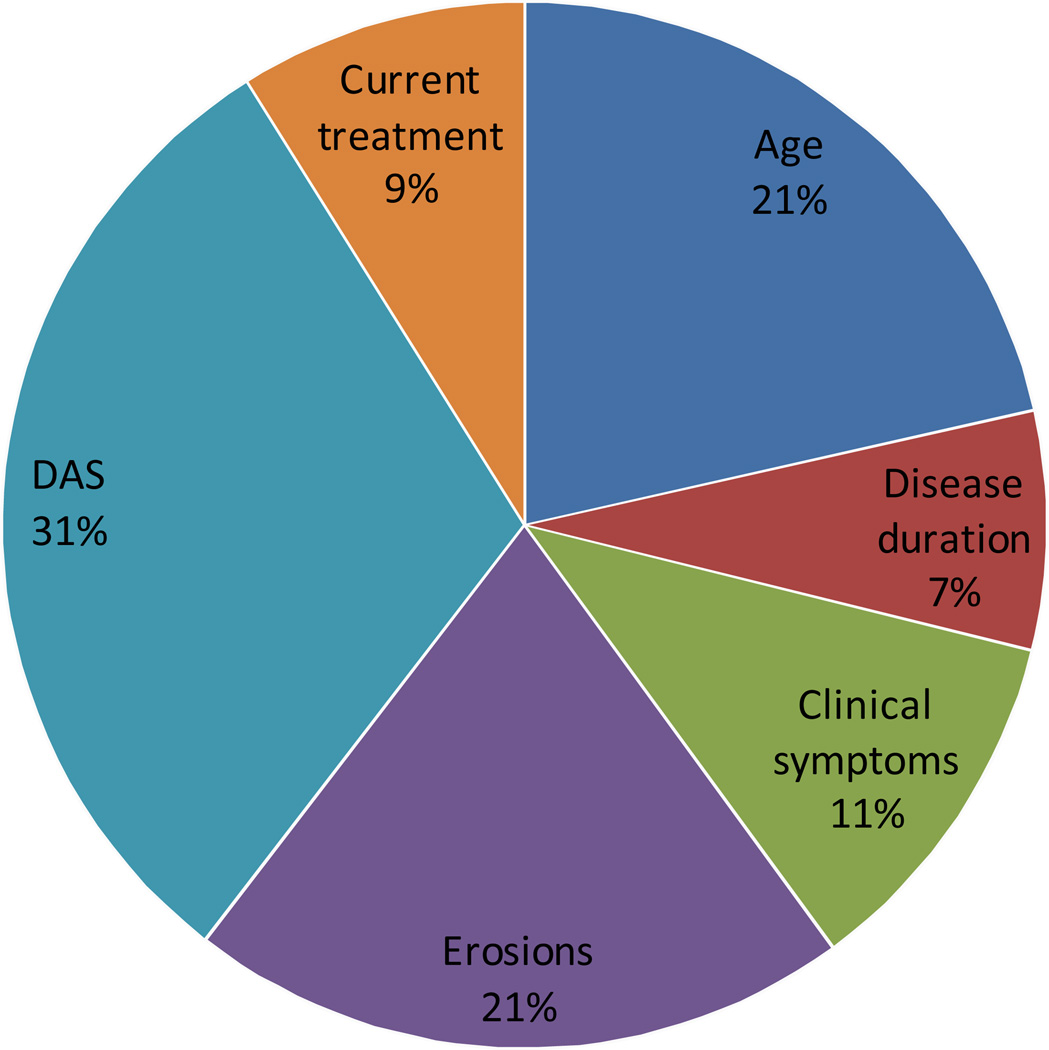
Rheumatologists assigned the most importance to the DAS score (relative importance of 30.7%) in their decision to escalate care. The age of the patient (21.5%) and erosions (20.5%) were rated as equally important in this decision. The decision to escalate care was least influenced by change in symptoms reported by the patient (11.1%), current treatment (8.9%), and disease duration (7.4%).
Our findings suggest that rheumatologists endorse the DAS as a means to guide decision making in RA. We also found that age and erosions are important influences on rheumatologists' decisions to escalate care in RA. Our results add to the literature supporting age bias in RA and suggest that further research is needed to determine how age affects quality of care in clinical practice.
为了提高对治疗指南的依从性,并实现类风湿关节炎(RA)疾病活动度严格控制的绩效指标,深入了解影响风湿病学家决定是否升级治疗的因素非常重要。我们的目的是确定相对于疾病活动度的验证衡量标准(疾病活动评分[DAS])的特定属性对风湿病学家决定升级护理的影响。
我们使用基于计算机的选择式联合分析调查来确定与 RA 中护理升级相关的风湿病学家决策中 6 个属性的相对重要性。我们在参加 2008 年美国风湿病学会年会的便利样本风湿病学家中进行了这项调查。使用分层贝叶斯模型计算效用,并使用这些结果计算每个属性的相对重要性。
风湿病学家将 DAS 评分(相对重要性为 30.7%)在其决定升级护理中的重要性评定为最高。患者的年龄(21.5%)和侵蚀(20.5%)在该决策中被评定为同等重要。患者报告的症状变化(11.1%)、当前治疗(8.9%)和疾病持续时间(7.4%)对升级护理的决策影响最小。
我们的研究结果表明,风湿病学家认可 DAS 是指导 RA 决策的一种手段。我们还发现年龄和侵蚀是影响风湿病学家决定升级 RA 护理的重要因素。我们的研究结果为 RA 中的年龄偏见提供了更多的文献支持,并表明需要进一步研究确定年龄如何影响临床实践中的护理质量。