Nutritional Immunology and Molecular Nutrition Laboratory, Virginia Polytechnic Institute and State University, Blacksburg, VA 24061, USA.
BMC Gastroenterol. 2010 Jun 10;10:60. doi: 10.1186/1471-230X-10-60.
Peroxisome proliferator-activated receptor gamma (PPAR gamma) is a nuclear receptor whose activation has been shown to modulate macrophage and T cell-mediated inflammation. The objective of this study was to investigate the mechanisms by which the deletion of PPAR gamma in T cells modulates immune cell distribution and colonic gene expression and the severity of experimental IBD.
PPAR gamma flfl; CD4 Cre+ (CD4cre) or Cre- (WT) mice were challenged with 2.5% dextran sodium sulfate in their drinking water for 0, 2, or 7 days. Mice were scored on disease severity both clinically and histopathologically. Flow cytometry was used to assess lymphocyte and macrophage populations in the blood, spleen, and mesenteric lymph nodes (MLN). Global gene expression in colonic mucosa was profiled using Affymetrix microarrays.
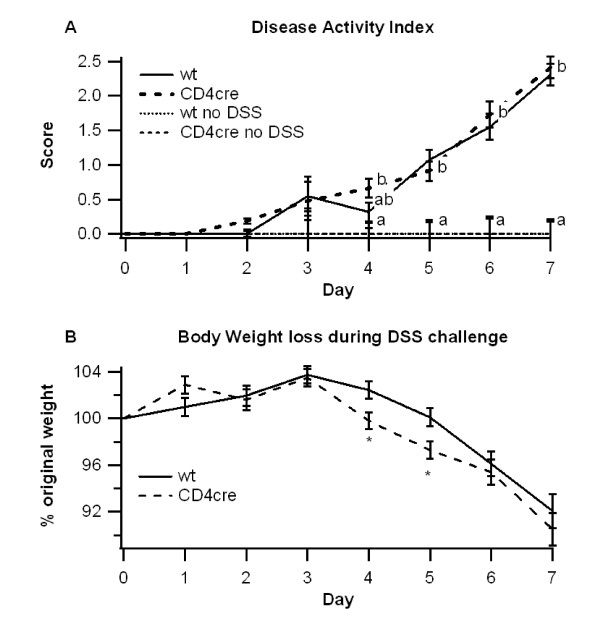
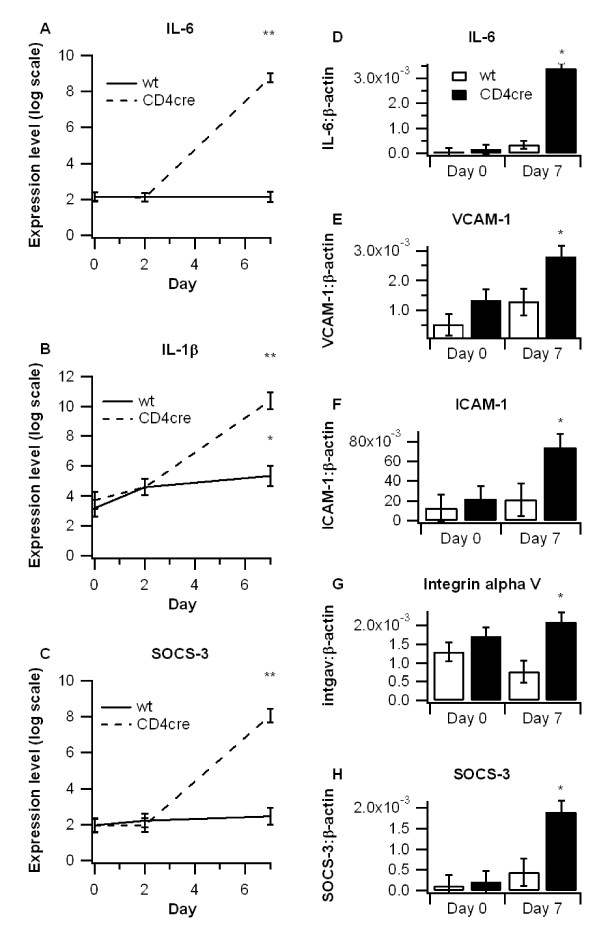
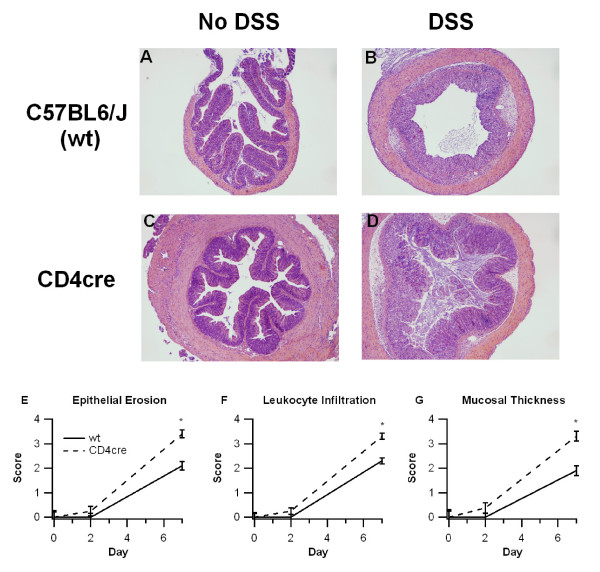
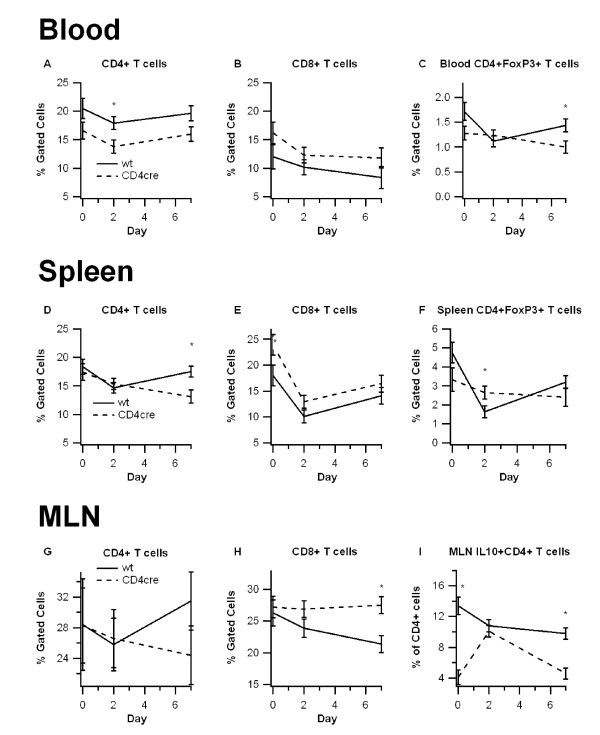
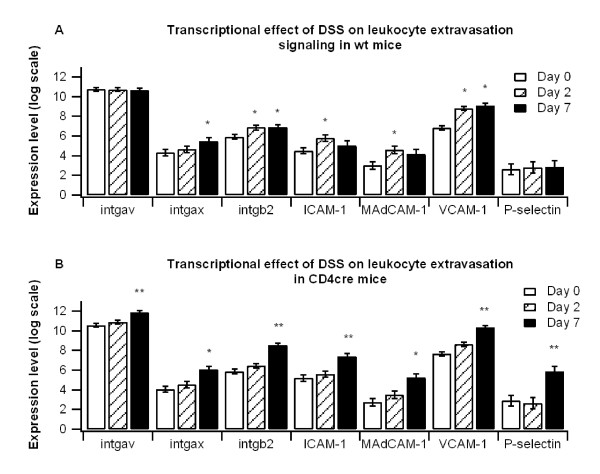
The deficiency of PPAR gamma in T cells accelerated the onset of disease and body weight loss. Examination of colon histopathology revealed significantly greater epithelial erosion, leukocyte infiltration, and mucosal thickening in the CD4cre mice on day 7. CD4cre mice had more CD8+ T cells than WT mice and fewer CD4+ FoxP3+ regulatory T cells (Treg) and IL10+ CD4+ T cells in blood and MLN, respectively. Transcriptomic profiling revealed around 3000 genes being transcriptionally altered as a result of DSS challenge in CD4cre mice. These included up-regulated mRNA expression of adhesion molecules, proinflammatory cytokines interleukin-6 (IL-6) and IL-1beta, and suppressor of cytokine signaling 3 (SOCS-3) on day 7. Gene set enrichment analysis (GSEA) showed that the ribosome and Krebs cycle pathways were downregulated while the apoptosis pathway was upregulated in colons of mice lacking PPAR gamma in T cells.
The expression of PPAR gamma in T cells is involved in preventing gut inflammation by regulating colonic expression of adhesion molecules and inflammatory mediators at later stages of disease while favoring the recruitment of Treg to the mucosal inductive sites.
过氧化物酶体增殖物激活受体γ(PPARγ)是一种核受体,其激活已被证明可调节巨噬细胞和 T 细胞介导的炎症。本研究的目的是研究 T 细胞中 PPARγ缺失调节免疫细胞分布和结肠基因表达以及实验性 IBD 严重程度的机制。
在饮用水中用 2.5%葡聚糖硫酸钠(DSS)对 PPARγfl/fl; CD4 Cre+(CD4cre)或 Cre-(WT)小鼠进行为期 0、2 或 7 天的攻毒。通过临床和组织病理学评估对小鼠的疾病严重程度进行评分。采用流式细胞术评估血液、脾脏和肠系膜淋巴结(MLN)中的淋巴细胞和巨噬细胞群体。使用 Affymetrix 微阵列对结肠黏膜的全基因组表达进行分析。
T 细胞中 PPARγ的缺失加速了疾病的发作和体重减轻。第 7 天,CD4cre 小鼠的结肠组织病理学检查显示上皮糜烂、白细胞浸润和黏膜增厚更为明显。与 WT 小鼠相比,CD4cre 小鼠的血液和 MLN 中 CD8+T 细胞更多,而 CD4+FoxP3+调节性 T 细胞(Treg)和 IL10+CD4+T 细胞更少。转录组谱分析显示,由于 DSS 攻毒,CD4cre 小鼠有约 3000 个基因发生转录改变。这些基因包括黏附分子、促炎细胞因子白细胞介素 6(IL-6)和白细胞介素 1β(IL-1β)以及细胞因子信号转导抑制因子 3(SOCS-3)的 mRNA 表达上调,这一变化发生在第 7 天。基因集富集分析(GSEA)显示,T 细胞中 PPARγ缺失的小鼠结肠中核糖体和 Krebs 循环途径下调,而凋亡途径上调。
T 细胞中 PPARγ的表达通过调节疾病后期黏附分子和炎症介质在结肠中的表达,促进 Treg 募集到黏膜诱导部位,从而防止肠道炎症。