Hu Shurong, Chen Mengmeng, Wang Yilin, Wang Zhengting, Pei Yaofei, Fan Rong, Liu Xiqiang, Wang Lei, Zhou Jie, Zheng Sichang, Zhang Tianyu, Lin Yun, Zhang Maochen, Tao Ran, Zhong Jie
Department of Gastroenterology, Ruijin hospital, Shanghai Jiaotong University School of Medicine, Shanghai, PR China.
Department of Surgery, Cancer hospital, Fudan University, Shanghai, PR China.
PLoS One. 2016 Apr 29;11(4):e0154564. doi: 10.1371/journal.pone.0154564. eCollection 2016.
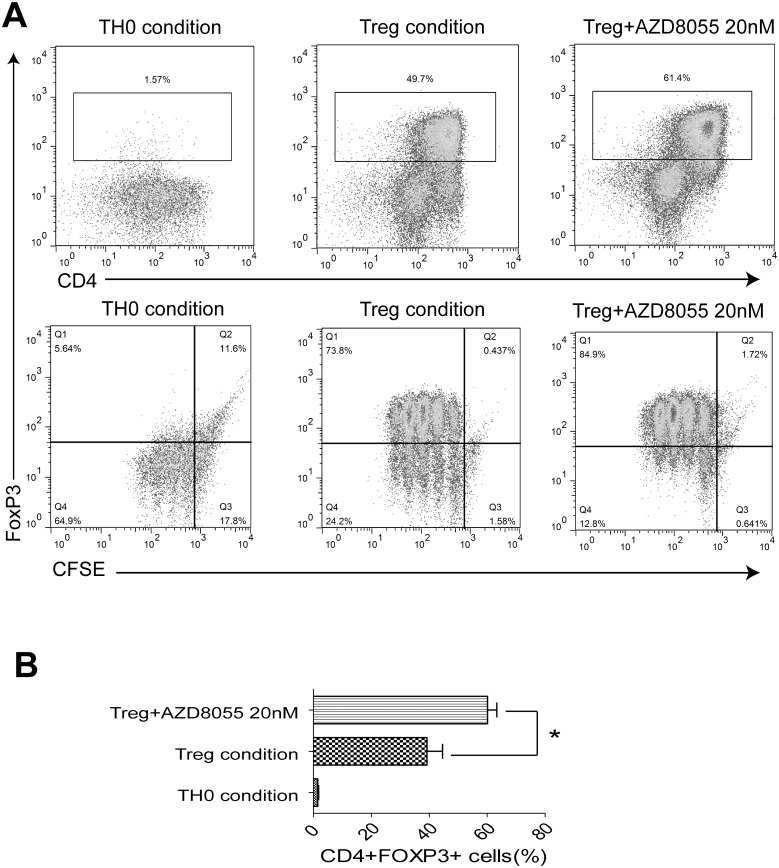
It has been established that mammalian target of Rapamycin (mTOR) inhibitors have anti-inflammatory effects in models of experimental colitis. However, the underlying mechanism is largely unknown. In this research, we investigate the anti-inflammatory effects of AZD8055, a potent mTOR inhibitor, on T cell response in dextran sulfate sodium (DSS)-induced colitis in mice, a commonly used animal model of inflammatory bowel diseases (IBD). Severity of colitis is evaluated by changing of body weight, bloody stool, fecal consistency, histology evaluation and cytokine expression. We find that AZD8055 treatment attenuates DSS-induced body weight loss, colon length shortening and pathological damage of the colon. And AZD8055 treatment decreases colonic expression of genes encoding the pro-inflammatory cytokines interferon-γ, interleukin (IL)-17A, IL-1β,IL-6 and tumor necrosis factor(TNF)-a and increases colonic expression of anti-inflammatory cytokines IL-10. We show that AZD8055 treatment decreases the percentages of CD4+ T cells and CD8+ T cells in spleen, lymph nodes and peripheral blood of mice. We also find that AZD8055 treatment significantly reduces the number of T helper 1(TH1) cells and TH17 cells and increases regulatory T (Treg) cells in the lamina propria and mesenteric lymph nodes. Furthermore, we demonstrates that AZD8055 suppresses the proliferation of CD4+ and CD8+ T cells and the differentiation of TH1/TH17 cells and expands Treg cells in vitro. The results suggest that, in experimental colitis, AZD8055 exerts anti-inflammatory effect by regulating T helper cell polarization and proliferation.
雷帕霉素哺乳动物靶点(mTOR)抑制剂在实验性结肠炎模型中具有抗炎作用,这一点已经得到证实。然而,其潜在机制在很大程度上尚不清楚。在本研究中,我们研究了一种强效mTOR抑制剂AZD8055对葡聚糖硫酸钠(DSS)诱导的小鼠结肠炎中T细胞反应的抗炎作用,DSS诱导的小鼠结肠炎是炎症性肠病(IBD)常用的动物模型。通过体重变化、便血、粪便稠度、组织学评估和细胞因子表达来评估结肠炎的严重程度。我们发现,AZD8055治疗可减轻DSS诱导的体重减轻、结肠长度缩短和结肠病理损伤。并且AZD8055治疗可降低结肠中编码促炎细胞因子干扰素-γ、白细胞介素(IL)-17A、IL-1β、IL-6和肿瘤坏死因子(TNF)-α的基因表达,并增加抗炎细胞因子IL-10的结肠表达。我们发现,AZD8055治疗可降低小鼠脾脏、淋巴结和外周血中CD4+T细胞和CD8+T细胞的百分比。我们还发现,AZD8055治疗可显著减少固有层和肠系膜淋巴结中辅助性T细胞1(TH1)细胞和TH17细胞的数量,并增加调节性T(Treg)细胞的数量。此外,我们证明AZD8055在体外可抑制CD4+和CD8+T细胞的增殖以及TH1/TH17细胞的分化,并扩增Treg细胞。结果表明,在实验性结肠炎中,AZD8055通过调节辅助性T细胞极化和增殖发挥抗炎作用。