Bloorview Research Institute, Bloorview Kids Rehab, Toronto, Ontario, Canada.
Biomed Eng Online. 2010 Jun 10;9:23. doi: 10.1186/1475-925X-9-23.
Recently, pattern recognition methods have been deployed in the classification of multiple activation states from mechanomyogram (MMG) signals for the purpose of controlling switching interfaces. Given the propagative properties of MMG signals, it has been suggested that MMG classification should be robust to changes in sensor placement. Nonetheless, this purported robustness remains speculative to date. This study sought to quantify the change in classification accuracy, if any, when a classifier trained with MMG signals from the muscle belly, is subsequently tested with MMG signals from a nearby location.
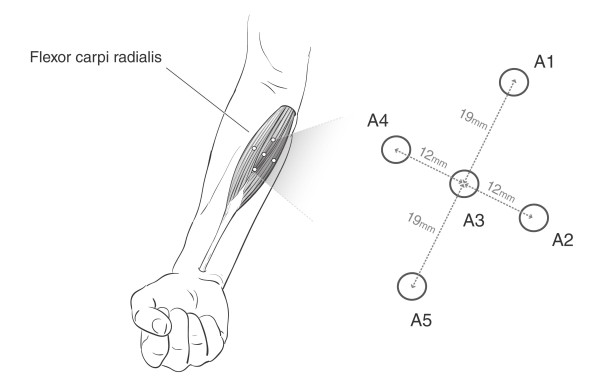
An arrangement of 5 accelerometers was attached to the flexor carpi radialis muscle of 12 able-bodied participants; a reference accelerometer was located over the muscle belly, two peripheral accelerometers were positioned along the muscle's transverse axis and two more were aligned to the muscle's longitudinal axis. Participants performed three classes of muscle activity: wrist flexion, wrist extension and semi-pronation. A collection of time, frequency and time-frequency features were considered and reduced by genetic feature selection. The classifier, trained using features from the reference accelerometer, was tested with signals from the longitudinally and transversally displaced accelerometers.
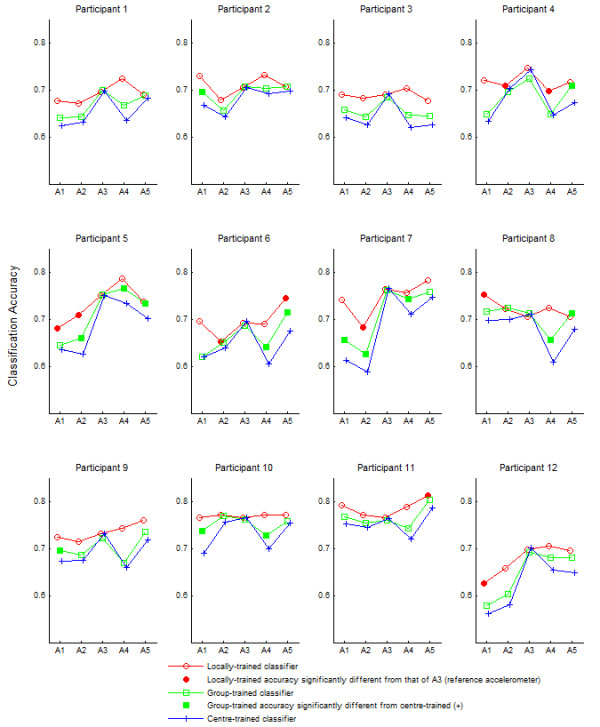
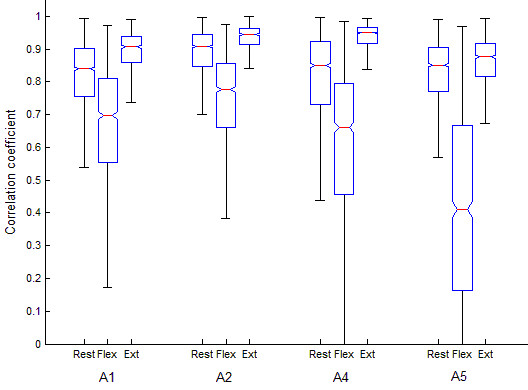
Classification degradation due to accelerometer displacement was significant for all participants, and showed no consistent trend with the direction of displacement. Further, the displaced accelerometer signals showed task-dependent de-correlations with respect to the reference accelerometer.
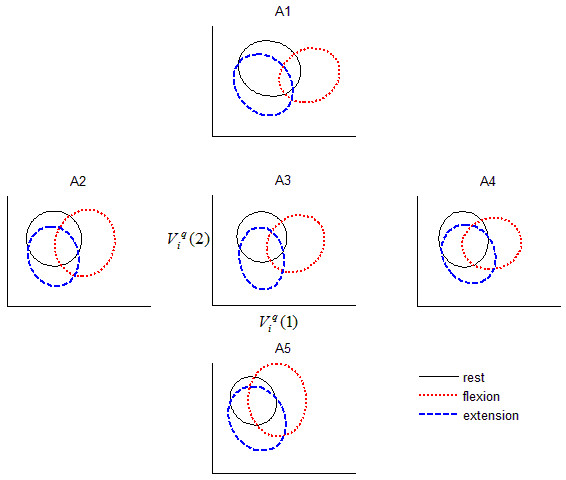
These results indicate that MMG signal features vary with spatial location and that accelerometer displacements of only 1-2 cm cause sufficient feature drift to significantly diminish classification accuracy. This finding emphasizes the importance of consistent sensor placement between MMG classifier training and deployment for accurate control of switching interfaces.
最近,模式识别方法已被应用于肌动描记图(MMG)信号的多激活状态分类,以控制切换接口。鉴于 MMG 信号的传播特性,有人认为 MMG 分类应该对传感器位置的变化具有鲁棒性。然而,迄今为止,这种所谓的鲁棒性仍然是推测性的。本研究旨在量化当使用来自肌肉腹部的 MMG 信号训练分类器,然后用附近位置的 MMG 信号进行测试时,分类准确性的变化(如果有的话)。
在 12 名健康参与者的桡侧腕屈肌上附着了 5 个加速度计的排列;一个参考加速度计位于肌肉腹部,两个外围加速度计沿肌肉的横轴定位,另外两个与肌肉的纵轴对齐。参与者执行了三种肌肉活动:腕屈、腕伸和半旋前。考虑了一系列时间、频率和时频特征,并通过遗传特征选择进行了减少。使用参考加速度计的特征训练的分类器,用纵向和横向移位的加速度计信号进行测试。
所有参与者的加速度计位移导致分类退化显著,且没有随位移方向的一致趋势。此外,移位的加速度计信号与参考加速度计的相关性随任务而变化。
这些结果表明,MMG 信号特征随空间位置而变化,仅 1-2 厘米的加速度计位移就会导致足够的特征漂移,从而显著降低分类准确性。这一发现强调了在 MMG 分类器训练和部署之间保持一致的传感器位置对于切换接口的准确控制的重要性。