Department of Surgery, The University of Hong Kong, Queen Mary Hospital, Pokfulam, Hong Kong.
BMC Cancer. 2010 Jun 11;10:279. doi: 10.1186/1471-2407-10-279.
Genetic testing for hereditary colorectal cancer (HCRC) had significant psychological consequences for test recipients. This prospective longitudinal study investigated the factors that predict psychological resilience in adults undergoing genetic testing for HCRC.
A longitudinal study was carried out from April 2003 to August 2006 on Hong Kong Chinese HCRC family members who were recruited and offered genetic testing by the Hereditary Gastrointestinal Cancer Registry to determine psychological outcomes after genetic testing. Self-completed questionnaires were administered immediately before (pre-disclosure baseline) and 2 weeks, 4 months and 1 year after result disclosure. Using validated psychological inventories, the cognitive style of hope was measured at baseline, and the psychological distress of depression and anxiety was measured at all time points.
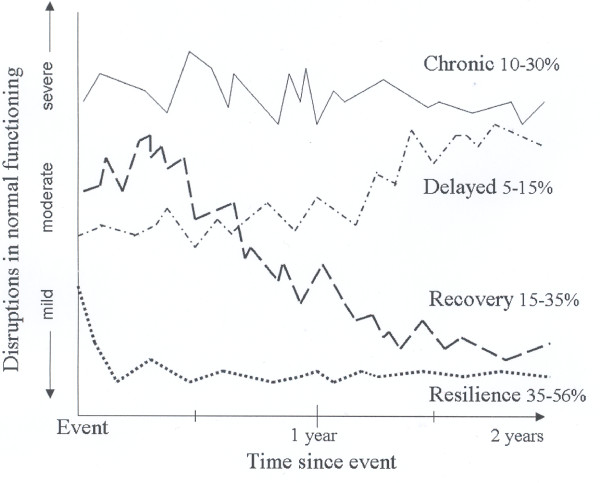
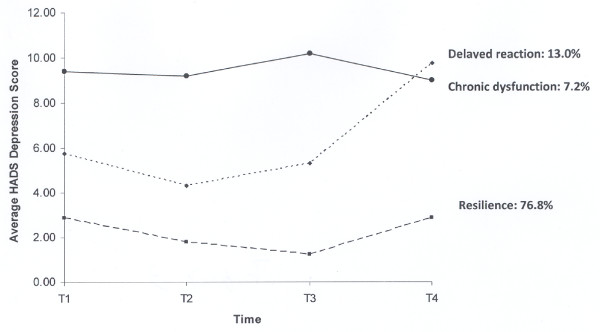
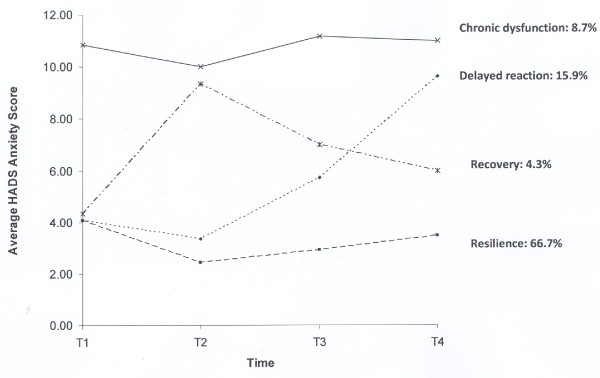
Of the 76 participating subjects, 71 individuals (43 men and 28 women; mean age 38.9 +/- 9.2 years) from nine FAP and 24 HNPCC families completed the study, including 39 mutated gene carriers. Four patterns of outcome trajectories were created using established norms for the specified outcome measures of depression and anxiety. These included chronic dysfunction (13% and 8.7%), recovery (0% and 4.3%), delayed dysfunction (13% and 15.9%) and resilience (76.8% and 66.7%). Two logistic regression analyses were conducted using hope at baseline to predict resilience, with depression and anxiety employed as outcome indicators. Because of the small number of participants, the chronic dysfunction and delayed dysfunction groups were combined into a non-resilient group for comparison with the resilient group in all subsequent analysis. Because of low frequencies, participants exhibiting a recovery trajectory (n = 3 for anxiety and n = 0 for depression) were excluded from further analysis. Both regression equations were significant. Baseline hope was a significant predictor of a resilience outcome trajectory for depression (B = -0.24, p < 0.01 for depression); and anxiety (B = -0.11, p = 0.05 for anxiety).
The current findings suggest that hopefulness may predict resilience after HCRC genetic testing in Hong Kong Chinese. Interventions to increase the level of hope may be beneficial to the psychological adjustment of CRC genetic testing recipients.
遗传性结直肠癌(HCRC)的基因检测对检测接受者有重大的心理影响。本前瞻性纵向研究旨在调查预测 HCRC 基因检测受检者心理弹性的因素。
本研究于 2003 年 4 月至 2006 年 8 月进行,研究对象为香港遗传性胃肠道癌登记处招募并提供基因检测的 HCRC 家族成员,以确定基因检测后的心理结果。在结果披露前(披露前基线)、2 周、4 个月和 1 年后,通过自我填写的问卷进行评估。在基线时使用经过验证的心理量表来测量希望的认知风格,在所有时间点测量抑郁和焦虑的心理困扰。
在 76 名参与研究的受试者中,9 个 FAP 和 24 个 HNPCC 家族的 71 名个体(39 名突变基因携带者,43 名男性和 28 名女性;平均年龄 38.9±9.2 岁)完成了研究。使用抑郁和焦虑的特定结果测量的既定标准,创建了 4 种结果轨迹模式。其中包括慢性功能障碍(13%和 8.7%)、恢复(0%和 4.3%)、延迟功能障碍(13%和 15.9%)和弹性(76.8%和 66.7%)。使用基线时的希望进行了两次逻辑回归分析,将抑郁和焦虑作为结果指标,以预测弹性。由于参与者数量较少,将慢性功能障碍和延迟功能障碍组合并为非弹性组,与所有后续分析中的弹性组进行比较。由于频率较低,排除了焦虑表现出恢复轨迹的参与者(n=3)和抑郁表现出恢复轨迹的参与者(n=0)进行进一步分析。两个回归方程都有统计学意义。基线希望是抑郁(B=-0.24,p<0.01)和焦虑(B=-0.11,p=0.05)弹性结果轨迹的显著预测因素。
本研究结果表明,在香港华人中,希望感可能预测 HCRC 基因检测后的弹性。增加希望水平的干预措施可能对 CRC 基因检测受检者的心理调整有益。