Sartori Thiago E, Nunes Rafael A B, da Silva Gisela T, da Silva Sandra C, Rondon Maria U P B, Negrão Carlos E, Mansur Alfredo J
Heart Institute (InCor), University of São Paulo Medical School, São Paulo, Brazil.
Vasc Health Risk Manag. 2010 Jun 1;6:431-7. doi: 10.2147/vhrm.s10683.
Vascular reactivity is involved in the regulation of vascular function either in normal conditions or in the pathophysiology of cardiovascular diseases. We tested the hypothesis that vascular reactivity evaluated by forearm blood flow may vary according to demographic and metabolic variables in a cohort of individuals without any evidence of heart disease after clinical examination.
We studied 186 individuals (mean age 41.4 years, standard deviation 13.1 years; 95 (51%) men and 91 (49%) women. We investigated forearm blood flow and vascular conductance with venous occlusion plethysmography at baseline, during handgrip isometric exercise and during the recovery phase. Demographic and laboratory data were collected. Statistical analysis was performed with mixed linear models appropriate for repeated measurements.
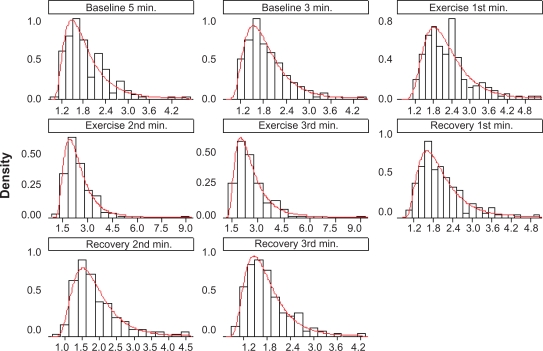
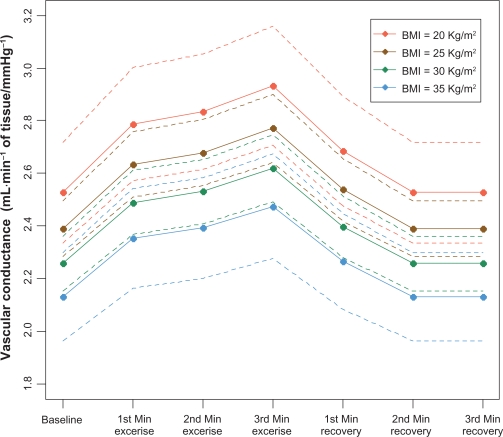
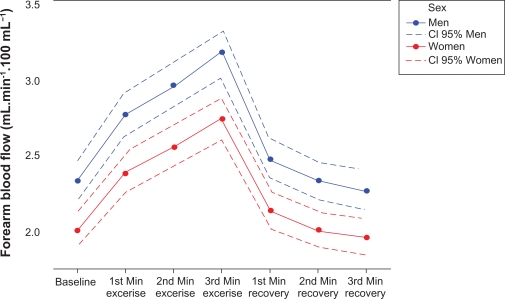
Mean forearm blood flow values in the different study conditions ranged between 1.7+/-0.47 mL.min(-1).100 mL(-1) of tissue and 2.82+/-1.13 mL.min(-1).100 mL(-1) of tissue. Forearm blood flow was higher in men than in women (P<0.005) and increased as the heart rate increased during handgrip maneuver (P<0.0001). Serum triglyceride levels were inversely related to forearm blood flow at baseline, during isometric exercise and recovery phase (P=0.0209). Body mass index was inversely related to forearm vascular conductance at baseline, during isometric exercise and recovery phase (P=0.0223).
Our findings suggest that forearm blood flow and vascular conductance as a surrogate of the vascular function may be influenced by gender, heart rate, serum triglyceride levels and body mass index in individuals without overt heart disease.
血管反应性在正常情况下或心血管疾病的病理生理学中均参与血管功能的调节。我们检验了这样一个假设:在一组经临床检查无任何心脏病证据的个体中,通过前臂血流量评估的血管反应性可能会因人口统计学和代谢变量而有所不同。
我们研究了186名个体(平均年龄41.4岁,标准差13.1岁;95名(51%)男性和91名(49%)女性)。我们在基线、等长握力运动期间及恢复阶段,采用静脉阻断体积描记法研究了前臂血流量和血管传导率。收集了人口统计学和实验室数据。使用适合重复测量的混合线性模型进行统计分析。
在不同研究条件下,前臂血流量的平均值在1.7±0.47毫升·分钟⁻¹·100毫升⁻¹组织至2.82±1.13毫升·分钟⁻¹·100毫升⁻¹组织之间。男性的前臂血流量高于女性(P<0.005),并且在握力运动期间随着心率增加而升高(P<0.0001)。在基线、等长运动和恢复阶段,血清甘油三酯水平与前臂血流量呈负相关(P=0.0209)。在基线、等长运动和恢复阶段,体重指数与前臂血管传导率呈负相关(P=0.0223)。
我们的研究结果表明,在无明显心脏病的个体中,作为血管功能替代指标的前臂血流量和血管传导率可能受性别、心率、血清甘油三酯水平和体重指数的影响。