Department of Pediatrics, University of Washington, Seattle, WA 98195, USA.
J Exp Med. 2010 Jul 5;207(7):1409-20. doi: 10.1084/jem.20091885. Epub 2010 Jun 14.
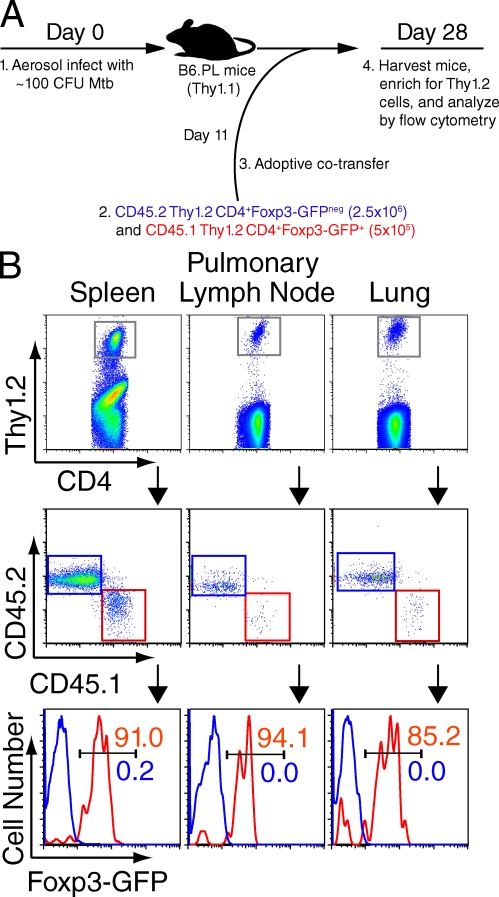
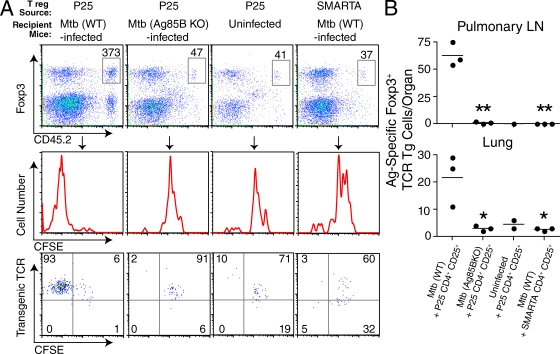
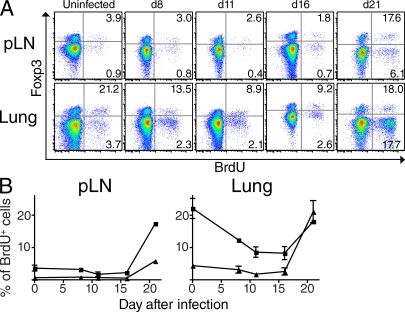
The ability of the adaptive immune system to restrict Mycobacterium tuberculosis (Mtb) is impeded by activated Foxp3(+) regulatory T (T reg) cells. The importance of pathogen-specific T reg cells in this process has not been addressed. We show that T reg cell expansion after aerosol Mtb infection does not occur until Mtb is transported to the pulmonary lymph node (pLN), and Mtb-specific T reg cells have an increased propensity to proliferate. Even small numbers of Mtb-specific T reg cells are capable of delaying the priming of effector CD4(+) and CD8(+) T cells in the pLN and their subsequent accumulation in the lung, the primary site of infection. This delay likely prolongs the initial phase of bacterial expansion and explains the higher bacterial burden observed in these mice. Thus, T reg cells recognizing Mtb-derived antigens specifically and potently restrict protective immune responses during tuberculosis.
适应性免疫系统限制结核分枝杆菌(Mtb)的能力受到激活的 Foxp3(+)调节性 T(Treg)细胞的阻碍。在这个过程中,病原体特异性 Treg 细胞的重要性尚未得到解决。我们表明,只有在 Mtb 被运送到肺淋巴结(pLN)后,气溶胶 Mtb 感染后 Treg 细胞的扩增才会发生,并且 Mtb 特异性 Treg 细胞具有更高的增殖倾向。即使只有少量的 Mtb 特异性 Treg 细胞也能够延迟 pLN 中效应性 CD4(+)和 CD8(+)T 细胞的初始激活及其随后在肺部的积累,肺部是感染的主要部位。这种延迟可能延长了细菌的初始扩增阶段,并解释了在这些小鼠中观察到的更高的细菌负荷。因此,识别 Mtb 衍生抗原的 Treg 细胞特异性地和有效地限制了结核病期间的保护性免疫反应。