Departamento de Morfologia, Universidade Estadual Paulista, Instituto de Biociências, Botucatu, SP, Brazil.
BMC Genet. 2010 Jun 15;11:50. doi: 10.1186/1471-2156-11-50.
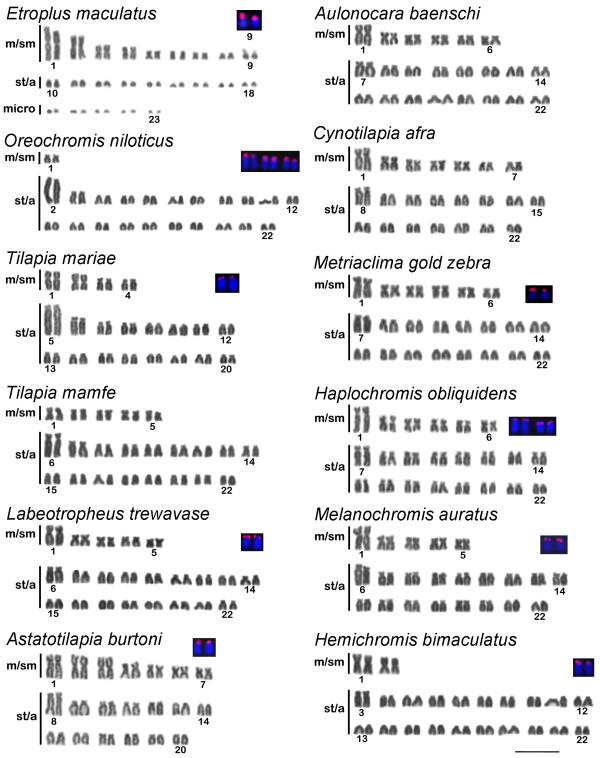
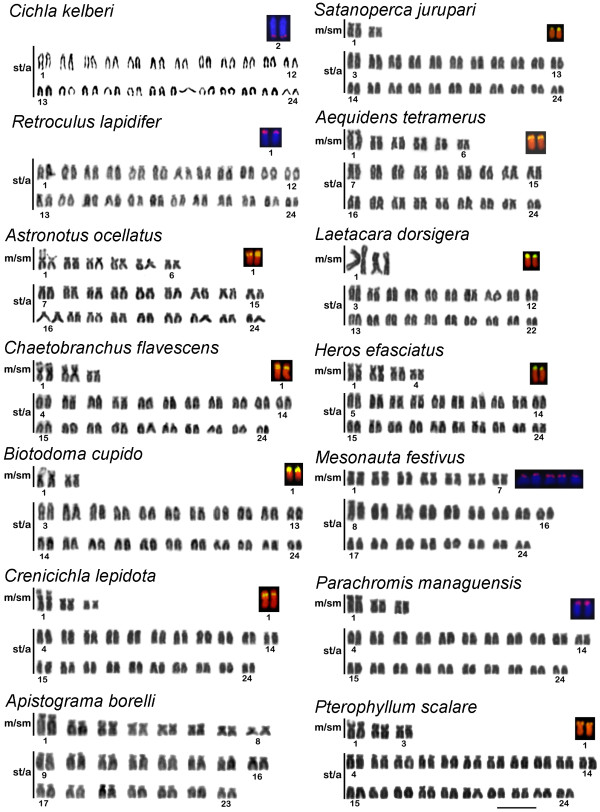
Cichlid fishes have been the subject of increasing scientific interest because of their rapid adaptive radiation which has led to an extensive ecological diversity and their enormous importance to tropical and subtropical aquaculture. To increase our understanding of chromosome evolution among cichlid species, karyotypes of one Asian, 22 African, and 30 South American cichlid species were investigated, and chromosomal data of the family was reviewed.
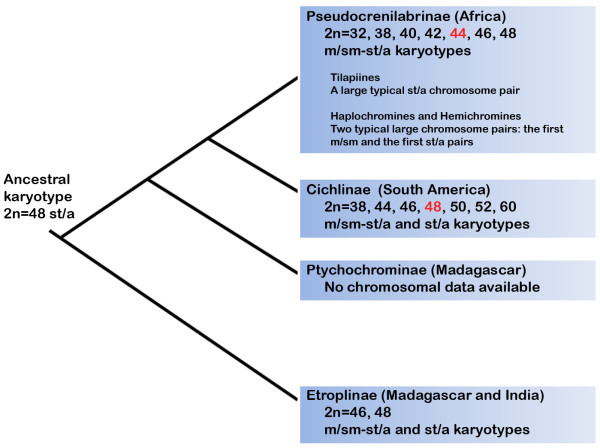
Although there is extensive variation in the karyotypes of cichlid fishes (from 2n = 32 to 2n = 60 chromosomes), the modal chromosome number for South American species was 2n = 48 and the modal number for the African ones was 2n = 44. The only Asian species analyzed, Etroplus maculatus, was observed to have 46 chromosomes. The presence of one or two macro B chromosomes was detected in two African species. The cytogenetic mapping of 18S ribosomal RNA (18S rRNA) gene revealed a variable number of clusters among species varying from two to six.
The karyotype diversification of cichlids seems to have occurred through several chromosomal rearrangements involving fissions, fusions and inversions. It was possible to identify karyotype markers for the subfamilies Pseudocrenilabrinae (African) and Cichlinae (American). The karyotype analyses did not clarify the phylogenetic relationship among the Cichlinae tribes. On the other hand, the two major groups of Pseudocrenilabrinae (tilapiine and haplochromine) were clearly discriminated based on the characteristics of their karyotypes. The cytogenetic mapping of 18S ribosomal RNA (18S rRNA) gene did not follow the chromosome diversification in the family. The dynamic evolution of the repeated units of rRNA genes generates patterns of chromosomal distribution that do not help follows the phylogenetic relationships among taxa. The presence of B chromosomes in cichlids is of particular interest because they may not be represented in the reference genome sequences currently being obtained.
由于丽鱼科鱼类经历了快速的适应性辐射,导致其具有广泛的生态多样性,对热带和亚热带水产养殖具有重要意义,因此它们越来越受到科学界的关注。为了增进我们对丽鱼科物种间染色体进化的理解,我们研究了 1 种亚洲、22 种非洲和 30 种南美洲丽鱼科物种的核型,并回顾了该科的染色体数据。
尽管丽鱼科鱼类的核型存在广泛的变异(从 2n = 32 到 2n = 60 条染色体),但南美洲物种的模式染色体数为 2n = 48,非洲物种的模式数为 2n = 44。唯一分析的亚洲物种,E. maculatus,观察到有 46 条染色体。在 2 种非洲物种中检测到存在 1 或 2 个大 B 染色体。18S 核糖体 RNA(18S rRNA)基因的细胞遗传学定位显示,物种间的基因簇数从 2 到 6 不等。
丽鱼科的染色体多样化似乎是通过涉及断裂、融合和倒位的几种染色体重排发生的。可以识别出亚科 Pseudocrenilabrinae(非洲)和 Cichlinae(美洲)的核型标记。核型分析未能澄清 Cichlinae 部落之间的系统发育关系。另一方面,根据其核型特征,可清楚地区分 Pseudocrenilabrinae 的两个主要群体(罗非鱼和haplochromine)。18S 核糖体 RNA(18S rRNA)基因的细胞遗传学定位并未遵循该科的染色体多样化。rRNA 基因重复单元的动态进化产生了染色体分布模式,这些模式无助于追踪分类群之间的系统发育关系。B 染色体在丽鱼科中的存在尤其有趣,因为它们可能在目前正在获得的参考基因组序列中没有代表。