Molecular and Cellular Therapeutics, Royal College of Surgeons in Ireland, St. Stephen's Green, Dublin 2, Ireland.
Schizophr Res. 2010 Sep;122(1-3):63-71. doi: 10.1016/j.schres.2010.05.001. Epub 2010 May 31.
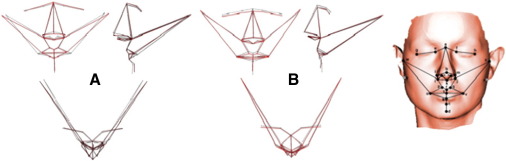
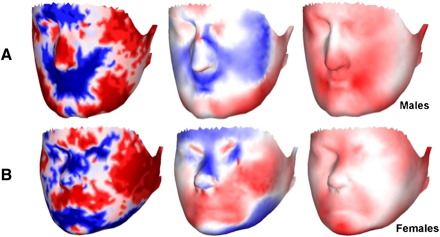
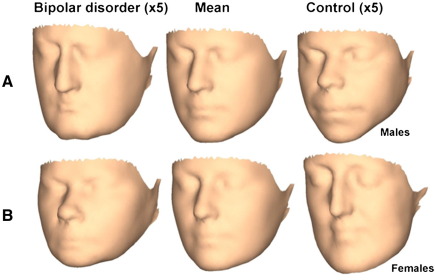
Any developmental relationship between bipolar disorder and schizophrenia engenders continuing debate. As the brain and face emerge in embryological intimacy, brain dysmorphogenesis is accompanied by facial dysmorphogenesis. 3D laser surface imaging was used to capture the facial surface of 13 male and 14 female patients with bipolar disorder in comparison with 61 male and 75 female control subjects and with 37 male and 32 female patients with schizophrenia. Surface images were analysed using geometric morphometrics and 3D visualisations to identify domains of facial shape that distinguish bipolar patients from controls and bipolar patients from those with schizophrenia. Both male and female bipolar patients evidenced significant facial dysmorphology: common to male and female patients was overall facial widening, increased width of nose, narrowing of mouth and upward displacement of the chin; dysmorphology differed between male and female patients for nose length, lip thickness and tragion height. There were few morphological differences in comparison with schizophrenia patients. That dysmorphology of the frontonasal prominences and related facial regions in bipolar disorder is more similar to than different from that found in schizophrenia indicates some common dysmorphogenesis. Bipolar disorder and schizophrenia might reflect similar insult(s) acting over slightly differing time-frames or slightly differing insult(s) acting over a similar time-frame.
双相情感障碍和精神分裂症之间的任何发育关系都引发了持续的争论。由于大脑和面部在胚胎学上紧密相关,大脑发育异常伴随着面部发育异常。使用 3D 激光表面成像技术,对 13 名男性和 14 名女性双相情感障碍患者、61 名男性和 75 名女性对照者以及 37 名男性和 32 名女性精神分裂症患者的面部表面进行了捕捉。使用几何形态计量学和 3D 可视化技术对面部图像进行了分析,以确定将双相情感障碍患者与对照者以及与精神分裂症患者区分开的面部形状区域。男性和女性双相情感障碍患者都表现出明显的面部畸形:男性和女性患者共有的是整个面部变宽、鼻子变宽、嘴变窄、下巴向上移位;男性和女性患者的鼻长、唇厚和泪骨高度的畸形不同。与精神分裂症患者相比,这些差异较少。与精神分裂症相比,双相情感障碍患者的额鼻隆起和相关面部区域的畸形更相似而非不同,这表明存在一些共同的发育异常。双相情感障碍和精神分裂症可能反映了相似的(多个)损伤因素在略有不同的时间框架内作用,或者相似的(多个)损伤因素在相似的时间框架内作用。