Department of Pediatrics, Division of General Pediatrics and Adolescent Medicine, 231 MacNider Building, 333 South Columbia St, CB# 7225, University of North Carolina at Chapel Hill, Chapel Hill, North Carolina 27599-7225, USA.
Acad Pediatr. 2010 Jul-Aug;10(4):274-81. doi: 10.1016/j.acap.2010.03.006. Epub 2010 May 31.
Communication of children's weight status and targeted counseling by pediatricians may change parental perceptions or child dietary and physical activity behaviors. The aim of this study was to determine whether accuracy of parental perception of children's weight status and reports of related behaviors changed following a brief pediatrics resident intervention.
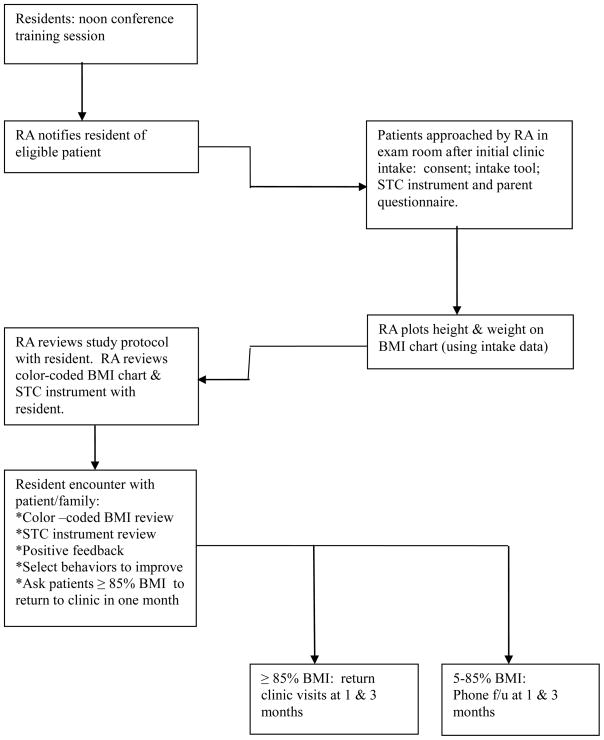
Parents (N = 115) of children aged 4 to 12 years enrolled in Medicaid completed baseline questionnaires with providers about prior communication of weight status and/or body mass index (BMI), perceptions of their children's weight, and children's dietary and physical activity behaviors, and children were weighed and measured. Trained residents used a toolkit to communicate weight status to parents (via color-coded BMI charts) and counseled about mutually chosen healthy behaviors. Questionnaires were repeated at 1 and 3 months, and measurements were repeated for children with BMI > or =85%.
At baseline, 42% of parents of overweight children believed their children were at healthy weight. Most (n = 96; 83%) parents completed 1-month questionnaires, and 56% completed 3-month follow-up questionnaires. Improvements in fruit and vegetable consumption, sweet drinks, unhealthy snacks, frequency of restaurant food, lower-fat milk, and screen time occurred among both overweight and healthy weight children. There were also increases in discussions with providers about weight/BMI and parental accuracy of overweight assessment.
Parent accuracy of weight status and short-term childhood dietary and physical activity behavior changes improved following resident pediatrician use of a toolkit to support communication of weight status and counseling. Further research needs to determine whether accurate parental perception motivates improved behavior change or healthier BMI trajectories.
儿科医生沟通儿童体重状况和提供有针对性的咨询,可能会改变家长对儿童体重的看法或改变儿童的饮食和身体活动行为。本研究的目的是确定在经过儿科住院医生的简短干预后,家长对儿童体重状况的感知准确性和相关行为报告是否发生变化。
参加医疗补助计划的 4 至 12 岁儿童的家长(N=115)与医生一起完成了基线问卷,内容涉及之前是否沟通过体重状况和/或体重指数(BMI)、家长对子女体重的看法以及子女的饮食和身体活动行为,并且还为子女称重和测量。经过培训的住院医生使用工具包向家长传达体重状况(通过彩色 BMI 图表)并就共同选择的健康行为进行咨询。在 1 个月和 3 个月时重复进行问卷调查,对于 BMI≥85%的儿童重复进行测量。
在基线时,42%超重儿童的家长认为自己的孩子体重健康。大多数(n=96;83%)家长完成了 1 个月的问卷调查,56%完成了 3 个月的随访问卷调查。超重和体重健康的儿童的水果和蔬菜摄入量、甜饮料、不健康零食、外出就餐频率、低脂牛奶和屏幕时间都有所增加。与提供者讨论体重/BMI 的次数以及家长对超重评估的准确性也有所增加。
在住院医生使用工具包支持体重状况沟通和咨询之后,家长对体重状况的准确性和儿童短期饮食和身体活动行为变化得到了改善。还需要进一步研究,以确定家长对体重的准确感知是否会促使行为改变更加健康或 BMI 轨迹更加健康。