Department of Health, Medicine and Caring Sciences, Division of Society and Health, Linköping University, 581 83, Linköping, Sweden.
Department of Biosciences and Nutrition, Karolinska Institutet, NEO, Huddinge, 141 83, Sweden.
Int J Behav Nutr Phys Act. 2023 Feb 21;20(1):22. doi: 10.1186/s12966-023-01405-5.
Childhood overweight and obesity is a public health priority. We have previously reported the efficacy of a parent-oriented mobile health (mHealth) app-based intervention (MINISTOP 1.0) which showed improvements in healthy lifestyle behaviors. However, the effectiveness of the MINISTOP app in real-world conditions needs to be established.
To evaluate the real-world effectiveness of a 6-month mHealth intervention (MINISTOP 2.0 app) on children's intake of fruits, vegetables, sweet and savory treats, sweet drinks, moderate-to-vigorous physical activity, and screen time (primary outcomes), and on parental self-efficacy (PSE) for promoting healthy lifestyle behaviors, and children's body mass index (BMI) (secondary outcomes).
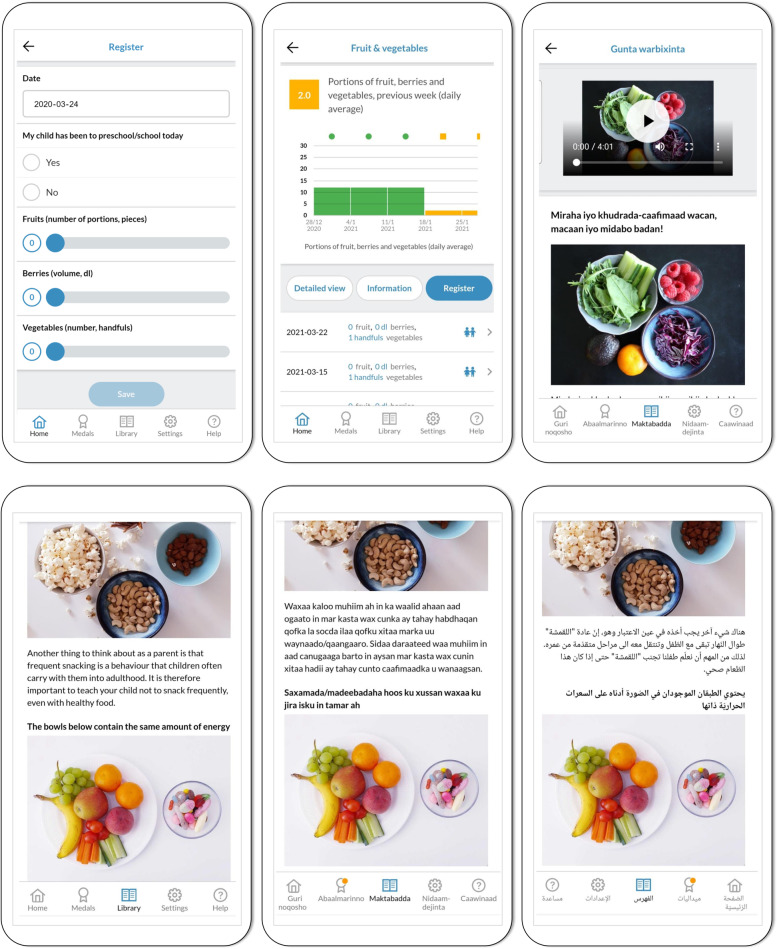
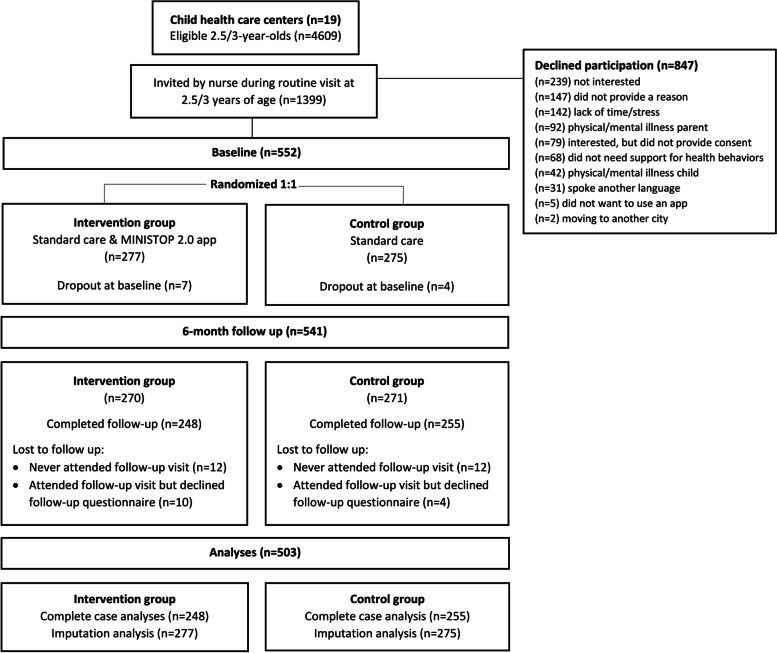
A hybrid type 1 effectiveness-implementation design was utilized. For the effectiveness outcomes, a two-arm, individually randomized controlled trial was conducted. Parents (n = 552) of 2.5-to-3-year-old children were recruited from 19 child health care centers across Sweden, and, randomized to either a control (standard care) or intervention group (MINISTOP 2.0 app). The 2.0 version was adapted and translated into English, Somali and Arabic to increase reach. All recruitment and data collection were conducted by the nurses. Outcomes were assessed at baseline and after six months, using standardized measures (BMI) and a questionnaire (health behaviors, PSE).
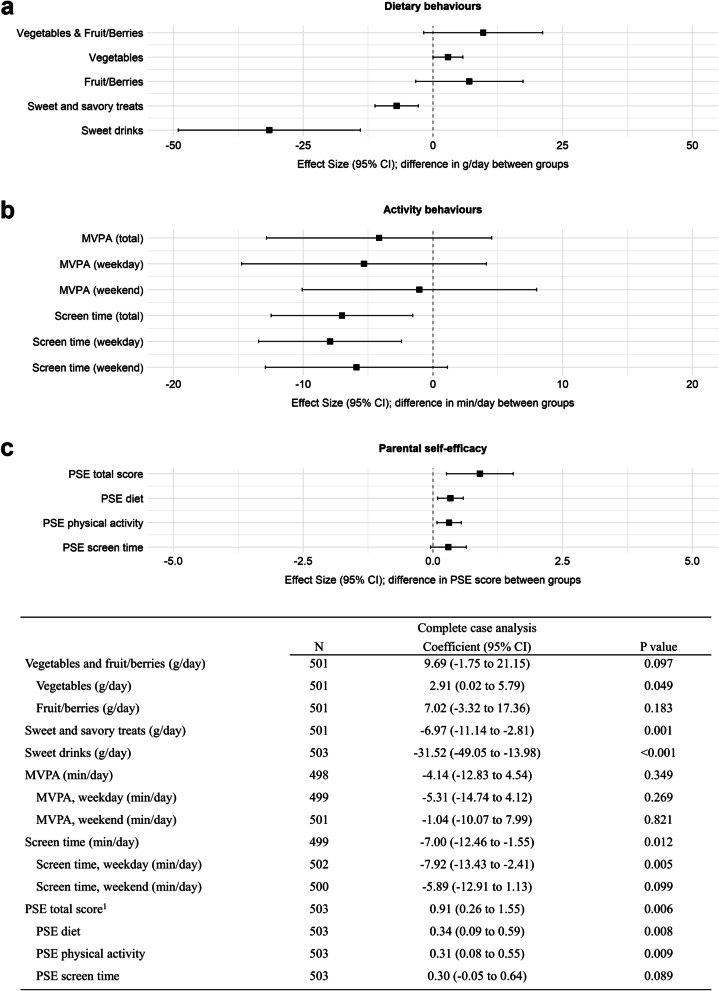
Among the participating parents (n = 552, age: 34.1 ± 5.0 years), 79% were mothers and 62% had a university degree. Twenty-four percent (n = 132) of children had two foreign-born parents. At follow-up, parents in the intervention group reported lower intakes of sweet and savory treats (-6.97 g/day; p = 0.001), sweet drinks (-31.52 g/day; p < 0.001), and screen time (-7.00 min/day; p = 0.012) in their children compared to the control group. The intervention group reported higher total PSE (0.91; p = 0.006), PSE for promoting healthy diet (0.34; p = 0.008) and PSE for promoting physical activity behaviors (0.31; p = 0.009) compared to controls. No statistically significant effect was observed for children's BMI z-score. Overall, parents reported high satisfaction with the app, and 54% reported using the app at least once a week.
Children in the intervention group had lower intakes of sweet and savory treats, sweet drinks, less screen time (primary outcomes) and their parents reported higher PSE for promoting healthy lifestyle behaviors. Our results from this real-world effectiveness trial support the implementation of the MINISTOP 2.0 app within Swedish child health care.
Clinicaltrials.gov NCT04147039; https://clinicaltrials.gov/ct2/show/NCT04147039.
儿童超重和肥胖是一个公共卫生重点。我们之前报告了一种以家长为导向的移动健康(mHealth)应用程序为基础的干预措施(MINISTOP 1.0)的疗效,该干预措施显示出健康生活方式行为的改善。然而,MINISTOP 应用程序在现实条件下的有效性需要得到证实。
评估为期 6 个月的 mHealth 干预(MINISTOP 2.0 应用程序)对儿童水果、蔬菜、甜咸小吃、甜饮料、中高强度体力活动和屏幕时间(主要结果)的实际效果,以及对父母促进健康生活方式行为的自我效能感(PSE)和儿童体重指数(BMI)(次要结果)的影响。
采用混合 1 型有效性-实施设计。对于有效性结果,进行了一项两臂、个体随机对照试验。从瑞典 19 家儿童保健中心招募了 2.5 至 3 岁儿童的父母(n=552),并随机分为对照组(标准护理)或干预组(MINISTOP 2.0 应用程序)。2.0 版本进行了改编和翻译成英语、索马里语和阿拉伯语,以增加覆盖面。所有招募和数据收集均由护士进行。使用标准化测量工具(BMI)和问卷(健康行为、PSE)在基线和 6 个月后评估结果。
在参与的父母中(n=552,年龄:34.1±5.0 岁),79%是母亲,62%拥有大学学位。24%(n=132)的儿童有两位外国出生的父母。随访时,干预组的父母报告其子女摄入的甜咸小吃(-6.97g/天;p=0.001)、甜饮料(-31.52g/天;p<0.001)和屏幕时间(-7.00min/天;p=0.012)减少。与对照组相比,干预组报告的总 PSE 更高(0.91;p=0.006),促进健康饮食的 PSE(0.34;p=0.008)和促进体力活动行为的 PSE(0.31;p=0.009)更高。儿童 BMI z 评分无统计学意义。总体而言,父母对应用程序的满意度较高,54%的父母报告每周至少使用一次应用程序。
干预组儿童摄入的甜咸小吃、甜饮料较少,屏幕时间较短(主要结果),其父母报告促进健康生活方式行为的 PSE 较高。我们这项真实世界有效性试验的结果支持在瑞典儿童保健中实施 MINISTOP 2.0 应用程序。
Clinicaltrials.gov NCT04147039;https://clinicaltrials.gov/ct2/show/NCT04147039。