Department of Medicine and Physiology, University of California, San Francisco, CA 94143, USA.
Mol Biol Cell. 2010 Aug 1;21(15):2639-48. doi: 10.1091/mbc.E09-12-1004. Epub 2010 Jun 16.
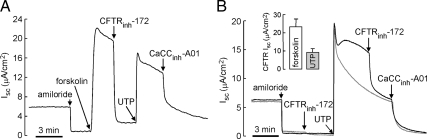
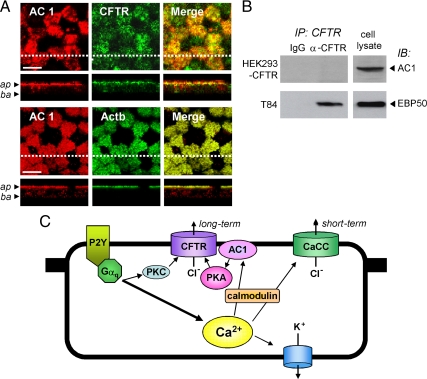
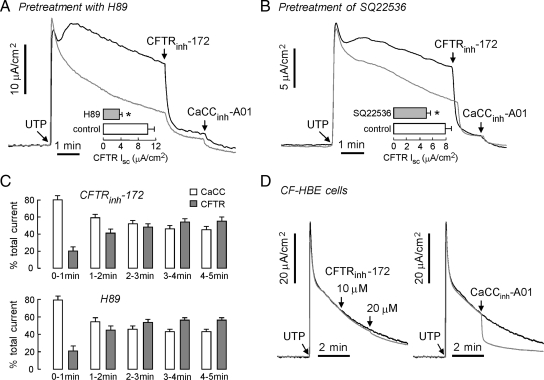
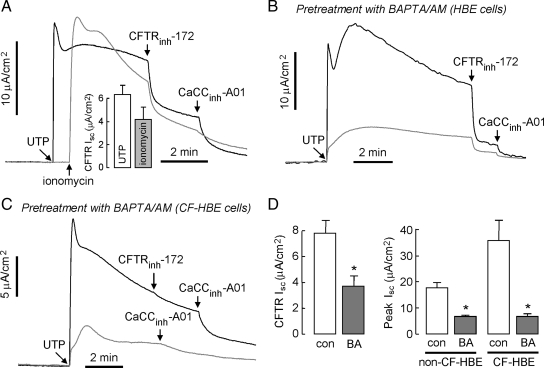
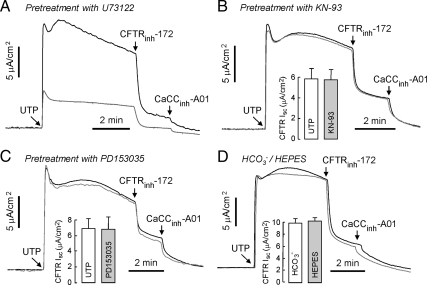
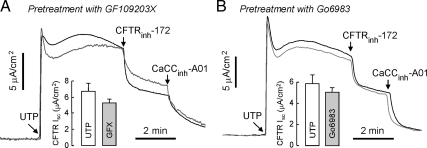
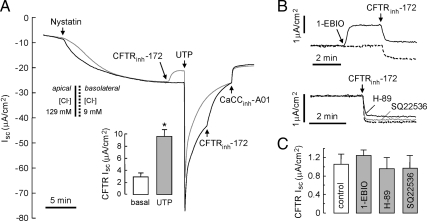
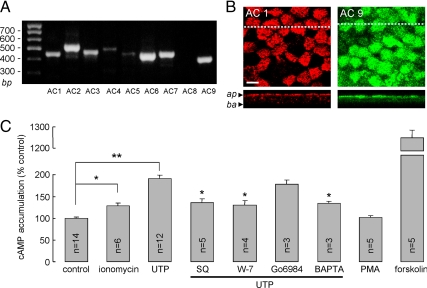
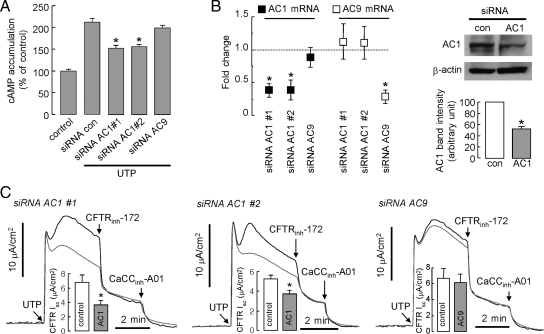
Chloride secretion by airway epithelial cells is defective in cystic fibrosis (CF). The conventional paradigm is that CFTR is activated through cAMP and protein kinase A (PKA), whereas the Ca(2+)-activated chloride channel (CaCC) is activated by Ca(2+) agonists like UTP. We found that most chloride current elicited by Ca(2+) agonists in primary cultures of human bronchial epithelial cells is mediated by CFTR by a mechanism involving Ca(2+) activation of adenylyl cyclase I (AC1) and cAMP/PKA signaling. Use of selective inhibitors showed that Ca(2+) agonists produced more chloride secretion from CFTR than from CaCC. CFTR-dependent chloride secretion was reduced by PKA inhibition and was absent in CF cell cultures. Ca(2+) agonists produced cAMP elevation, which was blocked by adenylyl cyclase inhibition. AC1, a Ca(2+)/calmodulin-stimulated adenylyl cyclase, colocalized with CFTR in the cell apical membrane. RNAi knockdown of AC1 selectively reduced UTP-induced cAMP elevation and chloride secretion. These results, together with correlations between cAMP and chloride current, suggest that compartmentalized AC1-CFTR association is responsible for Ca(2+)/cAMP cross-talk. We further conclude that CFTR is the principal chloride secretory pathway in non-CF airways for both cAMP and Ca(2+) agonists, providing a novel mechanism to link CFTR dysfunction to CF lung disease.
气道上皮细胞的氯离子分泌在囊性纤维化(CF)中存在缺陷。传统观点认为,CFTR 通过 cAMP 和蛋白激酶 A(PKA)激活,而 Ca(2+) 激活的氯离子通道(CaCC)则由 UTP 等 Ca(2+) 激动剂激活。我们发现,人支气管上皮细胞原代培养中,大多数由 Ca(2+) 激动剂引起的氯离子电流是通过 CFTR 介导的,其机制涉及 Ca(2+) 激活腺苷酸环化酶 I(AC1)和 cAMP/PKA 信号通路。使用选择性抑制剂表明,Ca(2+) 激动剂通过 CFTR 产生的氯离子分泌多于 CaCC。PKA 抑制可降低 CFTR 依赖性氯离子分泌,CF 细胞培养中则不存在。Ca(2+) 激动剂可引起 cAMP 升高,而该作用可被腺苷酸环化酶抑制所阻断。AC1 是一种 Ca(2+)/钙调蛋白刺激的腺苷酸环化酶,与 CFTR 在细胞顶膜上共定位。AC1 的 RNAi 敲低选择性降低 UTP 诱导的 cAMP 升高和氯离子分泌。这些结果,以及 cAMP 和氯离子电流之间的相关性,表明局部化的 AC1-CFTR 关联负责 Ca(2+)/cAMP 串扰。我们进一步得出结论,CFTR 是非 CF 气道中 cAMP 和 Ca(2+) 激动剂的主要氯离子分泌途径,为 CFTR 功能障碍与 CF 肺部疾病之间的联系提供了一种新的机制。