Center for International Blood and Marrow Transplant Research, Medical College of Wisconsin, MW, USA.
Lancet Oncol. 2010 Jul;11(7):653-60. doi: 10.1016/S1470-2045(10)70127-3.
Umbilical-cord blood (UCB) is increasingly considered as an alternative to peripheral blood progenitor cells (PBPCs) or bone marrow, especially when an HLA-matched adult unrelated donor is not available. We aimed to determine the optimal role of UCB grafts in transplantation for adults with acute leukaemia, and to establish whether current graft-selection practices are appropriate.
We used Cox regression to retrospectively compare leukaemia-free survival and other outcomes for UCB, PBPC, and bone marrow transplantation in patients aged 16 years or over who underwent a transplant for acute leukaemia. Data were available on 1525 patients transplanted between 2002 and 2006. 165 received UCB, 888 received PBPCs, and 472 received bone marrow. UCB units were matched at HLA-A and HLA-B at antigen level, and HLA-DRB1 at allele level (n=10), or mismatched at one (n=40) or two (n=115) antigens. PBPCs and bone-marrow grafts from unrelated adult donors were matched for allele-level HLA-A, HLA-B, HLA-C, and HLA-DRB1 (n=632 and n=332, respectively), or mismatched at one locus (n=256 and n=140, respectively).
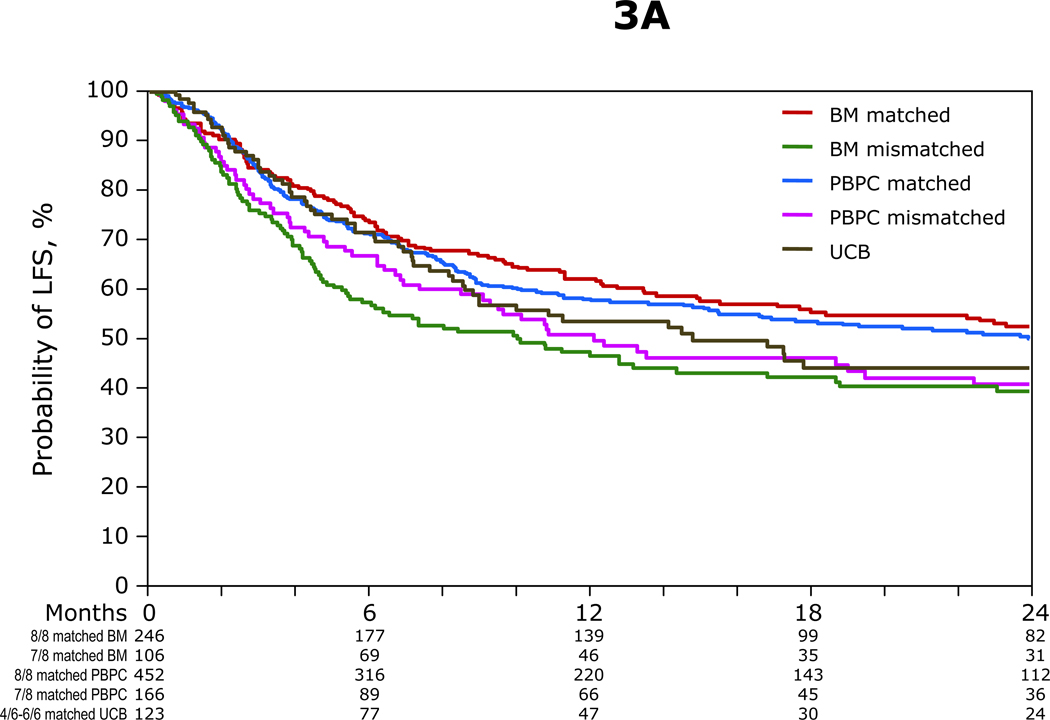
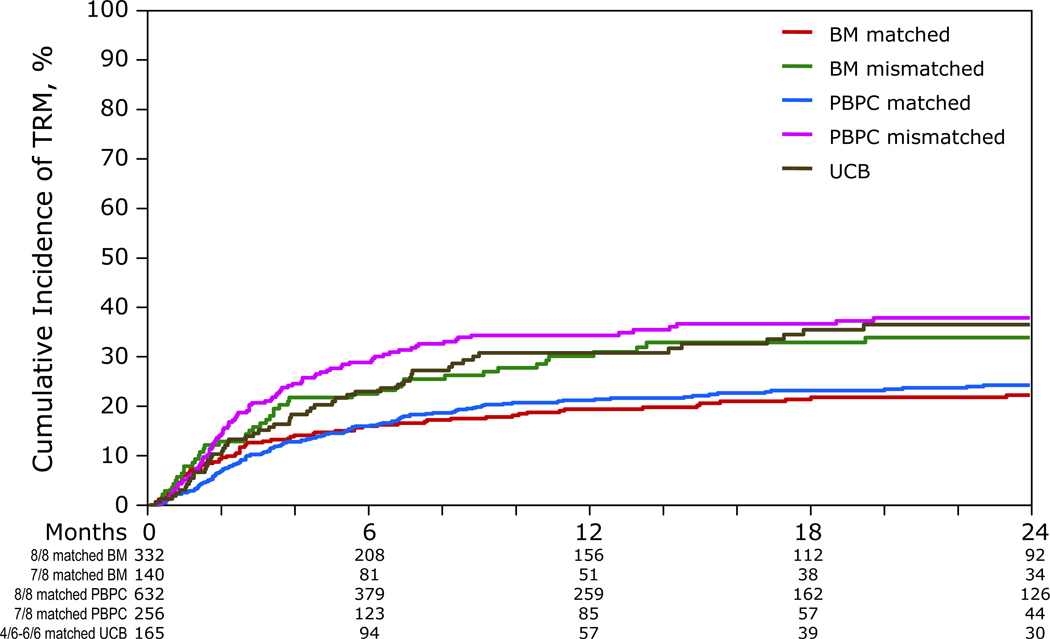
Leukaemia-free survival in patients after UCB transplantation was comparable with that after 8/8 and 7/8 allele-matched PBPC or bone-marrow transplantation. However, transplant-related mortality was higher after UCB transplantation than after 8/8 allele-matched PBPC recipients (HR 1.62, 95% CI 1.18-2.23; p=0.003) or bone-marrow transplantation (HR 1.69, 95% CI 1.19-2.39; p=0.003). Grades 2-4 acute and chronic graft-versus-host disease (GvHD) were lower in UCB recipients compared with allele-matched PBPC (HR 0.57, 95% 0.42-0.77; p=0.002 and HR 0.38, 0.27-0.53; p=0.003, respectively), while the incidence of chronic, but not acute GvHD, was lower after UCB than after 8/8 allele-matched bone-marrow transplantation (HR 0.63, 0.44-0.90; p=0.01).
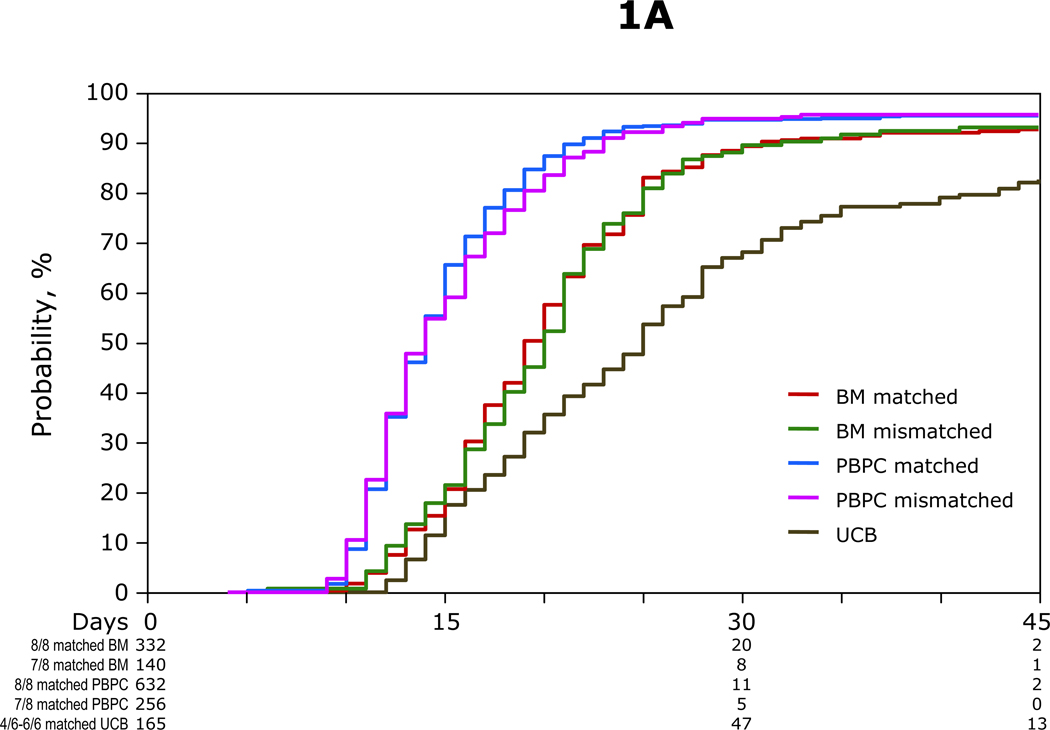
These data support the use of UCB for adults with acute leukaemia when there is no HLA-matched unrelated adult donor available, and when a transplant is needed urgently.
脐带血(UCB)越来越被认为是外周血造血祖细胞(PBPCs)或骨髓的替代物,尤其是当没有 HLA 匹配的成人无关供体时。我们旨在确定 UCB 移植物在成人急性白血病移植中的最佳作用,并确定当前的移植物选择实践是否合适。
我们使用 Cox 回归回顾性比较了年龄在 16 岁及以上接受急性白血病移植的患者中 UCB、PBPC 和骨髓移植的白血病无进展生存率和其他结局。在 2002 年至 2006 年间接受移植的 1525 名患者中可获得数据。165 名患者接受 UCB,888 名患者接受 PBPC,472 名患者接受骨髓。UCB 单位在 HLA-A 和 HLA-B 抗原水平上匹配,在 HLA-DRB1 等位基因水平上匹配(n=10),或在一个抗原(n=40)或两个抗原(n=115)上不匹配。来自无关成人供体的 PBPC 和骨髓移植物在 HLA-A、HLA-B、HLA-C 和 HLA-DRB1 的等位基因水平上匹配(n=632 和 n=332),或在一个位点上不匹配(n=256 和 n=140)。
UCB 移植后患者的白血病无进展生存率与 8/8 位和 7/8 位等位基因匹配的 PBPC 或骨髓移植相当。然而,与 8/8 位等位基因匹配的 PBPC 受者(HR 1.62,95%CI 1.18-2.23;p=0.003)或骨髓移植(HR 1.69,95%CI 1.19-2.39;p=0.003)相比,UCB 移植后的移植相关死亡率更高。与等位基因匹配的 PBPC 相比,UCB 受者的 2-4 级急性和慢性移植物抗宿主病(GvHD)发生率较低(HR 0.57,95%置信区间 0.42-0.77;p=0.002 和 HR 0.38,0.27-0.53;p=0.003),而慢性 GvHD 但不是急性 GvHD 的发生率在 UCB 后低于 8/8 位等位基因匹配的骨髓移植(HR 0.63,0.44-0.90;p=0.01)。
这些数据支持在没有 HLA 匹配的成人无关供体时,以及需要紧急移植时,将 UCB 用于成人急性白血病患者。