Department of Medical Oncology, Melanoma Study Group, Mayo Clinic and Mayo Foundation, Rochester, Minnesota 55905, USA.
Cancer. 2010 Jul 15;116(14):3463-8. doi: 10.1002/cncr.25191.
Chemotherapy has not been reported to have a significant impact on survival for patients with metastatic melanoma. Bortezomib was shown to have additive/synergistic effects with several chemotherapeutic agents, including paclitaxel and platinum. A phase 1 trial of this 3-drug combination reported that 6 of 28 patients treated with bortezomib followed by paclitaxel and carboplatin achieved a partial response (including 2 of 5 patients with metastatic melanoma).
A 2-stage phase 2 clinical trial was conducted to assess the antitumor activity of this 3-agent combination in patients with metastatic melanoma who had received at most 1 prior chemotherapy for metastatic disease. Treatment included bortezomib at a dose of 1.3 mg/m2 intravenously on Days 1, 4, and 8; paclitaxel at a dose of 175 mg/m2; and carboplatin at an area under the concentration (AUC) of 6 on Day 2 of a 21-day cycle. The primary endpoint of this trial was tumor response rate (TRR).
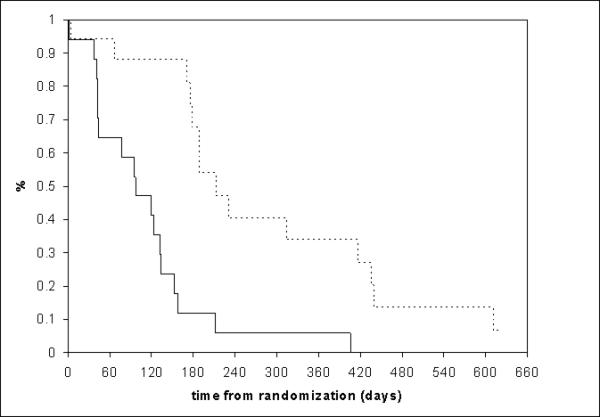
Seventeen eligible patients were enrolled. A median of 4 cycles were administered (range, 1-7 cycles). Three patients discontinued treatment due to persistent grade 4 (based on National Cancer Institute Common Terminology Criteria for Adverse Events [version 3.0]) neutropenia with grade 3 leukopenia (2 patients) or grade 4 pulmonary embolism (1 patient). Grade>or=3 toxicities included neutropenia (71%), leukopenia (41%), thrombocytopenia (29%), and arthralgia (12%). Two partial responses were observed (TRR, 11.8%). Four patients had stable disease at >12 weeks. The median progression-free survival was 3.2 months, and the median overall survival was 7.0 months.
Due to insufficient clinical efficacy, this trial did not proceed to second-stage accrual. The combination of paclitaxel, carboplatin, and bortezomib demonstrated limited clinical benefit and was associated with significant toxicity.
化疗并未显著改善转移性黑色素瘤患者的生存。硼替佐米与多种化疗药物联合具有相加/协同作用,包括紫杉醇和铂类药物。一项该三药联合的 1 期临床试验报道,28 例接受硼替佐米治疗后序贯紫杉醇和卡铂治疗的患者中,6 例(包括 5 例转移性黑色素瘤患者中的 2 例)获得部分缓解。
进行了 2 期临床试验,以评估该三药联合方案在转移性黑色素瘤患者中的抗肿瘤活性,这些患者既往转移性疾病最多接受过 1 线化疗。治疗包括硼替佐米 1.3 mg/m2,静脉滴注,第 1、4 和 8 天;紫杉醇 175 mg/m2;卡铂 AUC 为 6,第 21 天周期的第 2 天。该试验的主要终点为肿瘤缓解率(TRR)。
17 例合格患者入组。中位治疗周期数为 4 个(范围 1-7 个周期)。3 例患者因持续的 4 级(根据国立癌症研究所不良事件通用术语标准[版本 3.0])中性粒细胞减少症伴 3 级白细胞减少症(2 例)或 4 级肺栓塞(1 例)而停止治疗。≥3 级毒性包括中性粒细胞减少症(71%)、白细胞减少症(41%)、血小板减少症(29%)和关节痛(12%)。观察到 2 例部分缓解(TRR,11.8%)。4 例患者疾病稳定时间超过 12 周。无进展生存期的中位值为 3.2 个月,总生存期的中位值为 7.0 个月。
由于临床疗效不足,该试验未进入第 2 阶段入组。紫杉醇、卡铂和硼替佐米联合方案显示出有限的临床获益,并伴有显著的毒性。