Dabrowski Michal, Dojer Norbert, Zawadzka Malgorzata, Mieczkowski Jakub, Kaminska Bozena
Laboratory of Transcription Regulation, Department of Cell Biology, Nencki Institute, Pasteura 3, 02-093 Warsaw, Poland.
BMC Syst Biol. 2010 Jun 17;4:86. doi: 10.1186/1752-0509-4-86.
It is often desirable to separate effects of different regulators on gene expression, or to identify effects of the same regulator across several systems. Here, we focus on the rat brain following stroke or seizures, and demonstrate how the two tasks can be approached simultaneously.
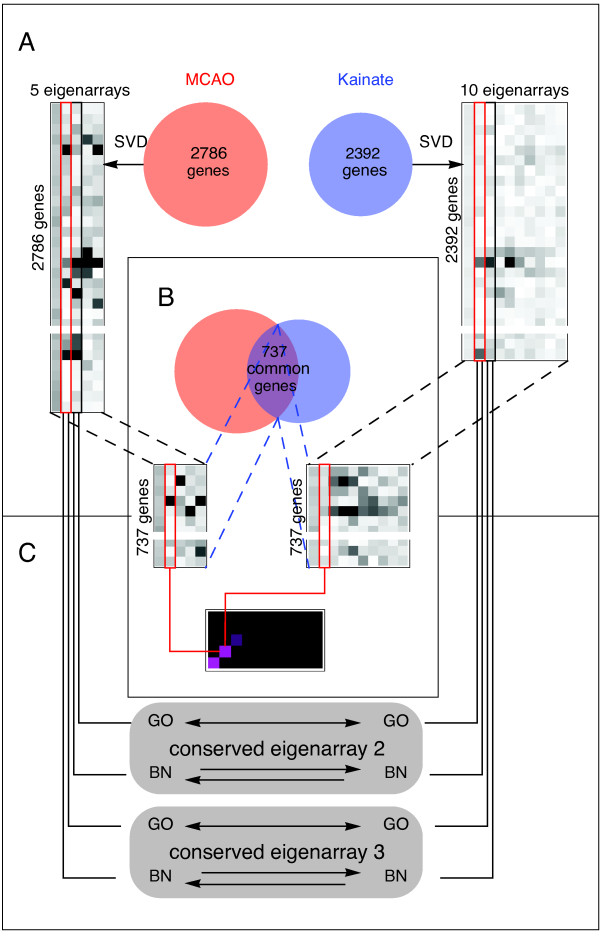
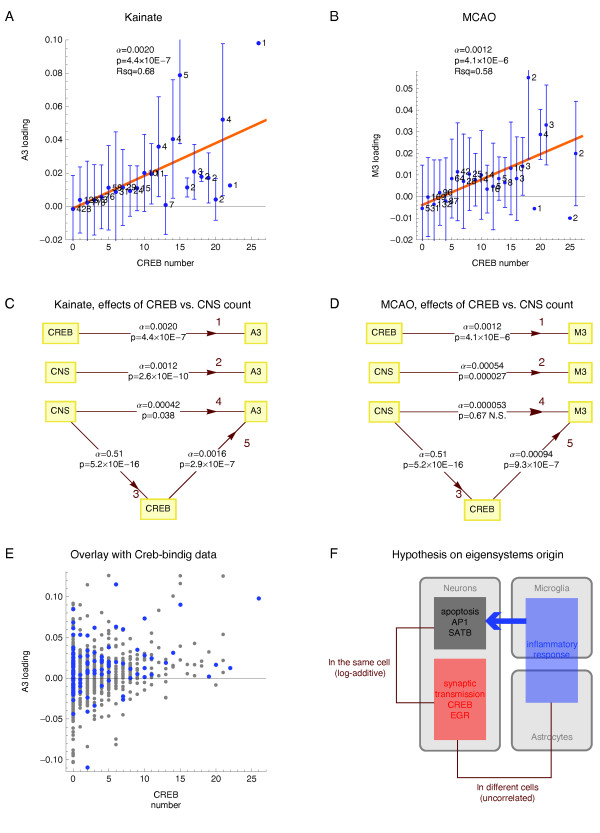
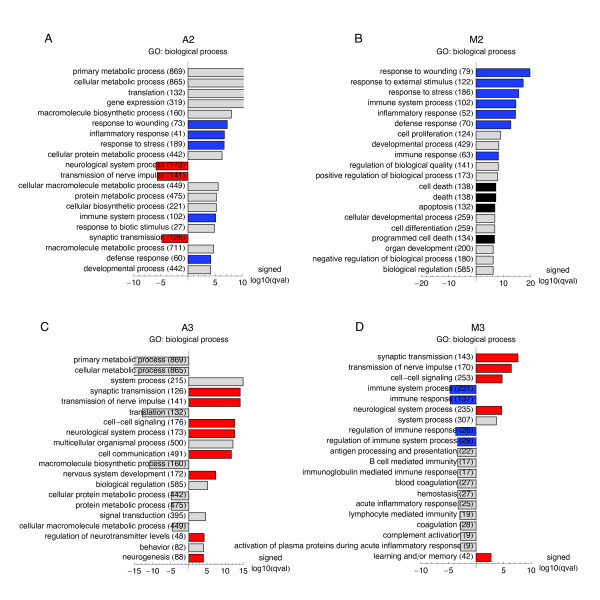
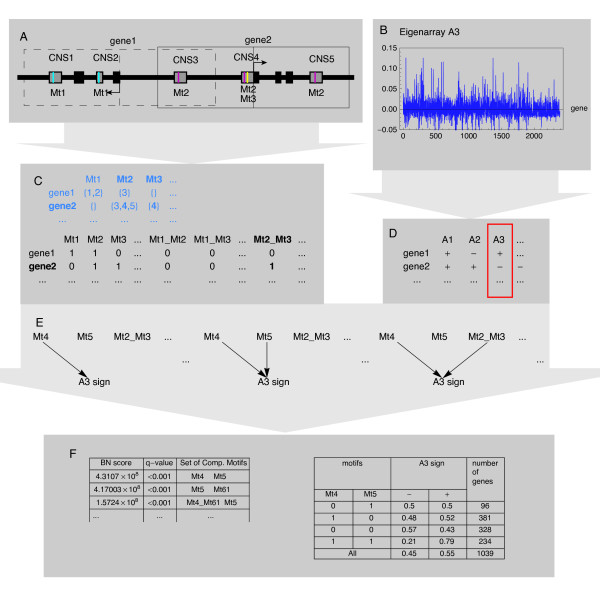
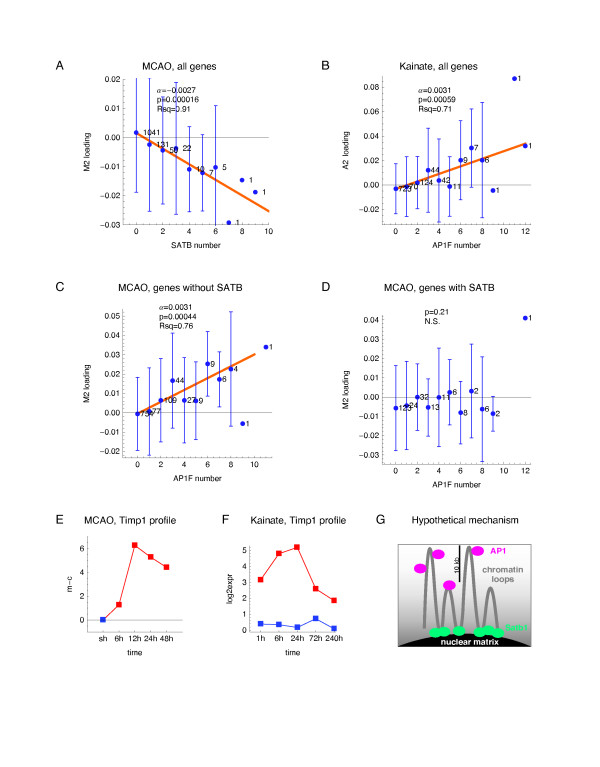
We applied SVD to time-series gene expression datasets from the rat experimental models of stroke and seizures. We demonstrate conservation of two eigensystems, reflecting inflammation and/or apoptosis (eigensystem 2) and neuronal synaptic activity (eigensystem 3), between the stroke and seizures. We analyzed cis-regulation of gene expression in the subspaces of the conserved eigensystems. Bayesian networks analysis was performed separately for either experimental model, with cross-system validation of the highest-ranking features. In this way, we correctly re-discovered the role of AP1 in the regulation of apoptosis, and the involvement of Creb and Egr in the regulation of synaptic activity-related genes. We identified a novel antagonistic effect of the motif recognized by the nuclear matrix attachment region-binding protein Satb1 on AP1-driven transcriptional activation, suggesting a link between chromatin loop structure and gene activation by AP1. The effects of motifs binding Satb1 and Creb on gene expression in brain conform to the assumption of the linear response model of gene regulation. Our data also suggest that numerous enhancers of neuronal-specific genes are important for their responsiveness to the synaptic activity.
Eigensystems conserved between stroke and seizures separate effects of inflammation/apoptosis and neuronal synaptic activity, exerted by different transcription factors, on gene expression in rat brain.
通常希望区分不同调节因子对基因表达的影响,或者识别同一调节因子在多个系统中的作用。在此,我们聚焦于中风或癫痫发作后的大鼠大脑,并展示如何同时处理这两项任务。
我们将奇异值分解(SVD)应用于中风和癫痫发作大鼠实验模型的时间序列基因表达数据集。我们证明了中风和癫痫发作之间存在两个特征系统的保守性,分别反映炎症和/或凋亡(特征系统2)以及神经元突触活动(特征系统3)。我们在保守特征系统的子空间中分析了基因表达的顺式调节。对每个实验模型分别进行贝叶斯网络分析,并对排名最高的特征进行跨系统验证。通过这种方式,我们正确地重新发现了AP1在凋亡调节中的作用,以及Creb和Egr在突触活动相关基因调节中的参与。我们发现核基质附着区结合蛋白Satb1识别的基序对AP1驱动的转录激活具有新的拮抗作用,这表明染色质环结构与AP1介导的基因激活之间存在联系。结合Satb1和Creb的基序对大脑中基因表达的影响符合基因调节线性响应模型的假设。我们的数据还表明,许多神经元特异性基因的增强子对其对突触活动的反应性很重要。
中风和癫痫发作之间保守的特征系统区分了由不同转录因子施加的炎症/凋亡和神经元突触活动对大鼠大脑基因表达的影响。