Department of Electrical Engineering, National Central University, Jhongli, Taiwan.
Biomed Eng Online. 2010 Jun 17;9:25. doi: 10.1186/1475-925X-9-25.
Brain oscillatory activities are stochastic and non-linearly dynamic, due to their non-phase-locked nature and inter-trial variability. Non-phase-locked rhythmic signals can vary from trial-to-trial dependent upon variations in a subject's performance and state, which may be linked to fluctuations in expectation, attention, arousal, and task strategy. Therefore, a method that permits the extraction of the oscillatory signal on a single-trial basis is important for the study of subtle brain dynamics, which can be used as probes to study neurophysiology in normal brain and pathophysiology in the diseased.
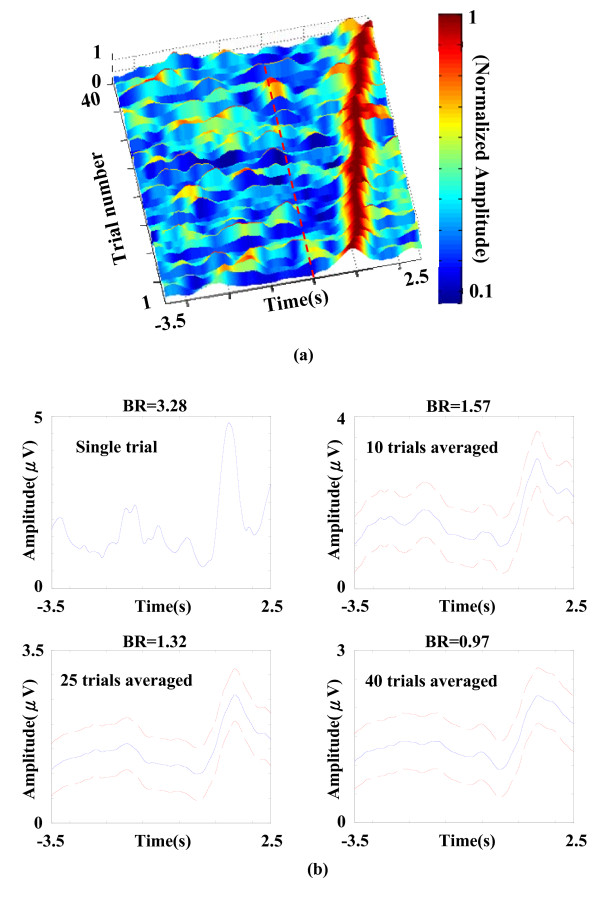
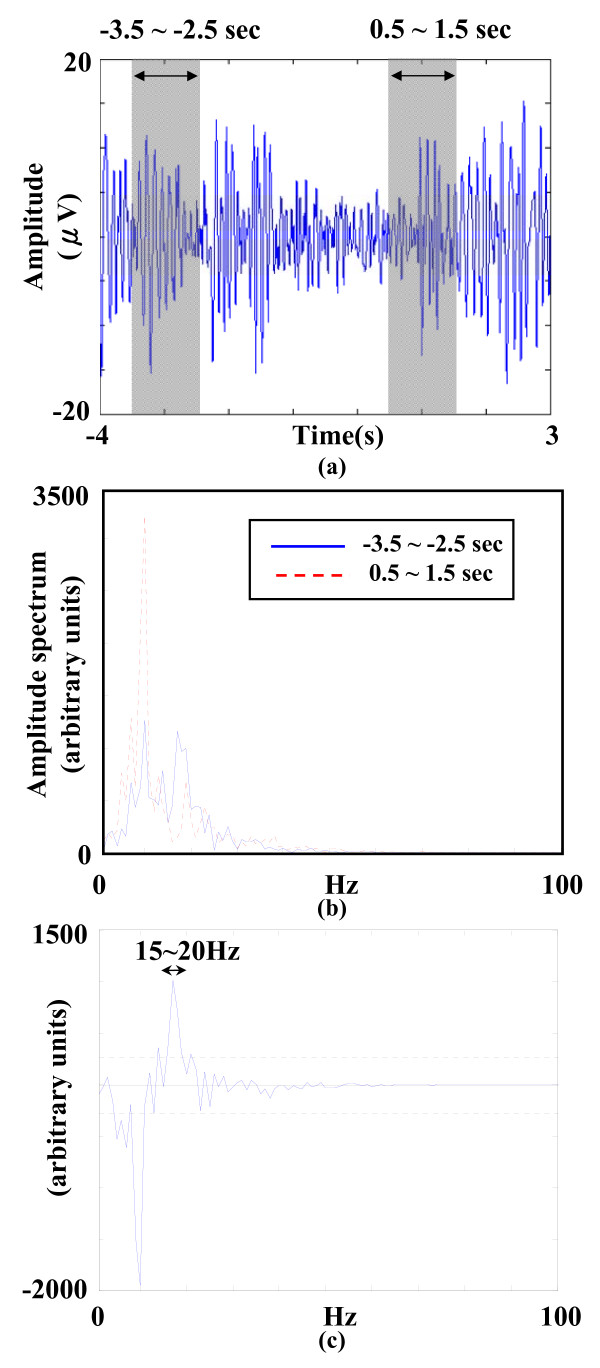
This paper presents an empirical mode decomposition (EMD)-based spatiotemporal approach to extract neural oscillatory activities from multi-channel electroencephalograph (EEG) data. The efficacy of this approach manifests in extracting single-trial post-movement beta activities when performing a right index-finger lifting task. In each single trial, an EEG epoch recorded at the channel of interest (CI) was first separated into a number of intrinsic mode functions (IMFs). Sensorimotor-related oscillatory activities were reconstructed from sensorimotor-related IMFs chosen by a spatial map matching process. Post-movement beta activities were acquired by band-pass filtering the sensorimotor-related oscillatory activities within a trial-specific beta band. Signal envelopes of post-movement beta activities were detected using amplitude modulation (AM) method to obtain post-movement beta event-related synchronization (PM-bERS). The maximum amplitude in the PM-bERS within the post-movement period was subtracted by the mean amplitude of the reference period to find the single-trial beta rebound (BR).
The results showed single-trial BRs computed by the current method were significantly higher than those obtained from conventional average method (P < 0.01; matched-pair Wilcoxon test). The proposed method provides high signal-to-noise ratio (SNR) through an EMD-based decomposition and reconstruction process, which enables event-related oscillatory activities to be examined on a single-trial basis.
The EMD-based method is effective for artefact removal and extracting reliable neural features of non-phase-locked oscillatory activities in multi-channel EEG data. The high extraction rate of the proposed method enables the trial-by-trial variability of oscillatory activities can be examined, which provide a possibility for future profound study of subtle brain dynamics.
由于其非锁相性质和试验间可变性,脑振荡活动是随机的和非线性动态的。非锁相节律信号可以根据受试者的表现和状态的变化而在试验之间发生变化,这可能与期望、注意力、觉醒和任务策略的波动有关。因此,一种能够在单次试验基础上提取振荡信号的方法对于研究微妙的大脑动力学非常重要,这种方法可以作为探针来研究正常大脑的神经生理学和疾病中的病理生理学。
本文提出了一种基于经验模态分解(EMD)的时空方法,从多通道脑电图(EEG)数据中提取神经振荡活动。该方法的有效性体现在从执行右食指提升任务时提取单个试验后的β活动中。在每个单次试验中,首先将感兴趣通道(CI)记录的 EEG 时程分为若干固有模态函数(IMF)。通过空间图谱匹配过程选择与感觉运动相关的 IMF 来重建与感觉运动相关的振荡活动。通过在特定于试验的β频带内对感觉运动相关的振荡活动进行带通滤波来获取运动后β活动。使用幅度调制(AM)方法检测运动后β活动的信号包络,以获得运动后β事件相关同步(PM-bERS)。通过减去参考期的平均幅度来找到单个试验β反弹(BR),从运动后期内的 PM-bERS 中检测到最大幅度。
结果表明,当前方法计算的单个试验 BR 明显高于传统平均方法(P < 0.01;配对 Wilcoxon 检验)。该方法通过基于 EMD 的分解和重建过程提供了高信噪比(SNR),从而能够在单个试验的基础上检查事件相关的振荡活动。
基于 EMD 的方法可有效去除伪影并提取多通道 EEG 数据中非锁相振荡活动的可靠神经特征。该方法的高提取率使我们能够检查振荡活动的试验间可变性,这为未来深入研究微妙的大脑动力学提供了可能性。