Center for Biomembrane Research, Stockholm Bioinformatics Center, Dept of Biochemistry and Biophysics, Stockholm University, SE-106 91 Stockholm, Sweden.
BMC Bioinformatics. 2010 Jun 18;11:333. doi: 10.1186/1471-2105-11-333.
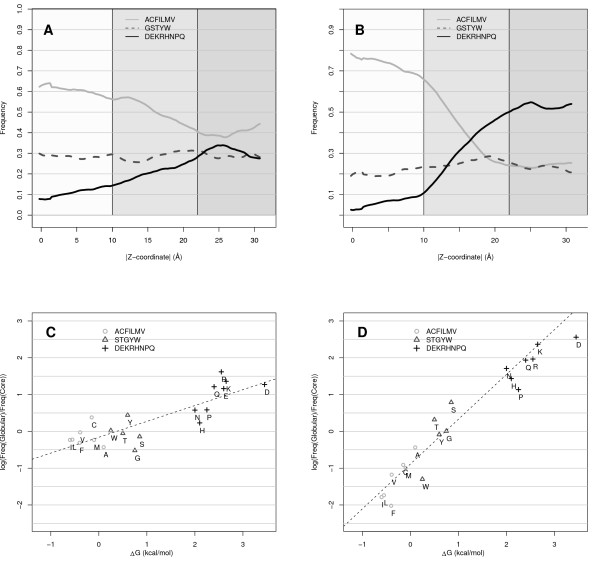
In water-soluble proteins it is energetically favorable to bury hydrophobic residues and to expose polar and charged residues. In contrast to water soluble proteins, transmembrane proteins face three distinct environments; a hydrophobic lipid environment inside the membrane, a hydrophilic water environment outside the membrane and an interface region rich in phospholipid head-groups. Therefore, it is energetically favorable for transmembrane proteins to expose different types of residues in the different regions.
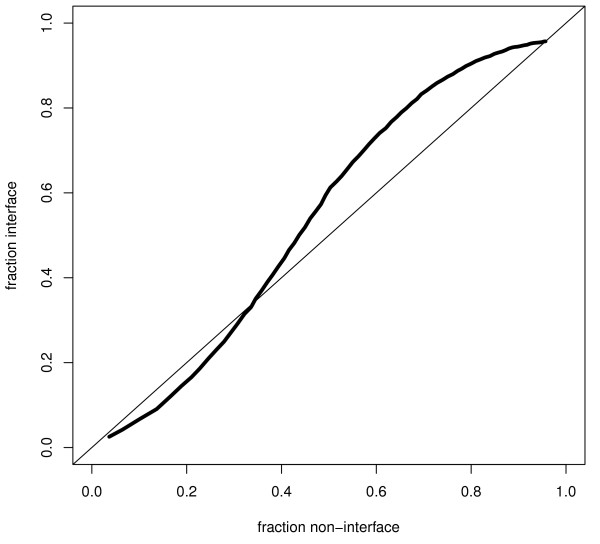
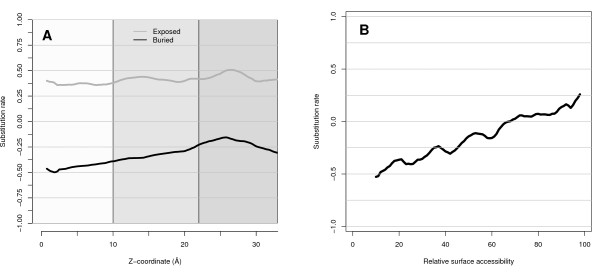
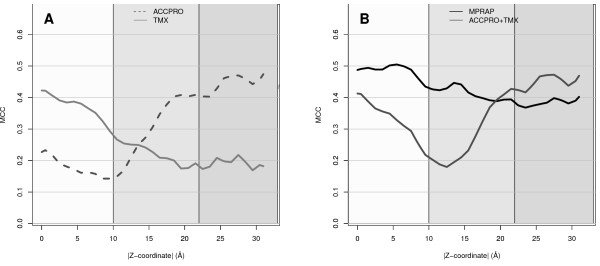
Investigations of a set of structurally determined transmembrane proteins showed that the composition of solvent exposed residues differs significantly inside and outside the membrane. In contrast, residues buried within the interior of a protein show a much smaller difference. However, in all regions exposed residues are less conserved than buried residues. Further, we found that current state-of-the-art predictors for surface area are optimized for one of the regions and perform badly in the other regions. To circumvent this limitation we developed a new predictor, MPRAP, that performs well in all regions. In addition, MPRAP performs better on complete membrane proteins than a combination of specialized predictors and acceptably on water-soluble proteins. A web-server of MPRAP is available at http://mprap.cbr.su.se/
By including complete a-helical transmembrane proteins in the training MPRAP is able to predict surface accessibility accurately both inside and outside the membrane. This predictor can aid in the prediction of 3D-structure, and in the identification of erroneous protein structures.
在水溶性蛋白质中,埋藏疏水残基并暴露极性和带电残基是能量有利的。与水溶性蛋白质相比,跨膜蛋白面临着三个不同的环境;膜内的疏水环境、膜外的亲水环境和富含磷脂头基的界面区域。因此,跨膜蛋白在不同区域暴露不同类型的残基是能量有利的。
对一组结构确定的跨膜蛋白的研究表明,溶剂暴露残基的组成在膜内和膜外有显著差异。相比之下,埋藏在蛋白质内部的残基差异较小。然而,在所有暴露的区域,暴露的残基的保守性都低于埋藏的残基。此外,我们发现,目前用于表面积预测的最先进的预测器是针对一个区域进行优化的,而在其他区域的性能很差。为了规避这一限制,我们开发了一种新的预测器 MPRAP,它在所有区域都表现良好。此外,MPRAP 在完整的膜蛋白上的表现优于专门预测器的组合,在水溶性蛋白上的表现也可以接受。MPRAP 的网络服务器可在 http://mprap.cbr.su.se/ 获得。
通过在训练中包含完整的α-螺旋跨膜蛋白,MPRAP 能够准确地预测膜内和膜外的表面可及性。该预测器可用于辅助 3D 结构预测,并识别错误的蛋白质结构。