Department of Internal Medicine I, Osaka Medical College, Takatsuki, Osaka, Japan.
BMC Neurol. 2010 Jun 18;10:45. doi: 10.1186/1471-2377-10-45.
Neuromyelitis optica (NMO) is an inflammatory demyelinating disease that predominantly affects the optic nerves and the spinal cord, and is possibly mediated by an immune mechanism distinct from that of multiple sclerosis (MS). Central scotoma is recognized as a characteristic visual field defect pattern of optic neuritis (ON), however, the differing pathogenic mechanisms of NMO and MS may result in different patterns of visual field defects for ON.
Medical records of 15 patients with NMO and 20 patients with MS having ON were retrospectively analyzed. A thorough systemic and neurological examination was performed for evaluating ON. The total number of relapses of ON and visual fields was investigated. Visual fields were obtained by Goldmann perimeter with each ON relapse.
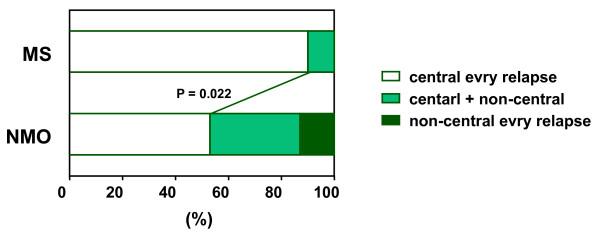
All MS patients experienced central scotoma, with 90% of them showing central scotoma with every ON relapse. However, 53% of NMO patients showed central scotoma with every ON relapse (p = 0.022), and the remaining 47% of patients experienced non-central scotoma (altitudinal, quadrant, three quadrant, hemianopia, and bitemporal hemianopia). Thirteen percent of NMO patients did not experience central scotoma during their disease course. Altitudinal hemianopia was the most frequent non-central scotoma pattern in NMO.
NMO patients showed higher incidence of non-central scotoma than MS, and altitudinal hemianopia may be characteristic of ON occurring in NMO. As altitudinal hemianopia is highly characteristic of ischemic optic neuropathy, we suggest that an ischemic mechanism mediated by anti-aquaporin-4 antibody may play a role in ON in NMO patients.
视神经脊髓炎(NMO)是一种以视神经和脊髓为主的炎症性脱髓鞘疾病,可能由不同于多发性硬化症(MS)的免疫机制介导。中央暗点被认为是视神经炎(ON)的特征性视野缺损模式,然而,NMO 和 MS 的不同发病机制可能导致 ON 的视野缺损模式不同。
回顾性分析了 15 例 NMO 和 20 例 MS 患者的 ON 病例。对 ON 进行了全面的系统和神经系统检查。调查了 ON 复发的总数和视野。每次 ON 复发时,使用 Goldmann 周边仪获取视野。
所有 MS 患者均出现中央暗点,90%的患者每次 ON 复发均出现中央暗点。然而,53%的 NMO 患者每次 ON 复发均出现中央暗点(p = 0.022),其余 47%的患者出现非中央暗点(垂直性、象限性、三象限性、偏盲和双颞侧偏盲)。13%的 NMO 患者在疾病过程中未出现中央暗点。垂直性偏盲是 NMO 中最常见的非中央暗点模式。
NMO 患者的非中央暗点发生率高于 MS,垂直性偏盲可能是 NMO 中发生的 ON 的特征。由于垂直性偏盲高度提示为缺血性视神经病变,我们建议抗水通道蛋白-4 抗体介导的缺血机制可能在 NMO 患者的 ON 中发挥作用。