Centre for Ecological and Evolutionary Synthesis (CEES), Department of Biology, University of Oslo, N-0316 Oslo, Norway.
BMC Evol Biol. 2010 Jun 21;10:191. doi: 10.1186/1471-2148-10-191.
Plastid replacements through secondary endosymbioses include massive transfer of genes from the endosymbiont to the host nucleus and require a new targeting system to enable transport of the plastid-targeted proteins across 3-4 plastid membranes. The dinoflagellates are the only eukaryotic lineage that has been shown to have undergone several plastid replacement events, and this group is thus highly relevant for studying the processes involved in plastid evolution. In this study, we analyzed the phylogenetic origin and N-terminal extensions of plastid-targeted proteins from Lepidodinium chlorophorum, a member of the only dinoflagellate genus that harbors a green secondary plastid rather than the red algal-derived, peridinin-containing plastid usually found in photosynthetic dinoflagellates.
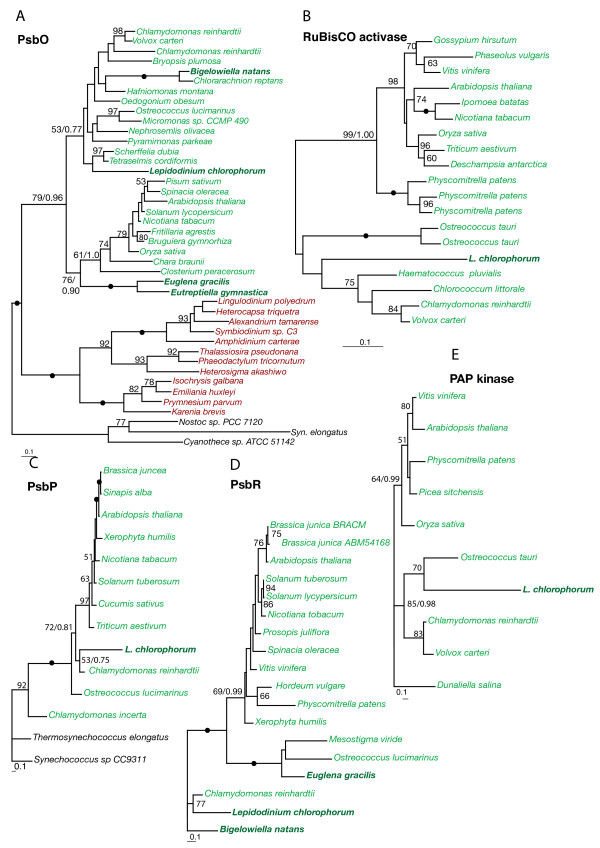
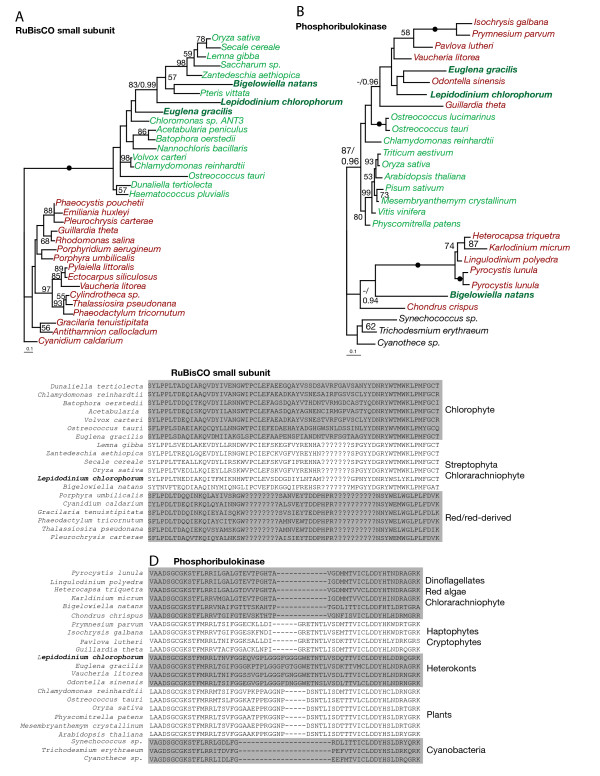
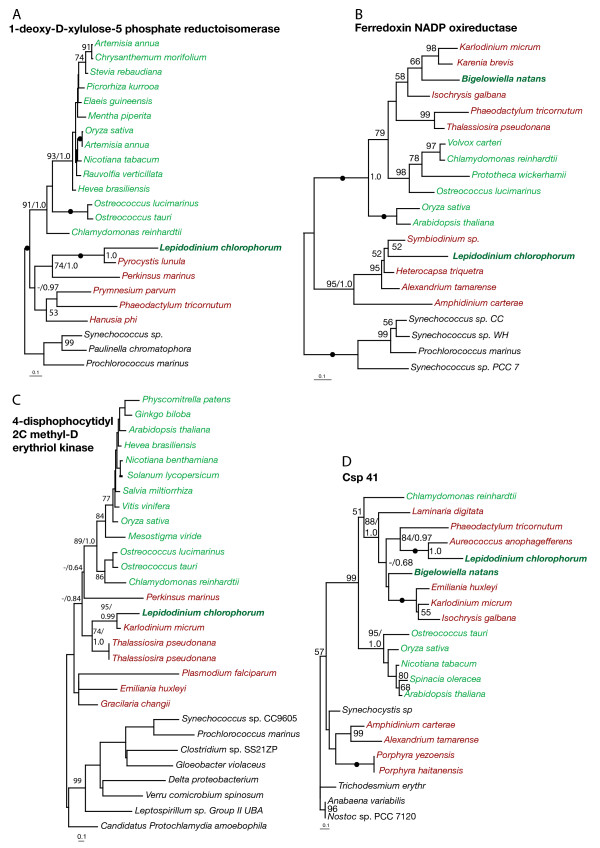
We sequenced 4,746 randomly picked clones from a L. chlorophorum cDNA library. 22 of the assembled genes were identified as genes encoding proteins functioning in plastids. Some of these were of green algal origin. This confirms that genes have been transferred from the plastid to the host nucleus of L. chlorophorum and indicates that the plastid is fully integrated as an organelle in the host. Other nuclear-encoded plastid-targeted protein genes, however, are clearly not of green algal origin, but have been derived from a number of different algal groups, including dinoflagellates, streptophytes, heterokonts, and red algae. The characteristics of N-terminal plastid-targeting peptides of all of these genes are substantially different from those found in peridinin-containing dinoflagellates and green algae.
L. chlorophorum expresses plastid-targeted proteins with a range of different origins, which probably arose through endosymbiotic gene transfer (EGT) and horizontal gene transfer (HGT). The N-terminal extension of the genes is different from the extensions found in green alga and other dinoflagellates (peridinin- and haptophyte plastids). These modifications have likely enabled the mosaic proteome of L. chlorophorum.
通过二次内共生进行的质体替换包括大量来自内共生体的基因转移到宿主核中,并需要一个新的靶向系统来使质体靶向蛋白穿过 3-4 个质体膜进行运输。 甲藻门是唯一被证明经历过几次质体替换事件的真核生物谱系,因此该组对于研究与质体进化相关的过程具有重要意义。 在这项研究中,我们分析了来自 Lepidodinium chlorophorum 的质体靶向蛋白的系统发生起源和 N 末端延伸,这是唯一拥有绿色次生性质体而不是通常在光合甲藻中发现的红藻衍生的含有 Peridinin 的质体的甲藻属成员。
我们从 Lepidodinium chlorophorum cDNA 文库中随机挑选了 4746 个克隆进行测序。 组装的 22 个基因被鉴定为编码在质体中起作用的蛋白质的基因。 其中一些来自绿藻。 这证实了基因已经从质体转移到 Lepidodinium chlorophorum 的宿主核中,并表明质体作为细胞器完全整合到宿主中。 然而,其他核编码的质体靶向蛋白基因显然不是绿藻起源的,而是来自多个不同的藻类群,包括甲藻门、木贼门、异鞭毛门和红藻门。 所有这些基因的 N 末端质体靶向肽的特征与含有 Peridinin 的甲藻门和绿藻中发现的特征有很大不同。
Lepidodinium chlorophorum 表达具有多种不同起源的质体靶向蛋白,这些蛋白可能是通过内共生基因转移(EGT)和水平基因转移(HGT)产生的。 基因的 N 末端延伸与绿藻和其他甲藻门(Peridinin 和 Haptophyte 质体)中的延伸不同。 这些修饰可能使 Lepidodinium chlorophorum 的嵌合蛋白质组成为可能。