Integrated Department of Immunology, University of Colorado, Denver, CO 80206, USA.
J Exp Med. 2010 Jul 5;207(7):1485-500. doi: 10.1084/jem.20092695. Epub 2010 Jun 21.
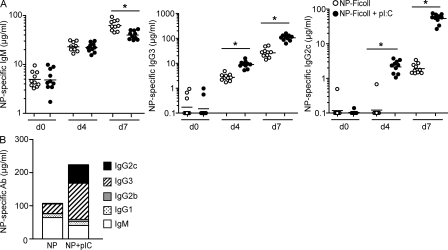
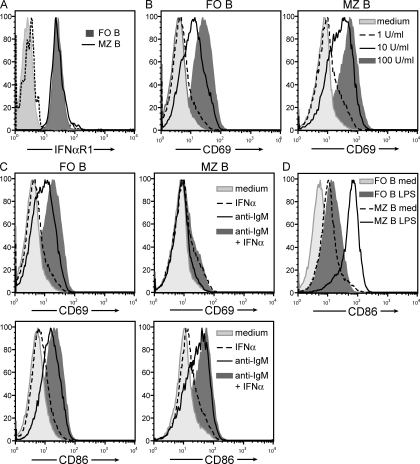
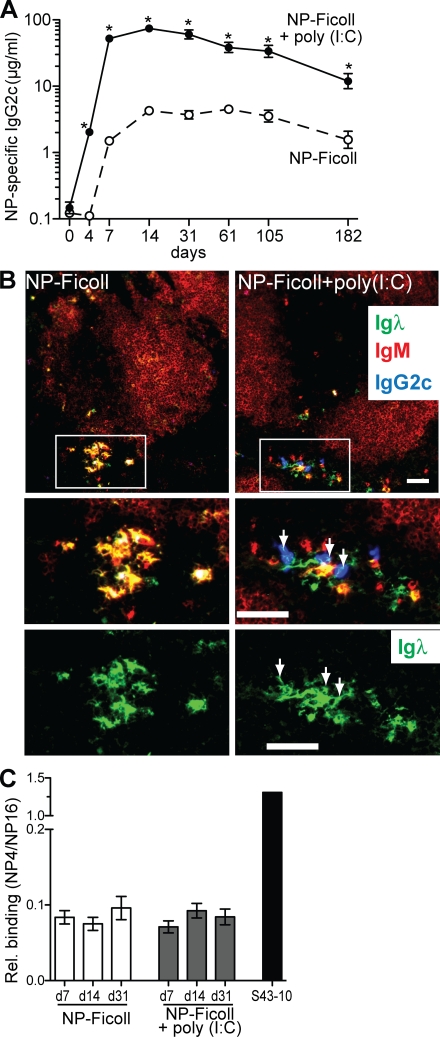
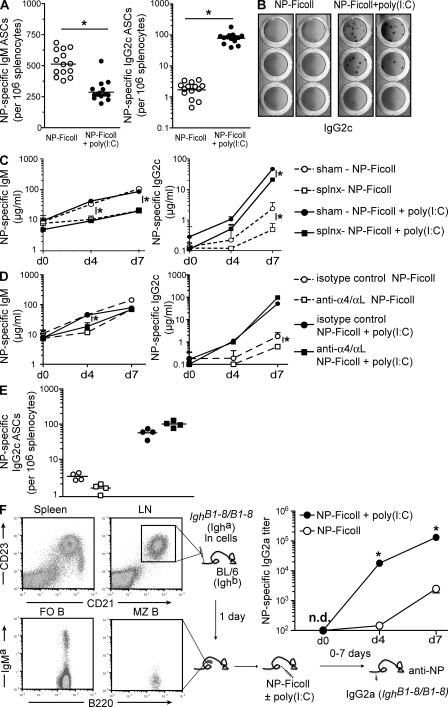
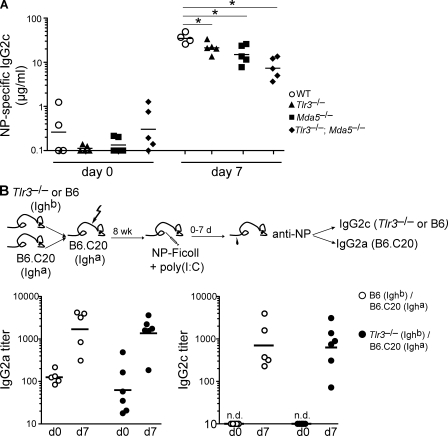
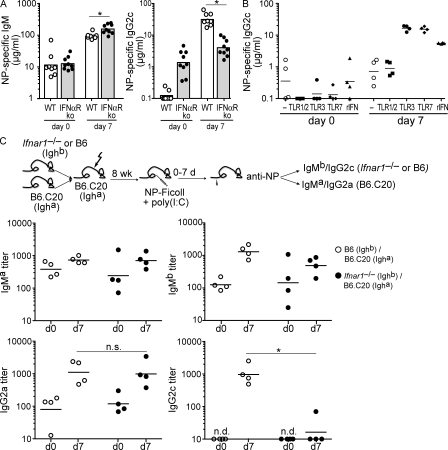
Humoral immunity to viruses and encapsulated bacteria is comprised of T cell-independent type 2 (TI-2) antibody responses that are characterized by rapid antibody production by marginal zone and B1 B cells. We demonstrate that toll-like receptor (TLR) ligands influence the TI-2 antibody response not only by enhancing the overall magnitude but also by skewing this response to one that is dominated by IgG isotypes. Importantly, TLR ligands facilitate this response by inducing type I interferon (IFN), which in turn elicits rapid and significant amounts of antigen-specific IgG2c predominantly from FO (follicular) B cells. Furthermore, we show that although the IgG2c antibody response requires B cell-autonomous IFN-alpha receptor signaling, it is independent of B cell-intrinsic TLR signaling. Thus, innate signals have the capacity to enhance TI-2 antibody responses by promoting participation of FO B cells, which then elaborate effective IgG anti-pathogen antibodies.
体液免疫针对病毒和囊膜细菌,由 T 细胞非依赖性 2 型(TI-2)抗体应答组成,其特征是边缘区和 B1 B 细胞快速产生抗体。我们证明, Toll 样受体(TLR)配体不仅通过增强整体幅度,而且通过使这种应答偏向 IgG 同种型为主的应答来影响 TI-2 抗体应答。重要的是,TLR 配体通过诱导 I 型干扰素(IFN)来促进这种应答,IFN 反过来又引发大量快速的抗原特异性 IgG2c,主要来自 FO(滤泡)B 细胞。此外,我们表明,尽管 IgG2c 抗体应答需要 B 细胞自主 IFN-α受体信号,但它独立于 B 细胞固有 TLR 信号。因此,先天信号具有通过促进 FO B 细胞的参与来增强 TI-2 抗体应答的能力,然后 FO B 细胞产生有效的 IgG 抗病原体抗体。