Centre for Neuroscience Studies, Botterell Hall, Queen's University, Kingston, ON, K7L 3N6, Canada.
Exp Brain Res. 2010 Aug;205(1):31-40. doi: 10.1007/s00221-010-2330-3. Epub 2010 Jun 22.
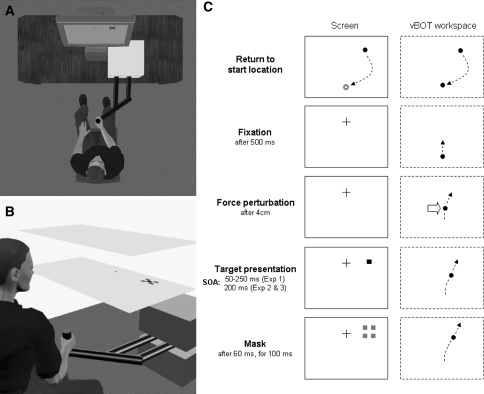
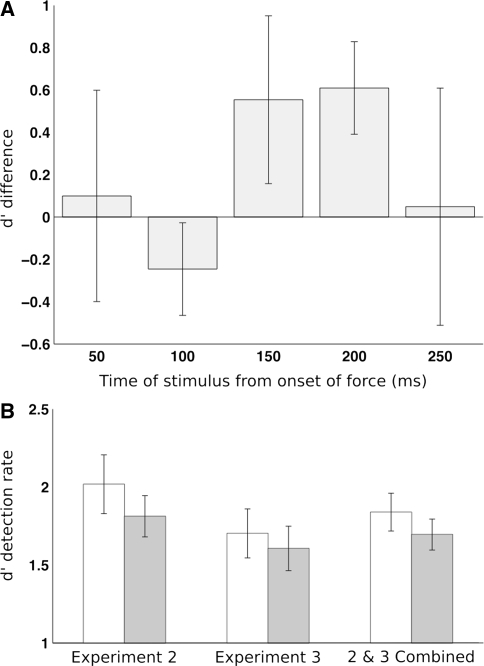
Vision and proprioception are the main sensory modalities that convey hand location and direction of movement. Fusion of these sensory signals into a single robust percept is now well documented. However, it is not known whether these modalities also interact in the spatial allocation of attention, which has been demonstrated for other modality pairings. The aim of this study was to test whether proprioceptive signals can spatially cue a visual target to improve its detection. Participants were instructed to use a planar manipulandum in a forward reaching action and determine during this movement whether a near-threshold visual target appeared at either of two lateral positions. The target presentation was followed by a masking stimulus, which made its possible location unambiguous, but not its presence. Proprioceptive cues were given by applying a brief lateral force to the participant's arm, either in the same direction (validly cued) or in the opposite direction (invalidly cued) to the on-screen location of the mask. The d' detection rate of the target increased when the direction of proprioceptive stimulus was compatible with the location of the visual target compared to when it was incompatible. These results suggest that proprioception influences the allocation of attention in visual space.
视觉和本体感觉是传达手部位置和运动方向的主要感觉模式。这些感觉信号融合成单一的稳健感知现在已经有充分的记录。然而,目前还不清楚这些模式是否也会在注意力的空间分配中相互作用,因为其他模式配对已经证明了这一点。本研究的目的是测试本体感觉信号是否可以在空间上提示视觉目标,以提高其检测能力。参与者被指示使用平面操纵器进行向前伸展动作,并在运动过程中确定在两个侧面位置中的任一个是否出现了接近阈值的视觉目标。目标呈现后,会出现一个掩蔽刺激,该刺激使目标的可能位置变得明确,但不能确定其存在。本体感觉提示是通过向参与者的手臂施加短暂的横向力来实现的,力的方向与掩蔽物的屏幕位置相同(有效提示)或相反(无效提示)。与刺激方向与视觉目标位置不匹配相比,当本体感觉刺激的方向与视觉目标的位置相匹配时,目标的检测率 d'会增加。这些结果表明,本体感觉会影响视觉空间中注意力的分配。