Center for Clinical and Basic Research, Ballerup, Denmark.
BMC Musculoskelet Disord. 2010 Jun 22;11:130. doi: 10.1186/1471-2474-11-130.
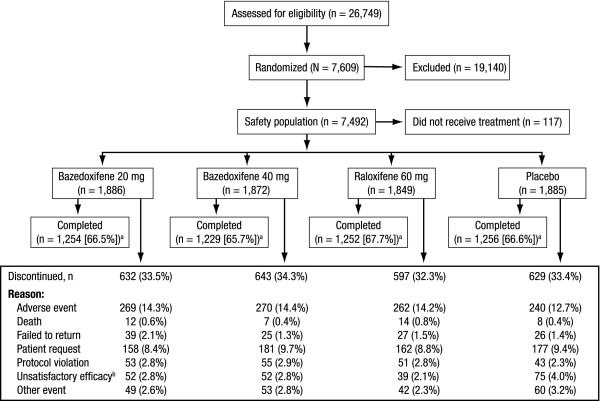
We report the safety findings from a 3-year phase 3 study (NCT00205777) of bazedoxifene, a novel selective estrogen receptor modulator under development for the prevention and treatment of postmenopausal osteoporosis.
Healthy postmenopausal osteoporotic women (N = 7,492; mean age, 66.4 years) were randomized to daily doses of bazedoxifene 20 or 40 mg, raloxifene 60 mg, or placebo for 3 years. Safety and tolerability were assessed by adverse event (AE) reporting and routine physical, gynecologic, and breast examination.
Overall, the incidence of AEs, serious AEs, and discontinuations due to AEs in the bazedoxifene groups was not different from that seen in the placebo group. The incidence of hot flushes and leg cramps was higher with bazedoxifene or raloxifene compared with placebo. The rates of cardiac disorders and cerebrovascular events were low and evenly distributed among groups. Venous thromboembolic events, primarily deep vein thromboses, were more frequently reported in the active treatment groups compared with the placebo group; rates were similar with bazedoxifene and raloxifene. Bazedoxifene showed a neutral effect on the breast and an excellent endometrial safety profile. The incidence of fibrocystic breast disease was lower with bazedoxifene 20 and 40 mg versus raloxifene or placebo. Reductions in total and low-density lipoprotein levels and increases in high-density lipoprotein levels were seen with bazedoxifene versus placebo; similar results were seen with raloxifene. Triglyceride levels were similar among groups.
Bazedoxifene showed a favorable safety and tolerability profile in women with postmenopausal osteoporosis.
NCT00205777; Trial registration date: September 16, 2005.
我们报告了一项为期 3 年的 3 期研究(NCT00205777)的安全性发现,该研究评估了巴多昔芬(一种新型选择性雌激素受体调节剂,正在开发用于预防和治疗绝经后骨质疏松症)。
健康的绝经后骨质疏松症女性(N=7492;平均年龄 66.4 岁)被随机分配至每日接受巴多昔芬 20 或 40mg、雷洛昔芬 60mg 或安慰剂治疗,为期 3 年。通过不良事件(AE)报告和常规体格、妇科及乳房检查评估安全性和耐受性。
总体而言,巴多昔芬组和安慰剂组的 AE 发生率、严重 AE 发生率和因 AE 停药率无差异。与安慰剂相比,巴多昔芬或雷洛昔芬组潮红和腿部痉挛的发生率更高。心脏疾病和脑血管事件的发生率较低,且在各组间分布均匀。静脉血栓栓塞事件(主要为深静脉血栓)在活性治疗组较安慰剂组更常报告;巴多昔芬和雷洛昔芬组间发生率相似。巴多昔芬对乳房具有中性作用,且子宫内膜安全性良好。巴多昔芬 20 和 40mg 组的纤维囊性乳腺疾病发生率低于雷洛昔芬或安慰剂组。与安慰剂相比,巴多昔芬组总胆固醇和低密度脂蛋白水平降低,高密度脂蛋白水平升高;雷洛昔芬组也观察到类似结果。各组的甘油三酯水平相似。
巴多昔芬在绝经后骨质疏松症女性中具有良好的安全性和耐受性。
NCT00205777;临床试验注册日期:2005 年 9 月 16 日。