1 Women's Health and Research Consultants, Washington, District of Columbia.
2 Shionogi, Inc. , Florham Park, New Jersey.
J Womens Health (Larchmt). 2018 Jan;27(1):14-23. doi: 10.1089/jwh.2017.6385. Epub 2017 Oct 24.
To evaluate the safety of daily oral ospemifene 60 mg, estrogen agonist/antagonist, used to treat moderate-to-severe dyspareunia due to postmenopausal vulvovaginal atrophy, which is part of genitourinary syndrome of menopause.
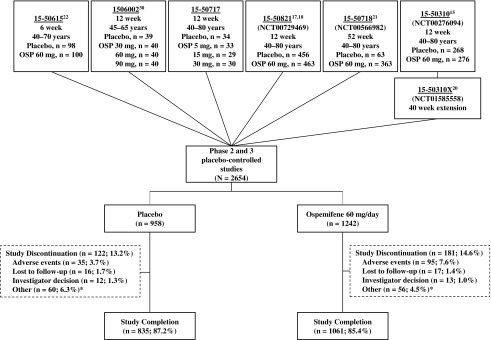
Post hoc analysis of safety data (treatment-emergent adverse events [TEAEs]) pooled from six phase 2 and 3 randomized, double-blind, multicenter placebo-controlled studies, evaluating the effects of ospemifene 60 mg on the breast, cardiovascular system, and bone in postmenopausal women.
At least one TEAE was reported by 67.6% (840/1242) and 54.1% (518/958) of women taking ospemifene 60 mg and placebo, respectively. Most TEAEs were mild or moderate and occurred within 4 to 12 weeks. The most commonly reported TEAEs with ospemifene were hot flush (8.5% vs. 3.3% for placebo) and urinary tract infection (6.5% vs. 4.8%). Discontinuation due to TEAEs was 7.6% with ospemifene and 3.8% with placebo. Most women discontinued treatment due to adverse events (AEs): hot flushes, muscle spasms, headache, and vaginal discharge. Serious AEs occurred infrequently (ospemifene, 2.6%; placebo, 1.8%); most were not considered related to treatment. Breast cancer and other breast-related TEAE incidences were comparable between ospemifene (2.5%) and placebo (2.2%), and cardiovascular TEAE incidence, including deep vein thrombosis, was low with ospemifene (0.3%) and placebo (0.1%).
No unexpected safety signals were reported, and discontinuation due to TEAEs was low, with use of ospemifene 60 mg versus placebo in six phase 2 and 3 trials, suggesting a lack of detrimental effects on the breast, bone, and cardiovascular health of postmenopausal women when ospemifene is used to effectively treat moderate-to-severe postmenopausal dyspareunia.
评估每日口服 60 毫克奥昔布宁(雌激素激动剂/拮抗剂)治疗绝经后女性因外阴阴道萎缩导致的中重度性交困难的安全性,这是绝经相关生殖泌尿系统综合征的一部分。
对 6 项 2 期和 3 期随机、双盲、多中心安慰剂对照研究的安全性数据(治疗中出现的不良事件 [TEAEs])进行事后分析,评估奥昔布宁 60 毫克对绝经后女性乳房、心血管系统和骨骼的影响。
分别有 67.6%(840/1242)和 54.1%(518/958)的服用奥昔布宁 60 毫克和安慰剂的女性报告至少发生 1 次 TEAEs。大多数 TEAEs 为轻度或中度,发生在 4 至 12 周内。奥昔布宁最常见的 TEAEs 是热潮红(8.5%比安慰剂组的 3.3%)和尿路感染(6.5%比安慰剂组的 4.8%)。因 TEAEs 停药的发生率分别为奥昔布宁组 7.6%和安慰剂组 3.8%。大多数女性因不良反应(AEs)停药:热潮红、肌肉痉挛、头痛和阴道分泌物。严重 AEs 很少发生(奥昔布宁组 2.6%;安慰剂组 1.8%);大多数与治疗无关。奥昔布宁(2.5%)和安慰剂(2.2%)的乳腺癌和其他乳房相关 TEAEs 发生率相当,奥昔布宁(0.3%)和安慰剂(0.1%)的心血管 TEAEs 发生率低,包括深静脉血栓形成。
在六项 2 期和 3 期试验中,奥昔布宁 60 毫克与安慰剂相比,未报告新的安全性信号,且因 TEAEs 停药率较低,提示奥昔布宁用于有效治疗绝经后中重度性交困难时,对绝经后女性的乳房、骨骼和心血管健康没有不良影响。