Leukocyte Biology Section, Faculty of Medicine, MRC and Asthma UK Centre in Allergic Mechanisms of Asthma, National Heart and Lung Institute, Imperial College London, London, UK.
Respir Res. 2010 Jun 23;11(1):85. doi: 10.1186/1465-9921-11-85.
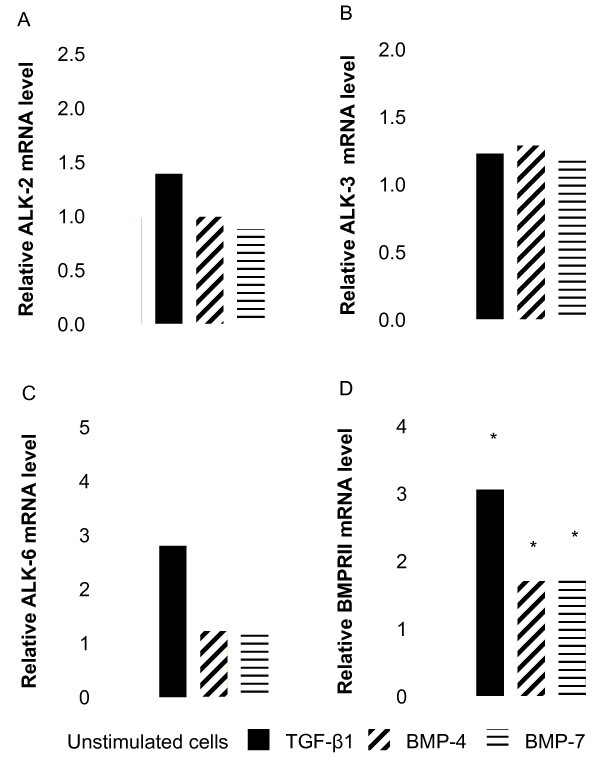
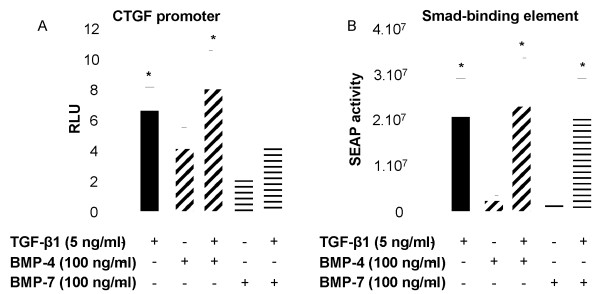
Airway remodelling is thought to be under the control of a complex group of molecules belonging to the transforming growth factor (TGF)-superfamily. The bone morphogenetic proteins (BMPs) belong to this family and have been shown to regulate fibrosis in kidney and liver diseases. However, the role of BMPs in lung remodelling remains unclear. BMPs may regulate tissue remodelling in asthma by controlling TGF-beta-induced profibrotic functions in lung fibroblasts.
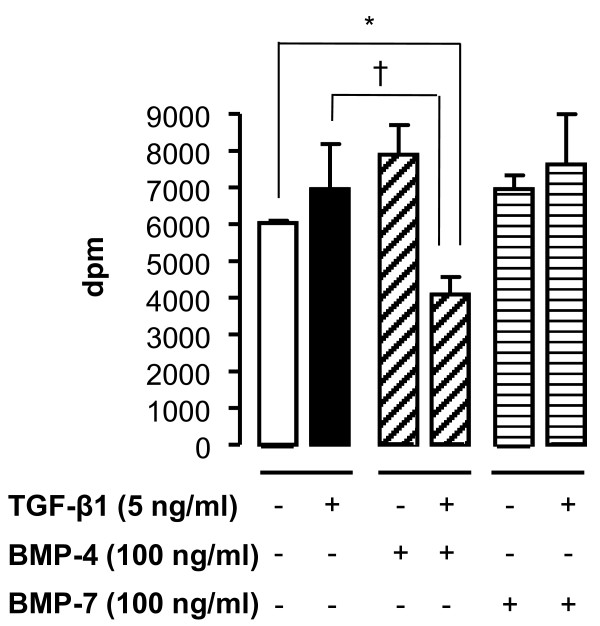
Cell cultures were exposed to TGF-beta1 alone or in the presence of BMP-4 or BMP-7; control cultures were exposed to medium only. Cell proliferation was assessed by quantification of the incorporation of [3H]-thymidine. The expression of the mRNA encoding collagen type I and IV, tenascin C and fibronectin in normal human lung fibroblasts (NHLF) was determined by real-time quantitative PCR and the main results were confirmed by ELISA. Cell differentiation was determined by the analysis of the expression of alpha-smooth muscle actin (alpha-SMA) by western blot and immunohistochemistry. The effect on matrix metalloproteinase (MMP) activity was assessed by zymography.
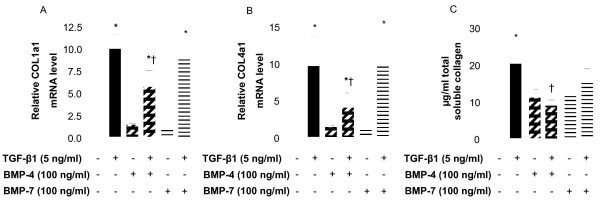
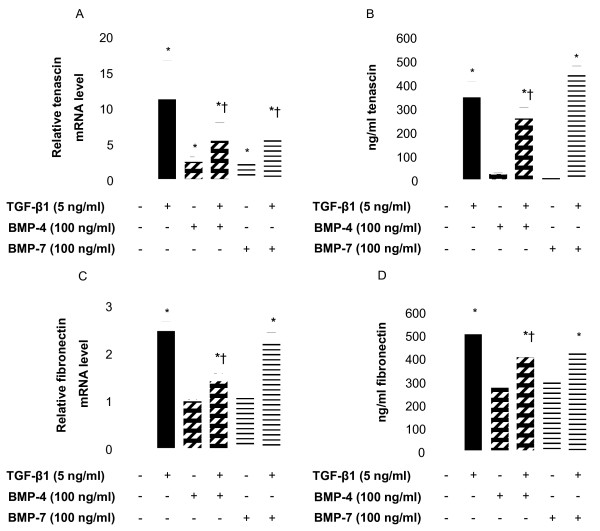
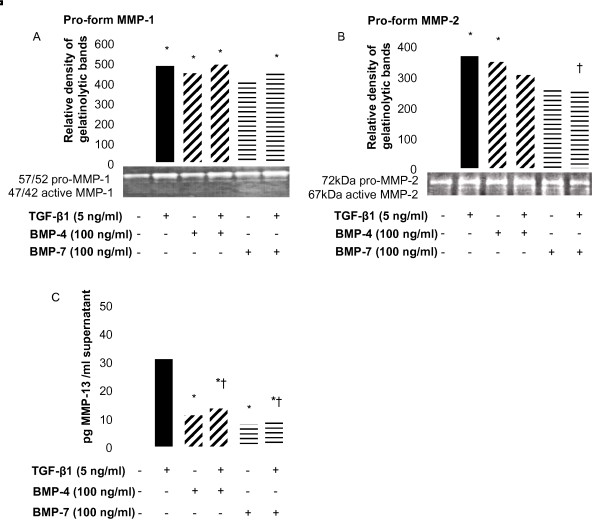
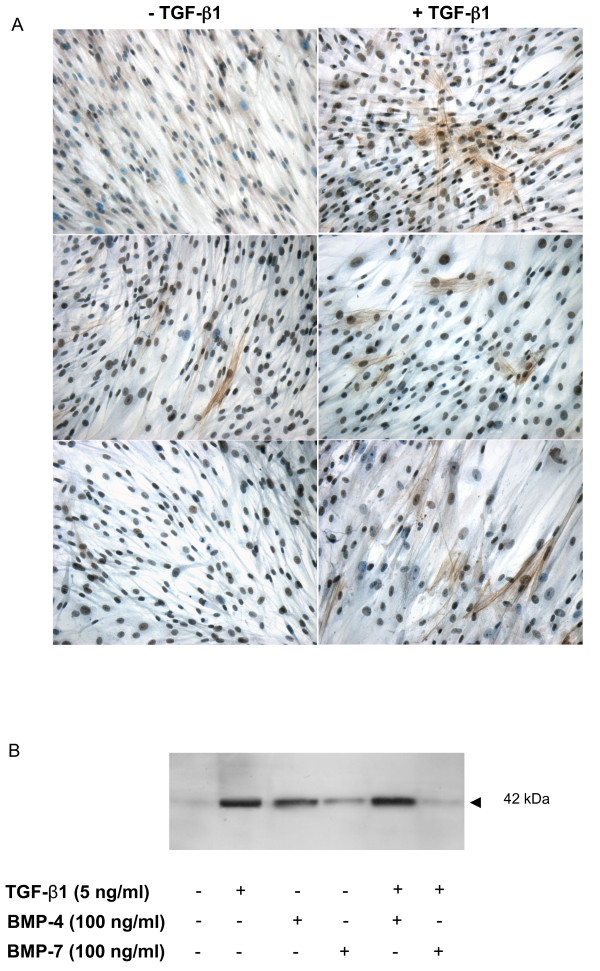
We have demonstrated TGF-beta1 induced upregulation of mRNAs encoding the extracellular matrix proteins, tenascin C, fibronectin and collagen type I and IV when compared to unstimulated NHLF, and confirmed these results at the protein level. BMP-4, but not BMP-7, reduced TGF-beta1-induced extracellular matrix protein production. TGF-beta1 induced an increase in the activity of the pro-form of MMP-2 which was inhibited by BMP-7 but not BMP-4. Both BMP-4 and BMP-7 downregulated TGF-beta1-induced MMP-13 release compared to untreated and TGF-beta1-treated cells. TGF-beta1 also induced a myofibroblast-like transformation which was partially inhibited by BMP-7 but not BMP-4.
Our study suggests that some regulatory properties of BMP-7 may be tissue or cell type specific and unveil a potential regulatory role for BMP-4 in the regulation of lung fibroblast function.
气道重塑被认为是受转化生长因子(TGF)超家族的一组复杂分子控制的。骨形态发生蛋白(BMPs)属于这个家族,已经被证明可以调节肾脏和肝脏疾病中的纤维化。然而,BMPs 在肺部重塑中的作用尚不清楚。BMPs 可能通过控制肺成纤维细胞中 TGF-β诱导的致纤维化功能来调节哮喘中的组织重塑。
将细胞培养物暴露于 TGF-β1 中,或在 BMP-4 或 BMP-7 的存在下暴露;对照培养物仅暴露于培养基中。通过定量掺入 [3H]-胸苷来评估细胞增殖。通过实时定量 PCR 确定正常肺成纤维细胞 (NHLF) 中编码 I 型和 IV 型胶原、腱糖蛋白 C 和纤维连接蛋白的 mRNA 的表达,并通过 ELISA 确认主要结果。通过 Western blot 和免疫组织化学分析α-平滑肌肌动蛋白 (α-SMA) 的表达来确定细胞分化。通过明胶酶谱法评估基质金属蛋白酶 (MMP) 活性的影响。
我们已经证明,与未刺激的 NHLF 相比,TGF-β1 诱导编码细胞外基质蛋白、腱糖蛋白 C、纤维连接蛋白和 I 型和 IV 型胶原的 mRNAs 的上调,并在蛋白质水平上证实了这些结果。BMP-4 但不是 BMP-7 减少了 TGF-β1 诱导的细胞外基质蛋白产生。TGF-β1 诱导前体形式的 MMP-2 活性增加,BMP-7 但不是 BMP-4 抑制了这种增加。与未处理和 TGF-β1 处理的细胞相比,BMP-4 和 BMP-7 均下调 TGF-β1 诱导的 MMP-13 释放。TGF-β1 还诱导肌成纤维细胞样转化,BMP-7 但不是 BMP-4 部分抑制了这种转化。
我们的研究表明,BMP-7 的一些调节特性可能是组织或细胞类型特异性的,并揭示了 BMP-4 在调节肺成纤维细胞功能中的潜在调节作用。