Namdar Thomas, Siemers Frank, Stollwerck Peter L, Stang Felix H, Mailänder Peter, Lange Thomas
Department of Plastic and Hand Surgery, Burn Unit, University Hospital Schleswig-Holstein, Campus Lübeck, 23538 Lübeck, Germany.
Ger Med Sci. 2010 Jun 7;8:Doc11. doi: 10.3205/000100.
In-hospital hypernatremia develops usually iatrogenically from inadequate or inappropriate fluid prescription. In severely burned patient an extensive initial fluid resuscitation is necessary for burn shock survival. After recovering of cellular integrity the circulating volume has to be normalized. Hereby extensive water and electrolyte shifts can provoke hypernatremia.
Is a hypernatremic state associated with increased mortality?
Retrospective study for the incidence of hypernatremia and survival in 40 patients with a totally burned surface area (TBSA) >10%. Age, sex, TBSA, ABSI-Score and fluid resuscitation within the first 24 hours were analyzed. Patients were separated in two groups without (Group A) or with (Group B) hypernatremia.
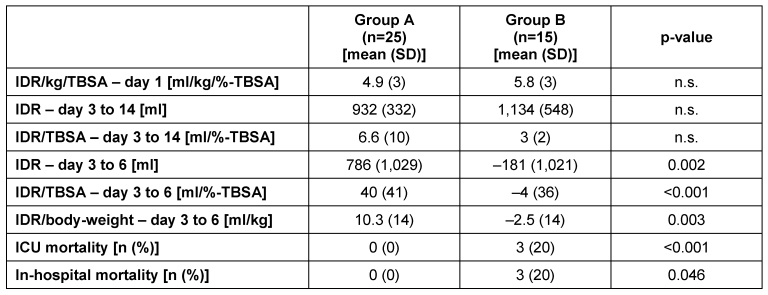
Hypernatremia occurred on day 5+/-1.4. No significant difference for age, sex, TBSA, ABSI-Score and fluid resuscitation within the first 24 hours were calculated. In Group A all patients survived, while 3 of the hypernatremic patient in Group B died during ICU-stay (Odds-ratio = 1.25; 95% CI 0.971-1.61; p=0.046).
Burned patients with an in-hospital acquired hypernatremia have an increased mortality risk. In case of a hypernatremic state early intervention is obligatory. There is a need of a fluid removal strategy in severely burned patient to avoid water imbalance.
医院内高钠血症通常是医源性的,由液体处方不足或不当引起。对于严重烧伤患者,进行广泛的初始液体复苏对于烧伤休克的存活至关重要。在细胞完整性恢复后,循环血量必须恢复正常。在此过程中,广泛的水和电解质转移可引发高钠血症。
高钠血症状态是否与死亡率增加相关?
对40例烧伤总面积(TBSA)>10%的患者进行高钠血症发生率和生存率的回顾性研究。分析患者的年龄、性别、TBSA、ABSI评分以及最初24小时内的液体复苏情况。将患者分为两组,无高钠血症组(A组)和有高钠血症组(B组)。
高钠血症发生在第5天±1.4天。计算得出年龄、性别、TBSA、ABSI评分以及最初24小时内的液体复苏情况无显著差异。A组所有患者均存活,而B组高钠血症患者中有3例在重症监护病房住院期间死亡(优势比=1.25;95%可信区间0.971-1.61;p=0.046)。
医院获得性高钠血症的烧伤患者死亡风险增加。一旦出现高钠血症状态,必须尽早干预。对于严重烧伤患者,需要一种液体清除策略以避免水失衡。