Department of Genetic Medicine, Weill Cornell Medical College, New York, NY 10065, USA.
Gene Ther. 2010 Aug;17(8):1042-51. doi: 10.1038/gt.2010.87. Epub 2010 Jul 1.
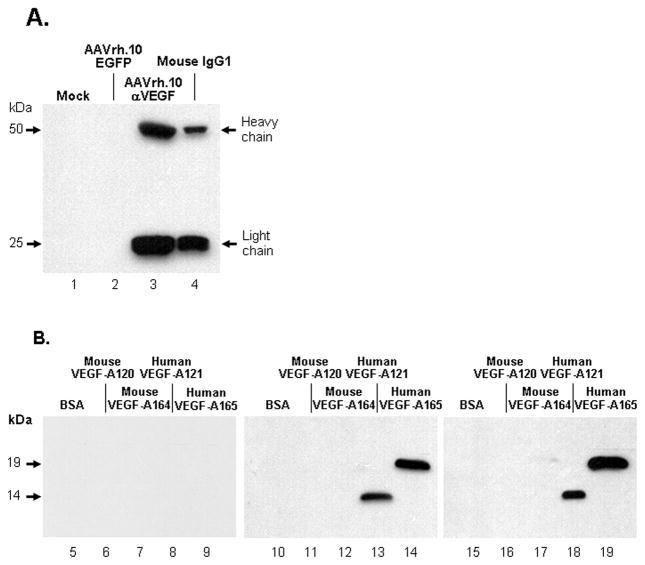
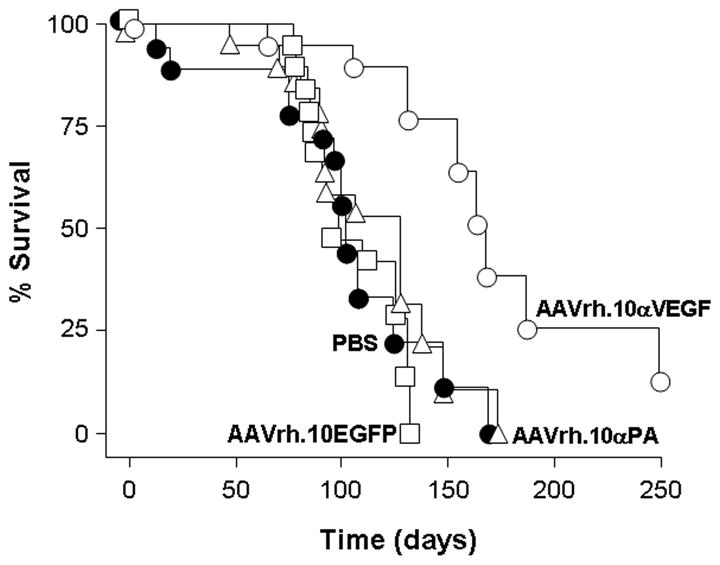
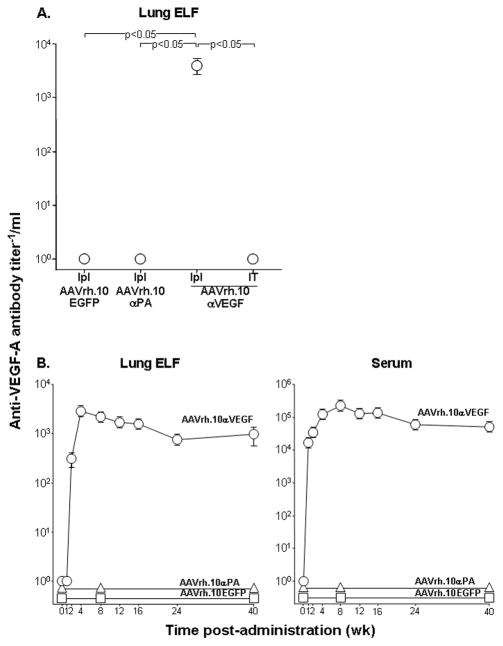
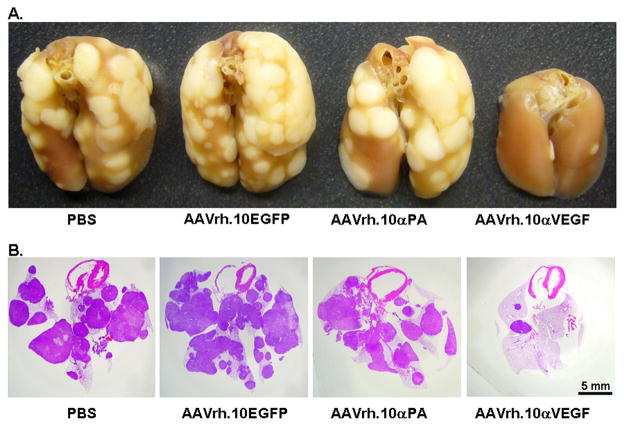
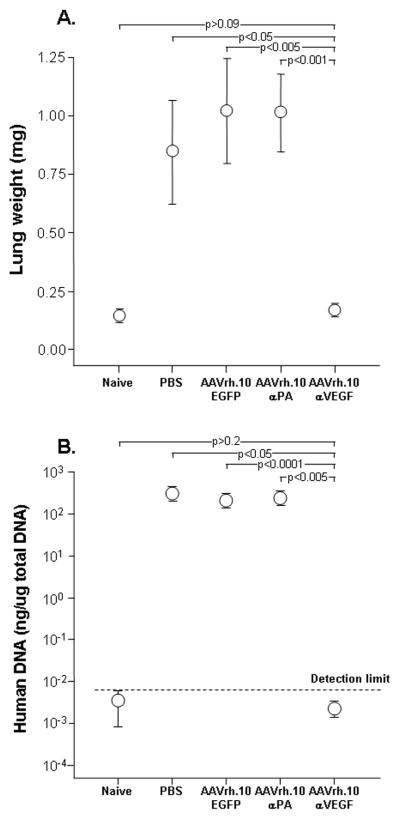
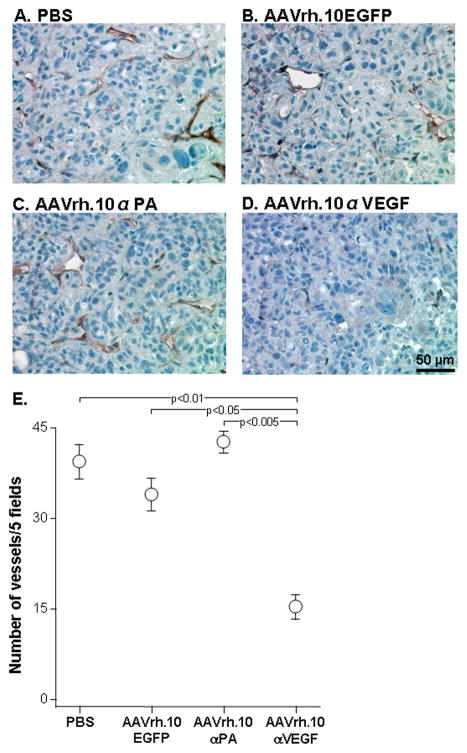
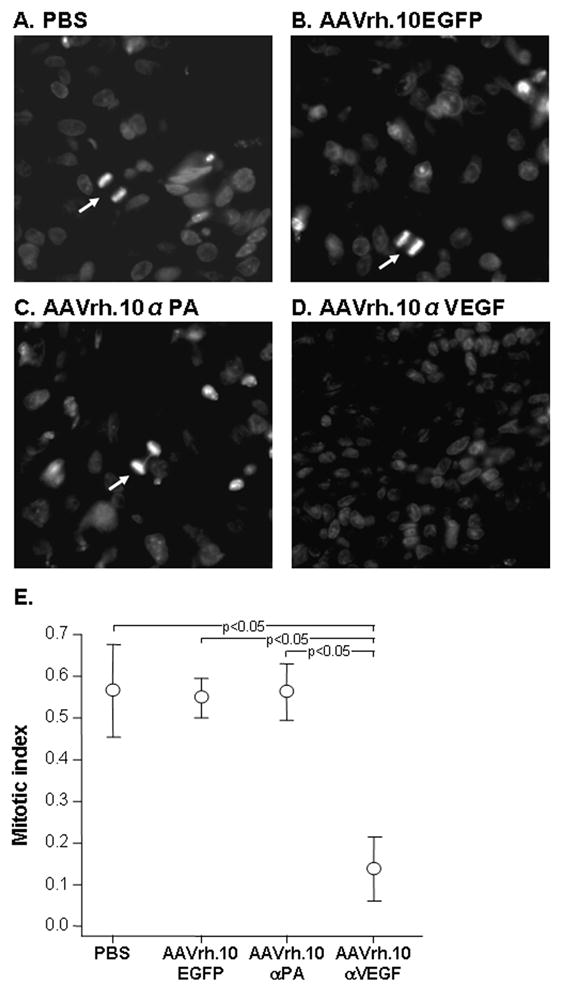
Vascular endothelial growth factor (VEGF) produced by tumor cells has a central role in stimulating angiogenesis required for tumor growth. Humanized monoclonal anti-VEGF antibody (bevacizumab, Avastin), approved as a treatment for non-squamous, non-small cell lung cancer, requires administration every 3 weeks. We hypothesized that an intrapleural administration of an adeno-associated virus (AAV) vector expressing an anti-VEGF-A antibody equivalent of bevacizumab would result in sustained anti-VEGF-A localized expression within the lung and suppress metastatic tumor growth. The AAV vector AAVrh.10alphaVEGF encodes the light chain and heavy chain complementary DNAs of monoclonal antibody A.4.6.1, a murine antibody that specifically recognizes human VEGF-A with the same antigen-binding site as bevacizumab. A metastatic lung tumor model was established in severe combined immunodeficient mice by intravenous administration of human DU145 prostate carcinoma cells. Intrapleural administration of AAVrh.10alphaVEGF directed long-term expression of the anti-human VEGF-A antibody in lung, as shown by sustained, high-level anti-human VEGF titers in lung epithelial lining fluid for 40 weeks, which was the duration of the study. In the AAVrh.10alphaVEGF-treated animals, tumor growth was significantly suppressed (P<0.05), the numbers of blood vessels and mitotic nuclei in the tumor was decreased (P<0.05) and there was increased survival (P<0.05). Thus, intrapleural administration of an AAVrh.10 vector, encoding the murine monoclonal antibody equivalent of bevacizumab, effectively suppresses the growth of metastatic lung tumors, suggesting AAV-mediated gene transfer to the pleura to deliver bevacizumab locally to the lung as a novel alternative platform to conventional monoclonal antibody therapy.
血管内皮生长因子(VEGF)由肿瘤细胞产生,在刺激肿瘤生长所需的血管生成中起核心作用。人源化单克隆抗 VEGF 抗体(贝伐单抗,阿瓦斯汀)被批准用于治疗非鳞状非小细胞肺癌,每 3 周给药一次。我们假设,向胸膜内给予表达与贝伐单抗等效的抗 VEGF-A 抗体的腺相关病毒(AAV)载体,将导致抗 VEGF-A 在肺内的局部表达持续,并抑制转移性肿瘤生长。AAV 载体 AAVrh.10alphaVEGF 编码单克隆抗体 A.4.6.1 的轻链和重链 cDNA,A.4.6.1 是一种特异性识别人 VEGF-A 的鼠单克隆抗体,与贝伐单抗具有相同的抗原结合位点。通过静脉内给予人 DU145 前列腺癌细胞,在严重联合免疫缺陷小鼠中建立了转移性肺肿瘤模型。AAVrh.10alphaVEGF 的胸膜内给予导致抗人 VEGF-A 抗体在肺内的长期表达,如肺上皮衬液中持续高水平的抗人 VEGF 滴度所示,这是研究的持续时间。在 AAVrh.10alphaVEGF 治疗的动物中,肿瘤生长受到显著抑制(P<0.05),肿瘤中的血管和有丝分裂核的数量减少(P<0.05),且生存率提高(P<0.05)。因此,向胸膜内给予编码贝伐单抗等效的鼠单克隆抗体的 AAVrh.10 载体可有效抑制转移性肺肿瘤的生长,表明 AAV 介导的基因转移到胸膜以将贝伐单抗局部递送至肺作为传统单克隆抗体治疗的新型替代平台。