Climate and Human Health Research Unit, Centre for Global Health Research, Kenya Medical Research Institute (KEMRI), P. O. Box 1578-40100, Kisumu, Kenya.
Ecohealth. 2010 Dec;7(4):485-97. doi: 10.1007/s10393-010-0321-2. Epub 2010 Jul 3.
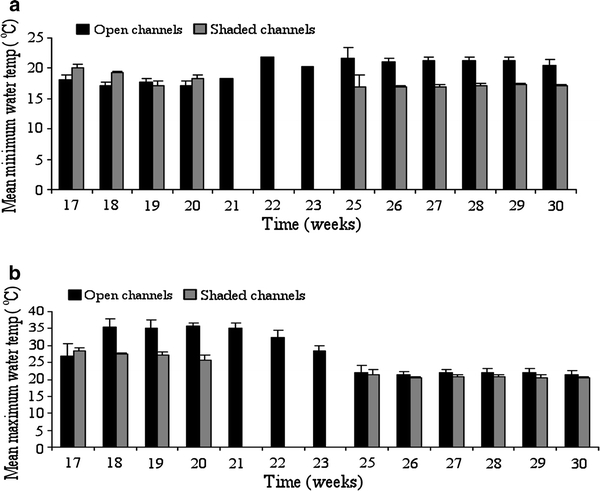
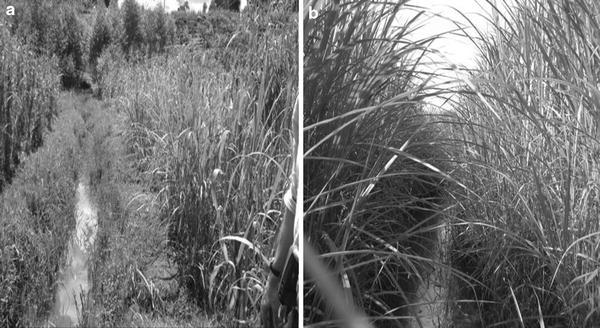
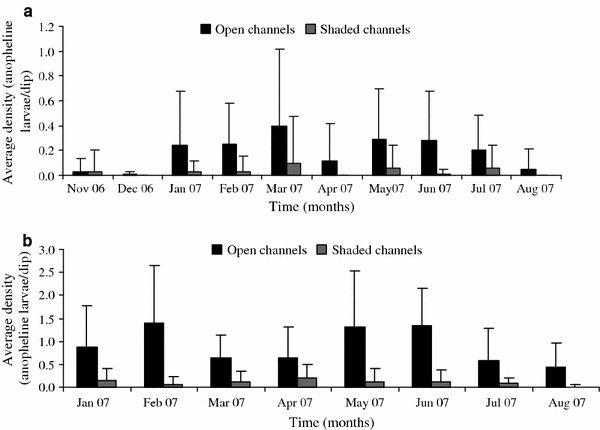
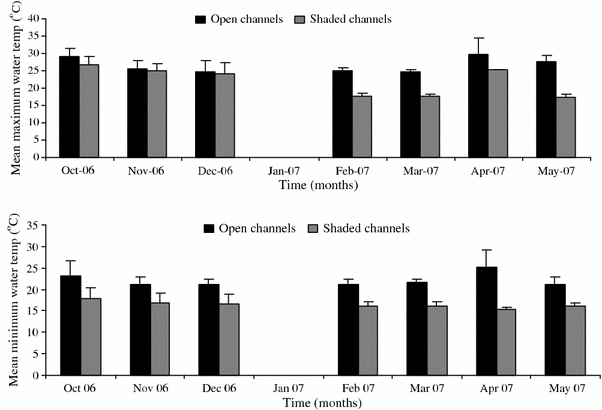
Increased human population in the Western Kenya highlands has led to reclamation of natural swamps resulting in the creation of habitats suitable for the breeding of Anopheles gambiae, the major malaria vector in the region. Here we report on a study to restore the reclaimed swamp and reverse its suitability as a habitat for malaria vectors. Napier grass-shaded and non-shaded water channels in reclaimed sites in Western Kenya highlands were studied for the presence and density of mosquito larvae, mosquito species composition, and daily variation in water temperature. Shading was associated with 75.5% and 88.4% (P < 0.0001) reduction in anopheline larvae densities and 78.1% and 88% (P < 0.0001) reduction in Anopheles gambiae sensu lato (s.l.) densities in two sites, respectively. Shading was associated with a 5.7°C, 5.0°C, and 4.7°C, and 1.6°C, 3.9°C, and 2.8°C (for maximum, minimum, and average temperatures, respectively) reduction (P < 0.0001) in water temperatures in the two locations, respectively. An. gambiae s.l. was the dominant species, constituting 83.2% and 73.1%, and 44.5% and 42.3%, of anophelines in non-shaded and shaded channels, respectively, in the two sites, respectively. An. gambiae sensu stricto (s.s.) constituted the majority (97.4%) of An. gambiae s.l., while the rest (2.6%) comprised of Anopheles arabiensis. Minimum water temperature decreased with increasing grass height (P = 0.0039 and P = 0.0415 for Lunyerere and Emutete sites, respectively). The results demonstrate how simple environmental strategies can have a strong impact on vector densities.
在肯尼亚高原西部,人口增长导致了天然沼泽的开垦,从而创造了适合冈比亚按蚊滋生的栖息地,而冈比亚按蚊是该地区主要的疟疾传播媒介。在这里,我们报告了一项研究,旨在恢复开垦的沼泽地,并扭转其作为疟疾传播媒介栖息地的适宜性。在肯尼亚高原西部开垦的地点,研究了 Napier 草遮荫和非遮荫的水道中蚊子幼虫的存在和密度、蚊子物种组成以及水温的日变化。在两个地点,遮荫分别与按蚊幼虫密度降低 75.5%和 88.4%(P<0.0001),冈比亚按蚊 s.l.密度降低 78.1%和 88%(P<0.0001)有关。遮荫与两个地点的水温分别降低 5.7°C、5.0°C 和 4.7°C,以及 1.6°C、3.9°C 和 2.8°C(分别为最高、最低和平均温度)有关(P<0.0001)。冈比亚按蚊 s.l.是优势种,在两个地点的非遮荫和遮荫水道中,分别占按蚊的 83.2%和 73.1%,以及 44.5%和 42.3%。冈比亚按蚊 s.s.构成冈比亚按蚊 s.l.的大部分(97.4%),而其余(2.6%)由阿拉伯按蚊组成。最小水温随草高的增加而降低(Lunyerere 和 Emutete 站点分别为 P=0.0039 和 P=0.0415)。结果表明,简单的环境策略如何对媒介密度产生强烈影响。