Department of Civil Engineering, National Cheng Kung University, Tainan, Taiwan.
BMC Musculoskelet Disord. 2010 Jul 5;11:151. doi: 10.1186/1471-2474-11-151.
Finite element analysis results will show significant differences if the model used is performed under various material properties, geometries, loading modes or other conditions. This study adopted an FE model, taking into account the possible asymmetry inherently existing in the spine with respect to the sagittal plane, with a more geometrically realistic outline to analyze and compare the biomechanical behaviour of the lumbar spine with regard to the facet force and intradiscal pressure, which are associated with low back pain symptoms and other spinal disorders. Dealing carefully with the contact surfaces of the facet joints at various levels of the lumbar spine can potentially help us further ascertain physiological behaviour concerning the frictional effects of facet joints under separate loadings or the responses to the compressive loads in the discs.
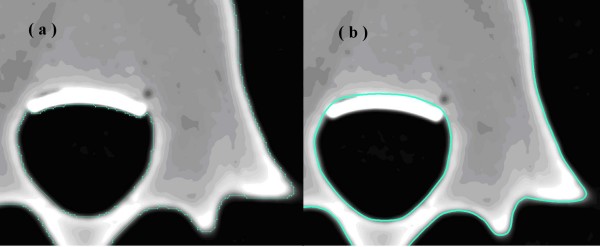
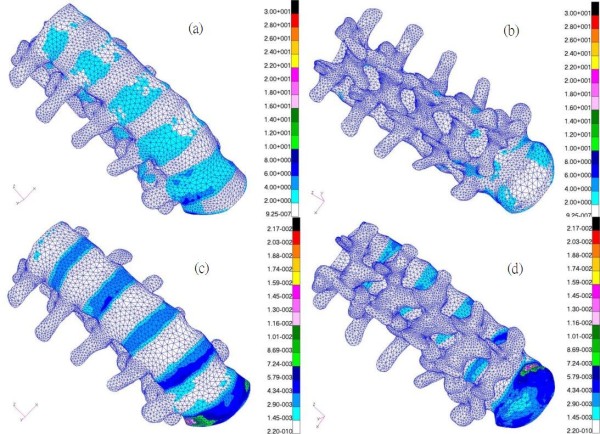
A lumbar spine model was constructed from processes including smoothing the bony outline of each scan image, stacking the boundary lines into a smooth surface model, and subsequent further processing in order to conform with the purpose of effective finite element analysis performance. For simplicity, most spinal components were modelled as isotropic and linear materials with the exception of spinal ligaments (bilinear). The contact behaviour of the facet joints and changes of the intradiscal pressure with different postures were analyzed.
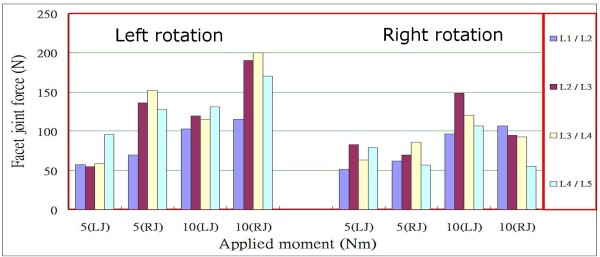
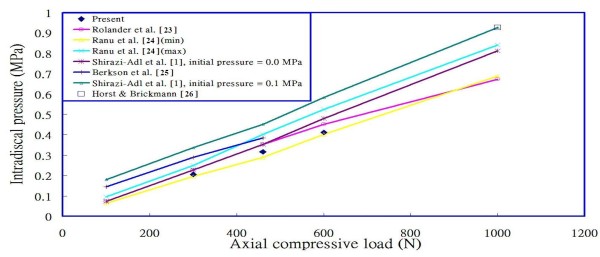
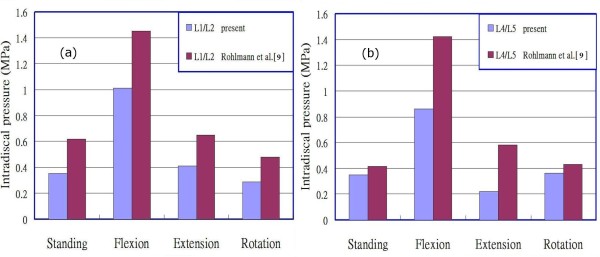
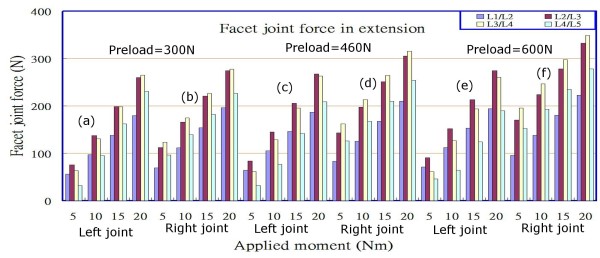
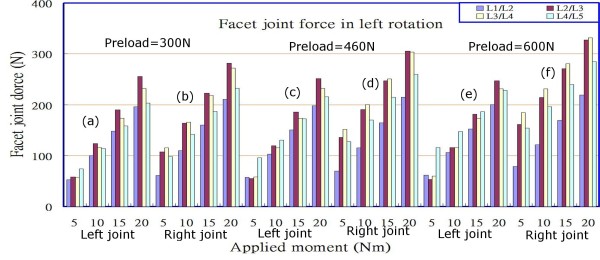
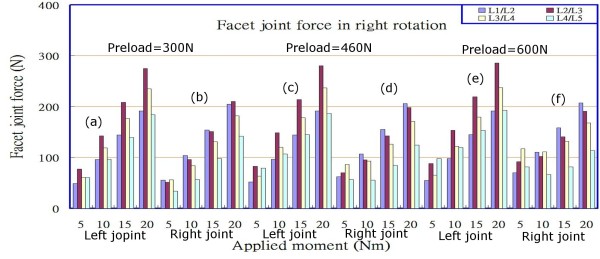
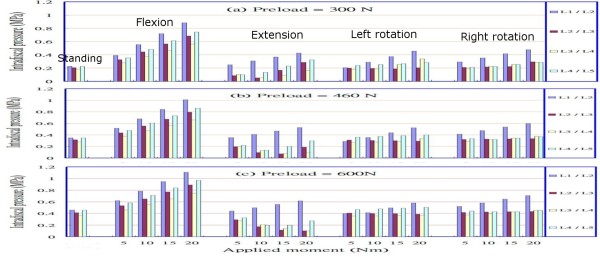
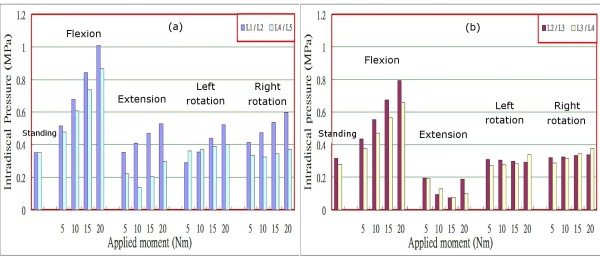
The results revealed that asymmetric responses of the facet joint forces exist in various postures and that such effect is amplified with larger loadings. In axial rotation, the facet joint forces were relatively larger in the contralateral facet joints than in the ipsilateral ones at the same level. Although the effect of the preloads on facet joint forces was not apparent, intradiscal pressure did increase with preload, and its magnitude increased more markedly in flexion than in extension and axial rotation.
Disc pressures showed a significant increase with preload and changed more noticeably in flexion than in extension or in axial rotation. Compared with the applied preloads, the postures played a more important role, especially in axial rotation; the facet joint forces were increased in the contralateral facet joints as compared to the ipsilateral ones at the same level of the lumbar spine.
如果模型使用的是不同的材料特性、几何形状、加载模式或其他条件,有限元分析结果会显示出显著的差异。本研究采用了一个有限元模型,考虑到脊柱相对于矢状面可能存在的固有不对称性,采用更符合几何实际的轮廓来分析和比较腰椎的生物力学行为,包括与腰痛症状和其他脊柱疾病相关的小关节力和椎间盘内压力。仔细处理腰椎各节段小关节的接触面,有助于进一步确定小关节在单独加载下的摩擦效应或对椎间盘压缩载荷的响应的生理行为。
构建了一个腰椎模型,包括对每个扫描图像的骨轮廓进行平滑处理、将边界线堆叠成光滑的表面模型,以及后续进行进一步处理,以符合有效有限元分析性能的目的。为简单起见,大多数脊柱组件被建模为各向同性和线性材料,除了脊柱韧带(双线性)。分析了小关节的接触行为和不同姿势下椎间盘内压力的变化。
结果表明,在各种姿势下,小关节力存在不对称反应,而且这种效应随着载荷的增大而放大。在轴向旋转中,同一水平的对侧小关节的小关节力比同侧小关节的小关节力相对较大。虽然预加载对小关节力的影响不明显,但椎间盘内压力随着预加载的增加而增加,在屈曲时比在伸展和轴向旋转时增加得更明显。
椎间盘压力随着预加载的增加而显著增加,在屈曲时比在伸展和轴向旋转时变化更为明显。与施加的预加载相比,姿势起着更重要的作用,尤其是在轴向旋转中;与同侧小关节相比,同一水平的对侧小关节的小关节力增加。