Storkel Holly L, Hoover Jill R
University of Kansas.
J Child Lang. 2011 Jun;38(3):628-43. doi: 10.1017/S0305000910000176. Epub 2010 Jul 8.
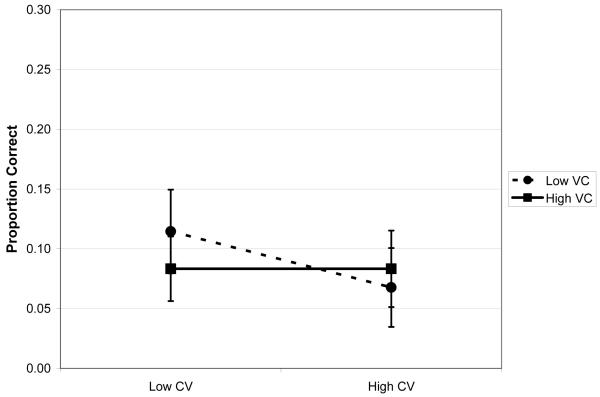
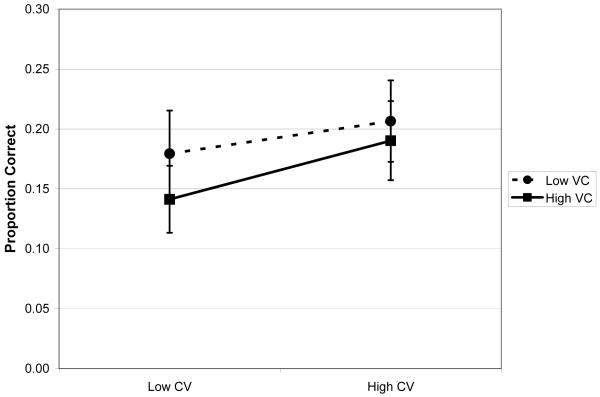
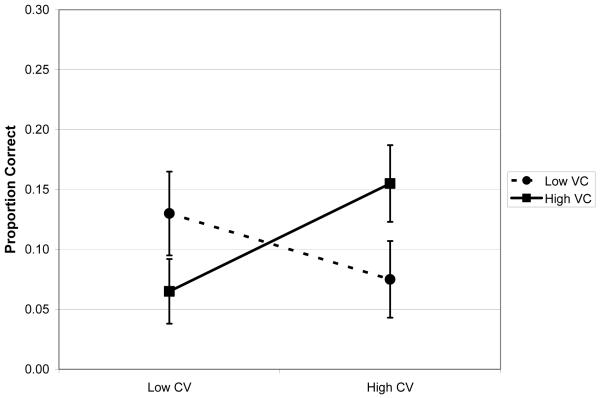
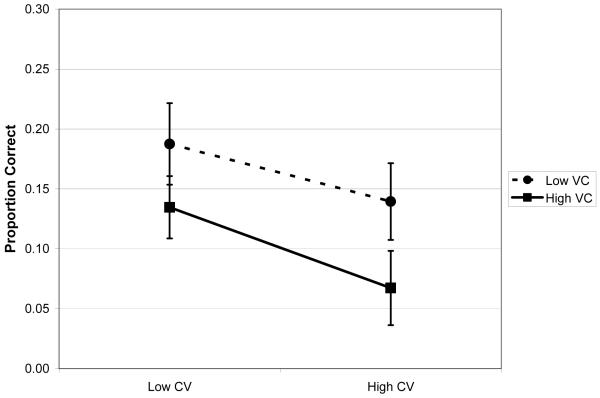
The goal of this study was to examine the influence of part-word phonotactic probability/neighborhood density on word learning by preschool children with normal vocabularies that varied in size. Ninety-eight children (age 2 ; 11-6 ; 0) were taught consonant-vowel-consonant (CVC) nonwords orthogonally varying in the probability/density of the CV (i.e. body) and VC (i.e. rhyme). Learning was measured via picture naming. Children with the lowest expressive vocabulary scores showed no effect of either CV or VC probability/density, although floor effects could not be ruled out. In contrast, children with low or high expressive vocabulary scores demonstrated sensitivity to part-word probability/density with the nature of the effect varying by group. Children with the highest expressive vocabulary scores displayed yet a third pattern of part-word probability/density effects. Taken together, word learning by preschool children was influenced by part-word probability/density but the nature of this influence appeared to depend on the size of the lexicon.
本研究的目的是考察部分单词的音位组构概率/邻域密度对词汇量大小不同但正常的学龄前儿童单词学习的影响。98名儿童(年龄在2;11至6;0之间)被教授了在CV(即主体)和VC(即韵脚)的概率/密度上呈正交变化的辅音-元音-辅音(CVC)非单词。通过图片命名来衡量学习情况。表达性词汇得分最低的儿童未表现出CV或VC概率/密度的影响,尽管不能排除地板效应。相比之下,表达性词汇得分低或高的儿童表现出对部分单词概率/密度的敏感性,且效应的性质因组而异。表达性词汇得分最高的儿童呈现出第三种部分单词概率/密度效应模式。总体而言,学龄前儿童的单词学习受到部分单词概率/密度的影响,但这种影响的性质似乎取决于词汇量的大小。