Storkel Holly L, Hoover Jill R
Department of Speech-Language-Hearing: Sciences and Disorders, University of Kansas, 3001 Dole Human Development Center, 1000 Sunnyside Avenue, Lawrence, KS 66045-7555, United States.
J Commun Disord. 2010 Mar-Apr;43(2):105-19. doi: 10.1016/j.jcomdis.2009.11.001. Epub 2009 Nov 18.
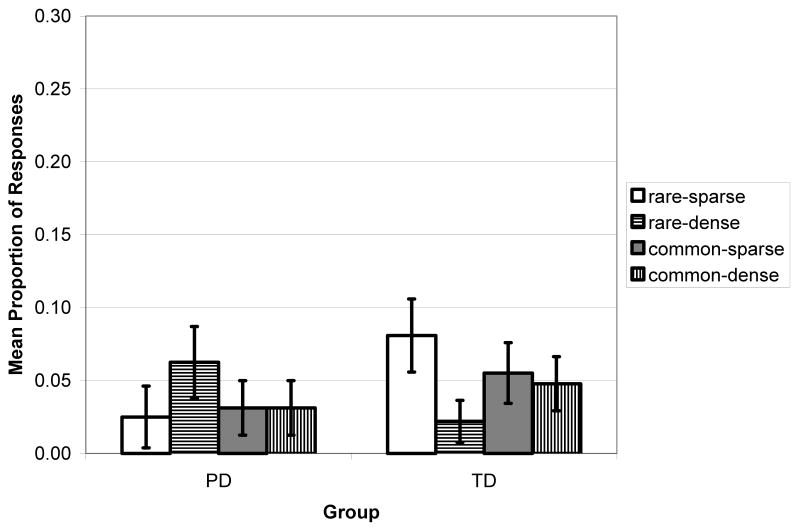
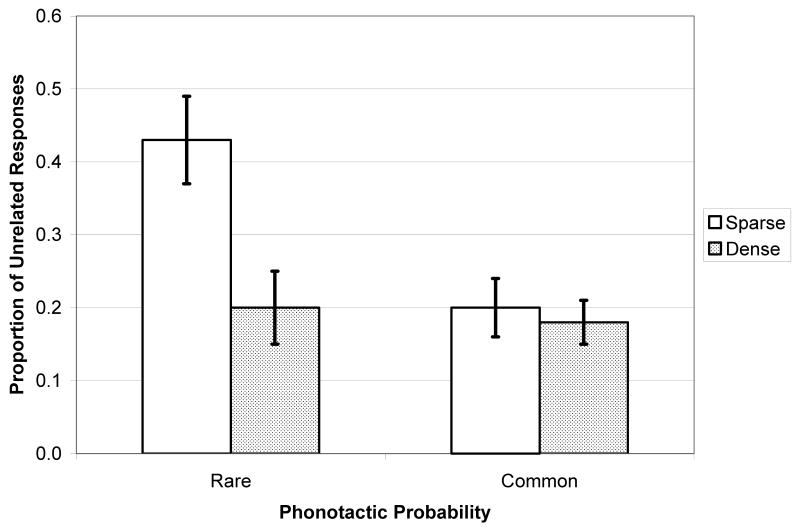
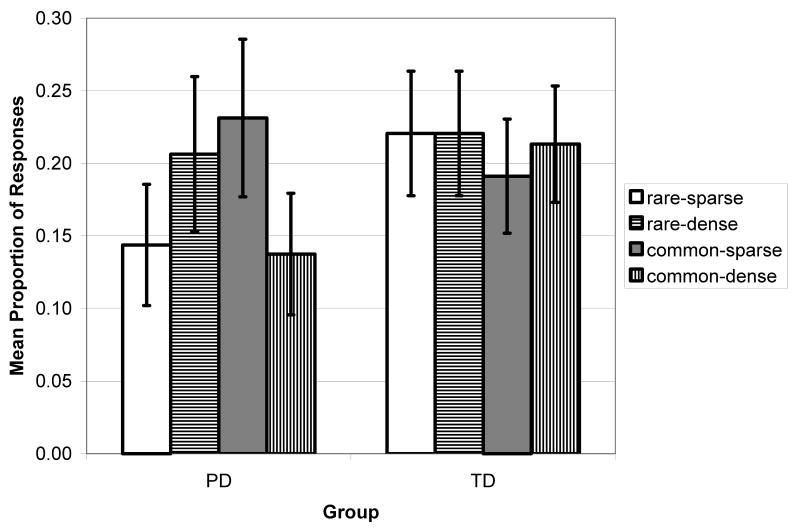
This study examined the ability of 20 preschool children with functional phonological delays and 34 age- and vocabulary-matched typical children to learn words differing in phonotactic probability (i.e., the likelihood of occurrence of a sound sequence) and neighborhood density (i.e., the number of words that differ from a target by one phoneme). Children were exposed to nonwords paired with novel objects in a story and learning was measured by a picture naming task. Results showed that both groups created lexical representations for rare sound sequences from sparse neighborhoods. However, only children with typical development appeared to build on this initial lexical representation to create a full representation of the word (i.e., lexical-semantic connection and semantic representation). It was hypothesized that creating a lexical representation may be too resource demanding for children with phonological delays, leaving few resources available to create a lexical-semantic connection and/or a semantic representation.
The reader will be able to (1) define phonotactic probability; (2) define neighborhood density; (3) identify how these variables impact the word learning process in general; (4) identify potential areas of deficit in the word learning process for children with functional phonological delays.
本研究考察了20名有功能性语音延迟的学龄前儿童以及34名年龄和词汇量匹配的发育正常儿童学习在音位组合概率(即声音序列出现的可能性)和邻域密度(即与目标词相差一个音素的单词数量)方面存在差异的单词的能力。儿童在一个故事中接触与新物体配对的非单词,并通过图片命名任务来衡量学习情况。结果表明,两组儿童都为来自稀疏邻域的罕见声音序列创建了词汇表征。然而,只有发育正常的儿童似乎在这个初始词汇表征的基础上进一步构建,以创建单词的完整表征(即词汇 - 语义联系和语义表征)。据推测,对于有语音延迟的儿童来说,创建词汇表征可能对资源要求过高,从而几乎没有资源可用于创建词汇 - 语义联系和/或语义表征。
读者将能够(1)定义音位组合概率;(2)定义邻域密度;(3)确定这些变量一般如何影响单词学习过程;(4)确定有功能性语音延迟的儿童在单词学习过程中潜在的缺陷领域。