Department of Ultrastructural Research, National Institute of Neuroscience, National Center of Neurology and Psychiatry, Ogawahigashi-cho 4-1-1, Kodaira, Tokyo 187-8502, Japan.
BMC Bioinformatics. 2010 Jul 8;11:373. doi: 10.1186/1471-2105-11-373.
A reliable extraction technique for resolving multiple spots in light or electron microscopic images is essential in investigations of the spatial distribution and dynamics of specific proteins inside cells and tissues. Currently, automatic spot extraction and characterization in complex microscopic images poses many challenges to conventional image processing methods.
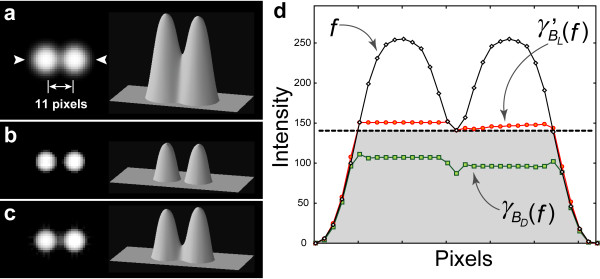
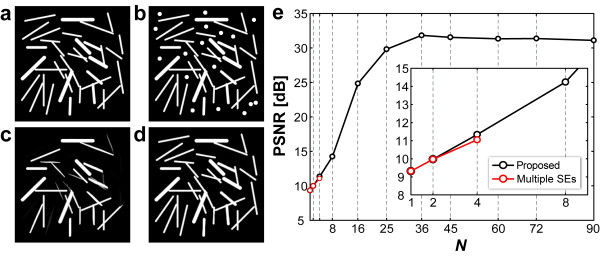
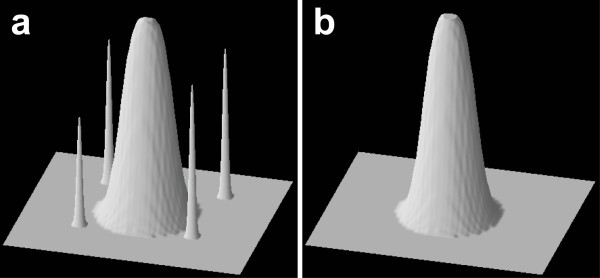
A new method to extract closely located, small target spots from biological images is proposed. This method starts with a simple but practical operation based on the extended morphological top-hat transformation to subtract an uneven background. The core of our novel approach is the following: first, the original image is rotated in an arbitrary direction and each rotated image is opened with a single straight line-segment structuring element. Second, the opened images are unified and then subtracted from the original image. To evaluate these procedures, model images of simulated spots with closely located targets were created and the efficacy of our method was compared to that of conventional morphological filtering methods. The results showed the better performance of our method. The spots of real microscope images can be quantified to confirm that the method is applicable in a given practice.
Our method achieved effective spot extraction under various image conditions, including aggregated target spots, poor signal-to-noise ratio, and large variations in the background intensity. Furthermore, it has no restrictions with respect to the shape of the extracted spots. The features of our method allow its broad application in biological and biomedical image information analysis.
在研究细胞和组织内特定蛋白质的空间分布和动态时,需要一种可靠的提取技术来解析明场或电子显微镜图像中的多个斑点。目前,传统的图像处理方法在复杂显微镜图像中自动提取和特征提取斑点存在许多挑战。
提出了一种从生物图像中提取近距离、小目标斑点的新方法。该方法首先基于扩展的形态学顶帽变换进行简单但实用的操作,以减去不均匀的背景。我们新方法的核心如下:首先,将原始图像以任意方向旋转,然后用单个直线段结构元素对每个旋转图像进行打开操作。其次,将打开的图像统一并从原始图像中减去。为了评估这些过程,创建了具有近距离目标的模拟斑点的模型图像,并将我们的方法与传统的形态滤波方法的效果进行了比较。结果表明,我们的方法具有更好的性能。可以对真实显微镜图像的斑点进行量化,以确认该方法在给定实践中的适用性。
我们的方法在各种图像条件下都能有效地提取斑点,包括聚集的目标斑点、信噪比差和背景强度变化大的情况。此外,它对提取斑点的形状没有限制。我们的方法的特点使其在生物和生物医学图像信息分析中有广泛的应用。