Sun Gerald J, Chung Susana T L, Tjan Bosco S
Department of Biological Sciences, University of Southern California, Los Angeles, CA, USA.
J Vis. 2010 May 1;10(5):16. doi: 10.1167/10.5.16.
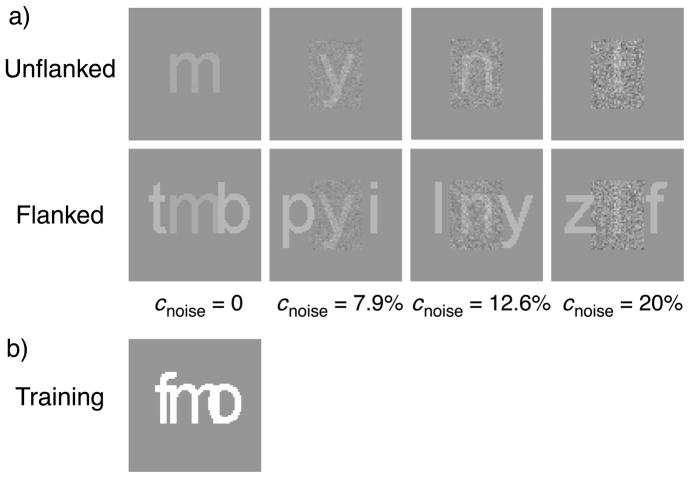
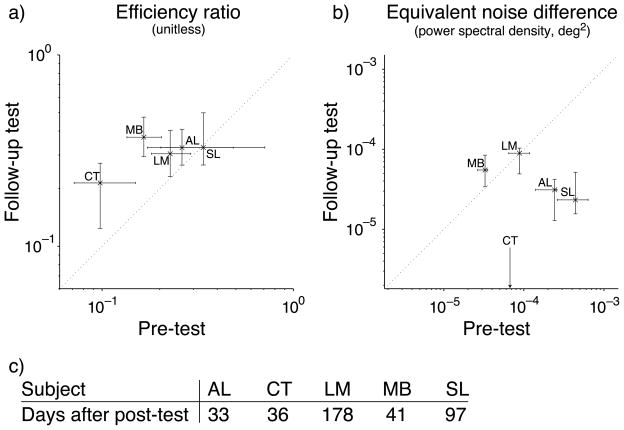
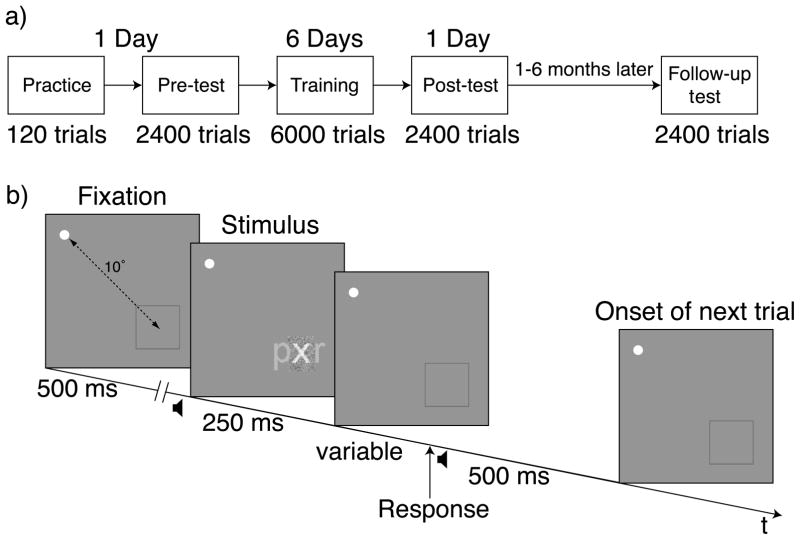
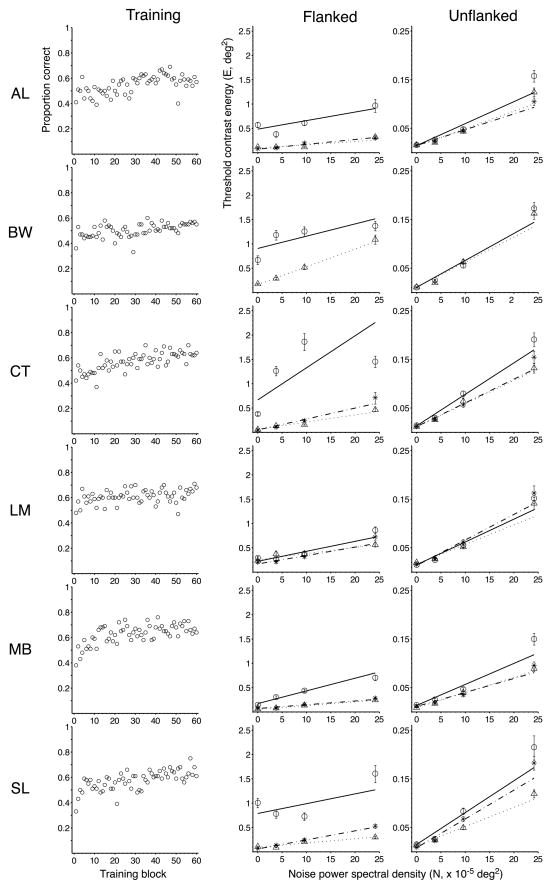
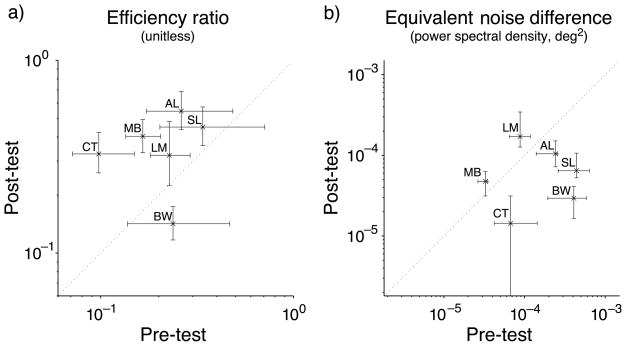
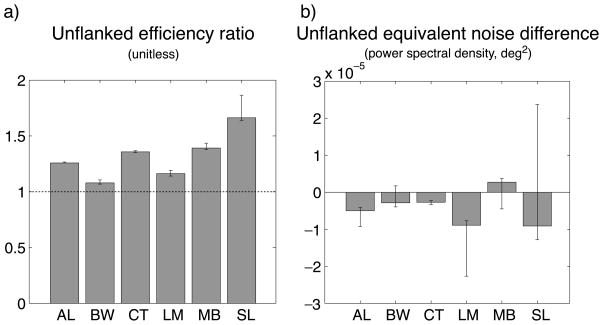
Crowding is a prominent phenomenon in peripheral vision where nearby objects impede one's ability to identify a target of interest. The precise mechanism of crowding is not known. We used ideal observer analysis and a noise-masking paradigm to identify the functional mechanism of crowding. We tested letter identification in the periphery with and without flanking letters and found that crowding increases equivalent input noise and decreases sampling efficiency. Crowding effectively causes the signal from the target to be noisier and at the same time reduces the visual system's ability to make use of a noisy signal. After practicing identification of flanked letters without noise in the periphery for 6 days, subjects' performance for identifying flanked letters improved (reduction of crowding). Across subjects, the improvement was attributable to either a decrease in crowding-induced equivalent input noise or an increase in sampling efficiency, but seldom both. This pattern of results is consistent with a simple model whereby learning reduces crowding by adjusting the spatial extent of a perceptual window used to gather relevant input features. Following learning, subjects with inappropriately large windows reduced their window sizes; while subjects with inappropriately small windows increased their window sizes. The improvement in equivalent input noise and sampling efficiency persists for at least 6 months.
拥挤效应是周边视觉中的一个显著现象,即附近的物体妨碍人们识别感兴趣目标的能力。目前尚不清楚拥挤效应的确切机制。我们使用理想观察者分析和噪声掩蔽范式来确定拥挤效应的功能机制。我们测试了有无侧翼字母时周边视野中字母的识别情况,发现拥挤效应会增加等效输入噪声并降低采样效率。拥挤效应有效地使目标信号变得更嘈杂,同时降低了视觉系统利用嘈杂信号的能力。在外周视野中对侧翼字母进行6天无噪声的识别练习后,受试者识别侧翼字母的表现有所改善(拥挤效应降低)。在所有受试者中,这种改善要么归因于拥挤效应引起的等效输入噪声的降低,要么归因于采样效率的提高,但很少是两者同时发生。这种结果模式与一个简单模型一致,即学习通过调整用于收集相关输入特征的感知窗口的空间范围来减少拥挤效应。学习后,窗口大小不合适的受试者会减小窗口大小;而窗口大小不合适的受试者会增大窗口大小。等效输入噪声和采样效率的改善至少持续6个月。