Centre for Computational Neuroscience and Robotics, University of Sussex, Falmer, Brighton, United Kingdom.
PLoS Comput Biol. 2010 Jul 1;6(7):e1000839. doi: 10.1371/journal.pcbi.1000839.
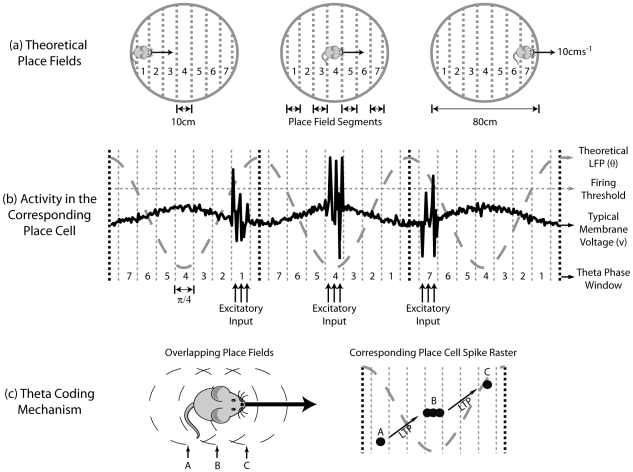
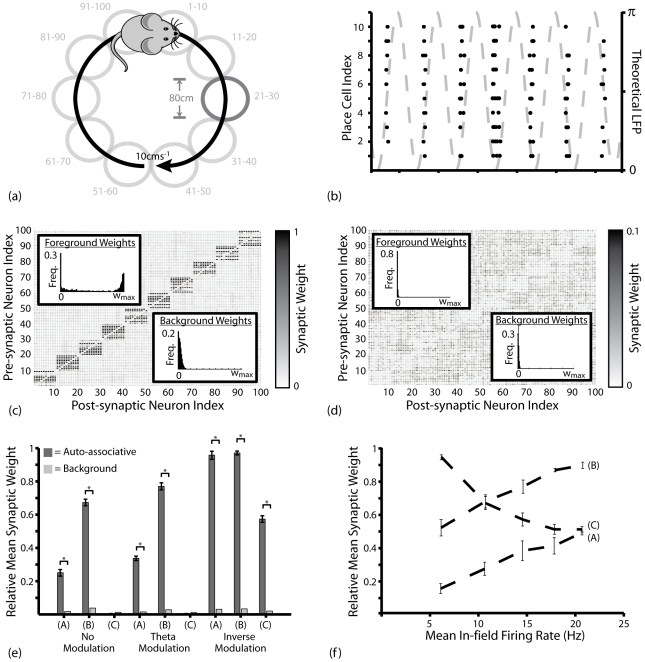
The firing rate of single neurons in the mammalian hippocampus has been demonstrated to encode for a range of spatial and non-spatial stimuli. It has also been demonstrated that phase of firing, with respect to the theta oscillation that dominates the hippocampal EEG during stereotype learning behaviour, correlates with an animal's spatial location. These findings have led to the hypothesis that the hippocampus operates using a dual (rate and temporal) coding system. To investigate the phenomenon of dual coding in the hippocampus, we examine a spiking recurrent network model with theta coded neural dynamics and an STDP rule that mediates rate-coded Hebbian learning when pre- and post-synaptic firing is stochastic. We demonstrate that this plasticity rule can generate both symmetric and asymmetric connections between neurons that fire at concurrent or successive theta phase, respectively, and subsequently produce both pattern completion and sequence prediction from partial cues. This unifies previously disparate auto- and hetero-associative network models of hippocampal function and provides them with a firmer basis in modern neurobiology. Furthermore, the encoding and reactivation of activity in mutually exciting Hebbian cell assemblies demonstrated here is believed to represent a fundamental mechanism of cognitive processing in the brain.
哺乳动物海马体中单神经元的发放频率已被证明可以对一系列空间和非空间刺激进行编码。此外,研究还表明,与刻板学习行为期间主导海马 EEG 的 theta 振荡相比,发放的相位与动物的空间位置相关。这些发现导致了这样的假设,即海马体使用双(率和时间)编码系统进行操作。为了研究海马体中的双编码现象,我们检查了一个具有 theta 编码神经动力学的尖峰递归网络模型,以及一个当突触前和突触后放电是随机时介导率编码海伯学习的 STDP 规则。我们证明,这种可塑性规则可以在分别在并发或连续 theta 相位下发射的神经元之间产生对称和非对称的连接,随后可以从部分线索中产生模式完成和序列预测。这统一了先前不同的海马体功能的自动和异联想网络模型,并为它们在现代神经生物学中提供了更坚实的基础。此外,这里演示的在相互兴奋的海伯细胞集合中活动的编码和重新激活被认为代表了大脑中认知处理的基本机制。