Department of Biochemistry and Molecular Biology, Rajshahi University, Rajshahi 6205, Bangladesh.
Environ Health. 2010 Jul 10;9:36. doi: 10.1186/1476-069X-9-36.
Arsenic is a potent pollutant that has caused an environmental catastrophe in certain parts of the world including Bangladesh where millions of people are presently at risk due to drinking water contaminated by arsenic. Chronic arsenic exposure has been scientifically shown as a cause for liver damage, cancers, neurological disorders and several other ailments. The relationship between plasma cholinesterase (PChE) activity and arsenic exposure has not yet been clearly documented. However, decreased PChE activity has been found in patients suffering liver dysfunction, heart attack, cancer metastasis and neurotoxicity. Therefore, in this study, we evaluated the PChE activity in individuals exposed to arsenic via drinking water in Bangladesh.
A total of 141 Bangladeshi residents living in arsenic endemic areas with the mean arsenic exposure of 14.10 +/- 3.27 years were selected as study subjects and split into tertile groups based on three water arsenic concentrations: low (< 129 microg/L), medium (130-264 microg/L) and high (> 265 microg/L). Study subjects were further sub-divided into two groups (<or=50 microg/L and > 50 microg/L) based on the recommended upper limit of water arsenic concentration (50 microg/L) in Bangladesh. Blood samples were collected from the study subjects by venipuncture and arsenic concentrations in drinking water, hair and nail samples were measured by Inductively Coupled Plasma Mass Spectroscopy (ICP-MS). PChE activity was assayed by spectrophotometer.
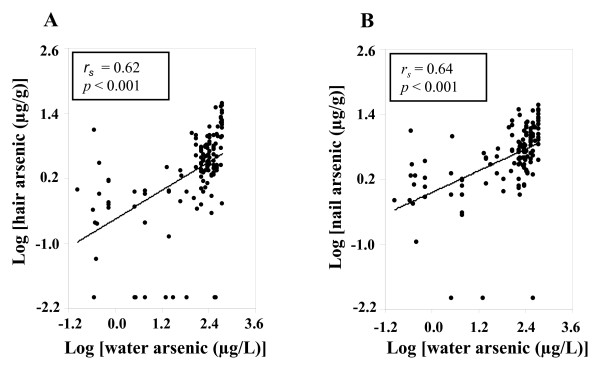
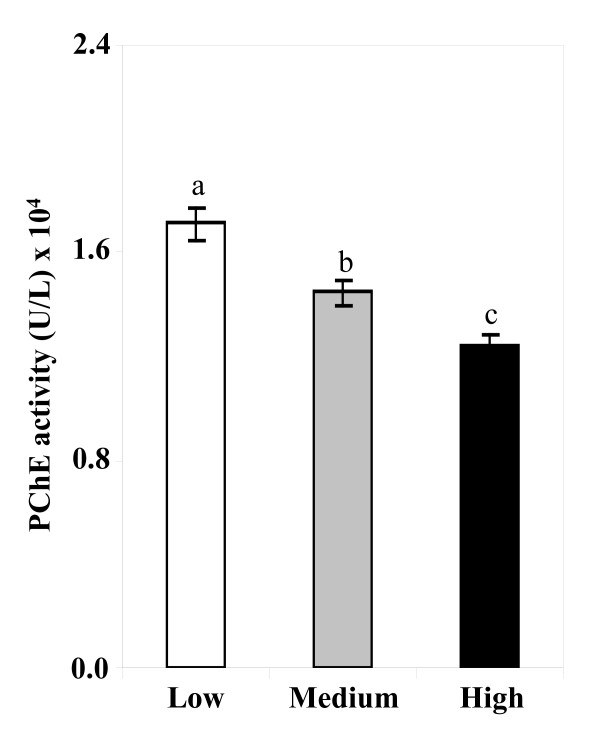
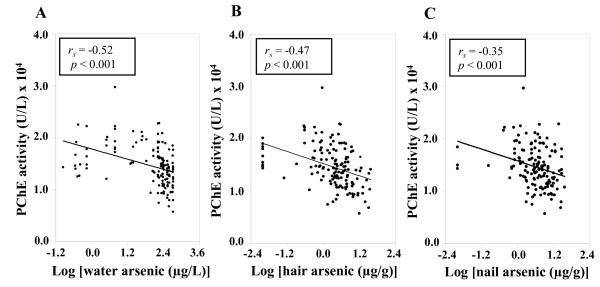
Arsenic concentrations in hair and nails were positively correlated with the arsenic levels in drinking water. Significant decreases in PChE activity were observed with increasing concentrations of arsenic in water, hair and nails. The average levels of PChE activity in low, medium and high arsenic exposure groups were also significantly different between each group. Lower levels of PChE activity were also observed in the > 50 microg/L group compared to the <or=50 microg/L group. Moreover, PChE activity was significantly decreased in the skin (+) symptoms group compared to those without (-).
We found a significant inverse relationship between arsenic exposure and PChE activity in a human population in Bangladesh. This research demonstrates a novel exposure-response relationship between arsenic and PChE activity which may explain one of the biological mechanisms through which arsenic exerts its neuro-and hepatotoxicity in humans.
砷是一种强效污染物,在世界某些地区造成了环境灾难,包括孟加拉国,目前有数百万人因饮用水受到砷污染而面临风险。慢性砷暴露已被科学证明是肝脏损伤、癌症、神经紊乱和其他几种疾病的原因。血浆胆碱酯酶 (PChE) 活性与砷暴露之间的关系尚未得到明确记录。然而,在患有肝功能障碍、心脏病发作、癌症转移和神经毒性的患者中发现 PChE 活性降低。因此,在这项研究中,我们评估了通过饮用水暴露于砷的孟加拉国人的 PChE 活性。
选择 141 名居住在砷流行地区的孟加拉国人作为研究对象,他们的平均砷暴露时间为 14.10 +/- 3.27 年,根据三种水砷浓度将他们分为三分位组:低(< 129μg/L)、中(130-264μg/L)和高(> 265μg/L)。根据孟加拉国推荐的水砷浓度上限(50μg/L),研究对象进一步分为两组(<or=50μg/L 和> 50μg/L)。通过静脉穿刺从研究对象采集血样,通过电感耦合等离子体质谱法 (ICP-MS) 测量饮用水、头发和指甲中的砷浓度。通过分光光度计测定 PChE 活性。
头发和指甲中的砷浓度与饮用水中的砷浓度呈正相关。随着水中、头发和指甲中砷浓度的增加,PChE 活性显著降低。低、中、高砷暴露组的 PChE 活性平均值也在各组之间存在显著差异。与<or=50μg/L 组相比,> 50μg/L 组的 PChE 活性水平也较低。此外,与无症状组相比,皮肤 (+) 症状组的 PChE 活性显著降低。
我们在孟加拉国的人群中发现了砷暴露与 PChE 活性之间的显著负相关关系。这项研究表明,砷与 PChE 活性之间存在新颖的暴露-反应关系,这可能解释了砷对人类神经和肝毒性的一种生物学机制。