Rindfuss Ronald R, Brauner-Otto Sarah R
East-West Center, 1601 East-West Road, Honolulu, HI, USA and Carolina Population Center, University of North Carolina, CB# 8120, University Square, 123 West Franklin Street, Chapel Hill, NC, USA.
Vienna Yearb Popul Res. 2008;2008:57-87. doi: 10.1553/populationyearbook2008s57.
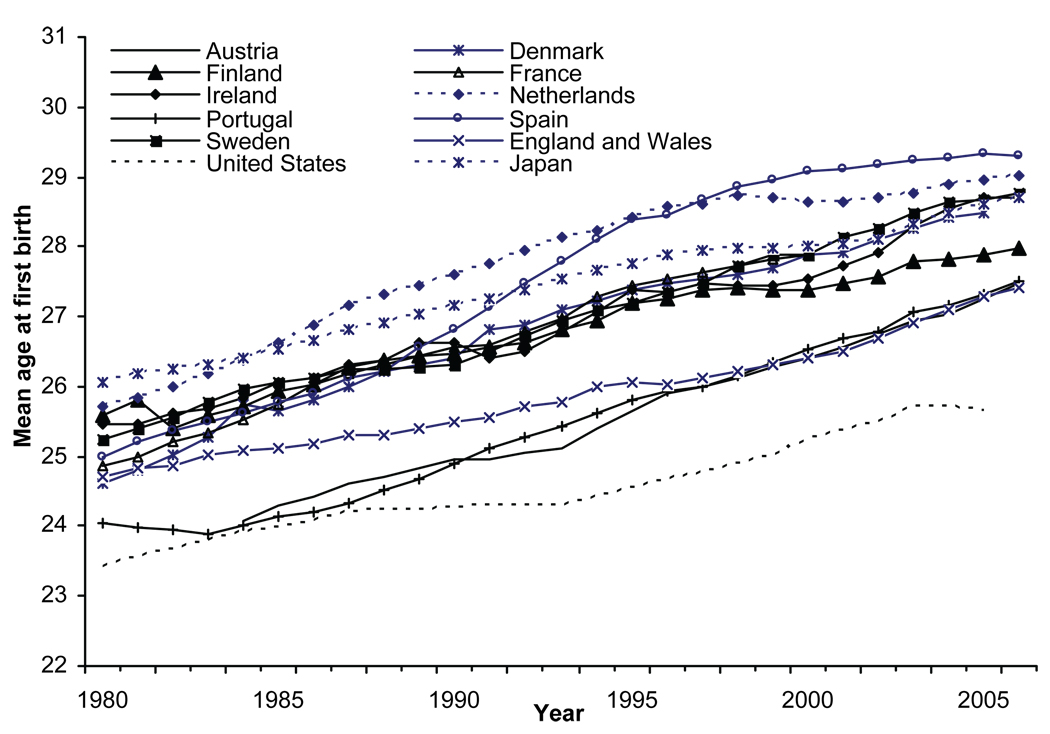
The number of countries experiencing very low fertility has been rising in recent years, garnering increasing academic, political and media attention. There is now widespread academic agreement that the postponement of fertility is a major contributing factor in the very low levels of fertility that have occurred, and yet most policy discussions have been devoted to increasing the numbers of children women have. We discuss factors in three institutions-the educational system, the labour market and the housing market-that may inadvertently have led to childbearing postponement. We highlight important components of the timing of childbearing, including its changing place within the transition to adulthood across countries and the significance of the demands of childbearing versus childrearing. Using illustrations from Europe, North America, Japan, Australia and New Zealand, we argue that the following all lead to younger childbearing: 1) an open education system whereby it is relatively easy to return to school after having dropped out for a while; 2) a shorter, smoother, easier school-to-work transition; 3) easier re-entry into the labour market after having taken time out for childrearing or any other reason; 4) greater capability of integrating childrearing into a career; 5) easier ability to obtain a mortgage with a moderately small down payment, moderately low interest rate and a long time period over which to repay the loan; and 6) easier ability to rent a dwelling unit at an affordable price. Conversely, reversing any or all of these factors would lead, other things being equal, to postponement of childbearing.
近年来,生育率极低的国家数量一直在增加,这引起了学术界、政界和媒体越来越多的关注。目前学术界已普遍达成共识,生育推迟是导致极低生育率出现的一个主要因素,然而大多数政策讨论都致力于增加女性生育子女的数量。我们探讨了教育系统、劳动力市场和住房市场这三个机构中可能无意中导致生育推迟的因素。我们强调了生育时间安排的重要组成部分,包括其在各国向成年过渡过程中不断变化的位置以及生育需求与养育需求的重要性。通过引用欧洲、北美、日本、澳大利亚和新西兰的例子,我们认为以下因素都会促使生育年龄提前:1)开放的教育系统,即辍学一段时间后相对容易重返校园;2)从学校到工作的过渡更短、更顺利、更容易;3)因育儿或其他原因暂时离开劳动力市场后更容易重新进入;4)将育儿融入职业生涯的能力更强;5)更容易以适度较低的首付、适度较低的利率和较长的还款期限获得抵押贷款;6)更容易以负担得起的价格租到居住单元。相反,在其他条件相同的情况下,扭转其中任何一个或所有这些因素都会导致生育推迟。