Brown Barrett S, McIff Terence E, Glattes Rudolph C, Burton Douglas C, Asher Marc A
Dept of Orthopedic Surgery, University of Kansas Medical Center, 3901 Rainbow Blvd, Kansas City, KS 66160, USA.
Scoliosis. 2010 Jul 13;5:14. doi: 10.1186/1748-7161-5-14.
The use of thoracic pedicle screws in spinal deformity, trauma, and tumor reconstruction is becoming more common. Unsuccessful screw placement may require salvage techniques utilizing transverse process hooks. The effect of different starting point placement techniques on the strength of the transverse process has not previously been reported. The purpose of this paper is to determine the biomechanical properties of the thoracic transverse process following various pedicle screw starting point placement techniques.
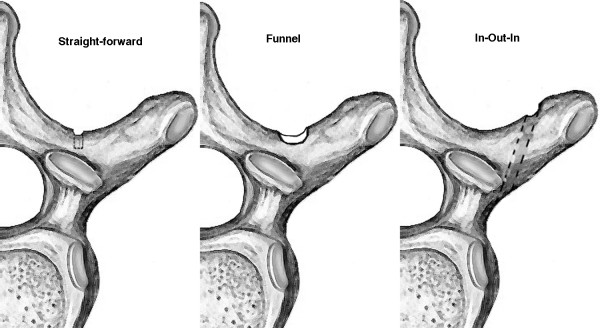
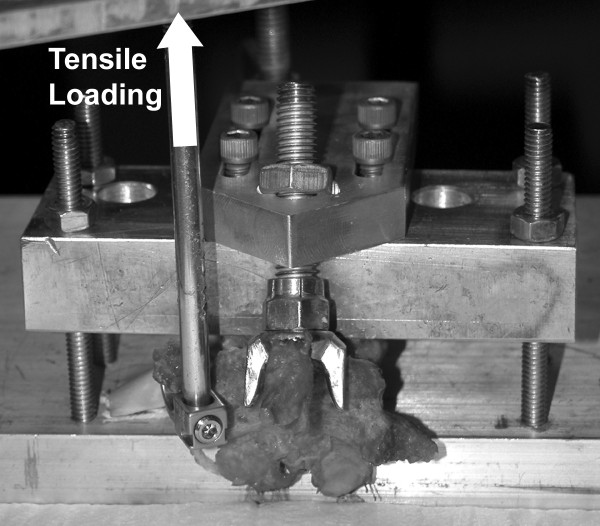
Forty-seven fresh-frozen human cadaveric thoracic vertebrae from T2 to T9 were disarticulated and matched by bone mineral density (BMD) and transverse process (TP) cross-sectional area. Specimens were randomized to one of four groups: A, control, and three others based on thoracic pedicle screw placement technique; B, straightforward; C, funnel; and D, in-out-in. Initial cortical bone removal for pedicle screw placement was made using a burr at the location on the transverse process or transverse process-laminar junction as published in the original description of each technique. The transverse process was tested measuring load-to-failure simulating a hook in compression mode. Analysis of covariance and Pearson correlation coefficients were used to examine the data.
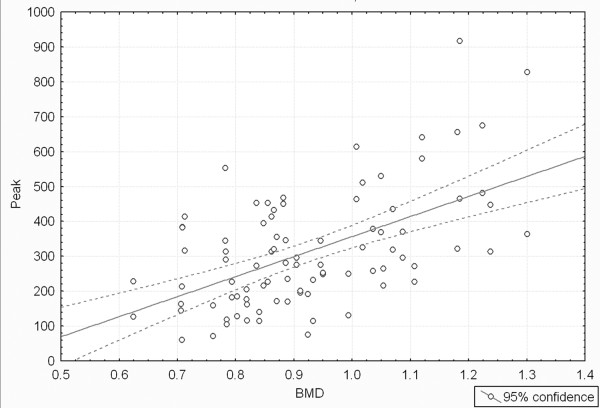
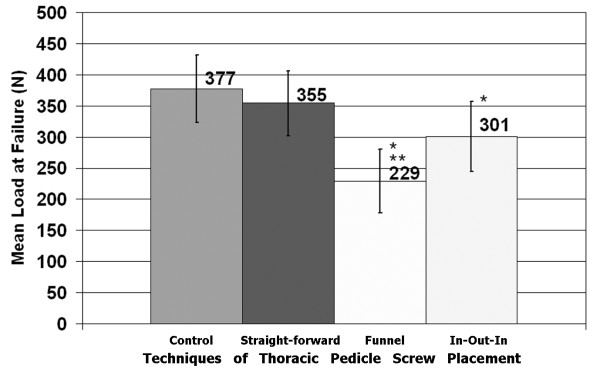
Technique was a significant predictor of load-to-failure (P = 0.0007). The least squares mean (LS mean) load-to-failure of group A (control) was 377 N, group B (straightforward) 355 N, group C (funnel) 229 N, and group D (in-out-in) 301 N. Significant differences were noted between groups A and C, A and D, B and C, and C and D. BMD (0.925 g/cm2 [range, 0.624-1.301 g/cm2]) was also a significant predictor of load-to-failure, for all specimens grouped together (P < 0.0001) and for each technique (P <0.05). Level and side tested were not found to significantly correlate with load-to-failure.
The residual coronal plane compressive strength of the thoracic transverse process is dependent upon the screw starting point placement technique. The funnel technique significantly weakens transverse processes as compared to the straightforward technique, which does not significantly weaken the transverse process. It is also dependent upon bone mineral density, and low failure loads even in some control specimens suggest limited usefulness of the transverse process for axial compression loading in the osteoporotic thoracic spine.
胸椎椎弓根螺钉在脊柱畸形、创伤及肿瘤重建中的应用日益普遍。螺钉置入失败可能需要采用横突钩挽救技术。此前尚未报道不同起始点置入技术对横突强度的影响。本文旨在确定各种椎弓根螺钉起始点置入技术后胸椎横突的生物力学特性。
从T2至T9的47个新鲜冷冻人体尸体胸椎被分离,并根据骨密度(BMD)和横突(TP)横截面积进行匹配。标本随机分为四组:A组为对照组,其他三组基于胸椎椎弓根螺钉置入技术分组;B组为直接法;C组为漏斗法;D组为进出进法。按照每种技术原始描述中公布的方法,在横突或横突-椎板交界处使用磨钻进行椎弓根螺钉置入的初始皮质骨去除。测试横突在模拟钩状压缩模式下的失效载荷。采用协方差分析和Pearson相关系数对数据进行检验。
技术是失效载荷的显著预测因素(P = 0.0007)。A组(对照组)的最小二乘均值(LS均值)失效载荷为377 N,B组(直接法)为355 N,C组(漏斗法)为229 N,D组(进出进法)为301 N。A组与C组、A组与D组、B组与C组以及C组与D组之间存在显著差异。对于所有分组在一起的标本(P < 0.0001)以及每种技术(P < 0.05),BMD(0.925 g/cm² [范围,0.624 - 1.301 g/cm²])也是失效载荷的显著预测因素。未发现测试的节段和侧别与失效载荷有显著相关性。
胸椎横突在冠状面的残余抗压强度取决于螺钉起始点置入技术。与直接法相比,漏斗法显著削弱横突,而直接法不会显著削弱横突。它还取决于骨密度,即使在一些对照标本中低失效载荷也表明在骨质疏松性胸椎中横突用于轴向压缩载荷的作用有限。