Laboratory of Anti-Inflammatory Signaling and Surgical Immunology, Department of Surgery, UMDNJ-New Jersey Medical School, 185 South Orange Avenue, Newark, NJ 07103, USA.
Mediators Inflamm. 2010;2010:642462. doi: 10.1155/2010/642462. Epub 2010 Jun 8.
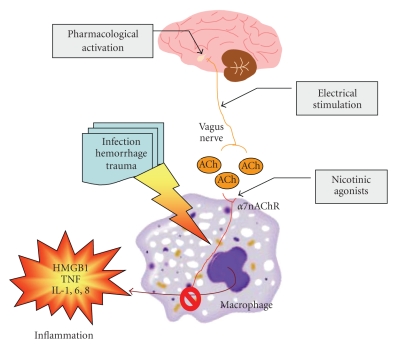
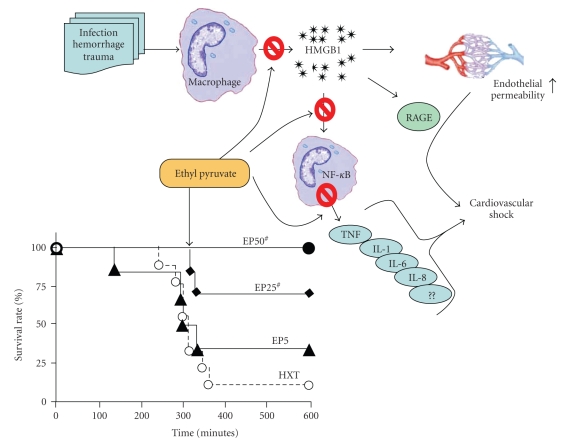
The inflammatory responses in sepsis and hemorrhage remain a major cause of death. Clinically, it is generally accepted that shock in sepsis or hemorrhage differs in its mechanisms. However, the recognition of inflammatory cytokines as a common lethal pathway has become consent. Proinflammatory cytokines such as tumor necrosis factor (TNF) or high-mobility group box1 (HMGB1) are fanatically released and cause lethal multiorgan dysfunction. Inhibition of these cytokines can prevent the inflammatory responses and organ damage. In seeking potential anti-inflammatory strategies, we reported that ethyl pyruvate and alpha7 nicotinic acetylcholine receptor (alpha7nAChR) agonists effectively restrained cytokine production to provide therapeutic benefits in both experimental sepsis and hemorrhage. Here, we review the inflammatory responses and the anti-inflammatory strategies in experimental models of sepsis and hemorrhage, as they may have a consistent inflammatory pathway in spite of their different pathophysiological processes.
在脓毒症和出血中,炎症反应仍然是主要的死亡原因。临床上,一般认为脓毒症或出血中的休克在机制上有所不同。然而,炎症细胞因子作为共同的致死途径已得到公认。肿瘤坏死因子(TNF)或高迁移率族蛋白 1(HMGB1)等促炎细胞因子被疯狂释放,并导致致命的多器官功能障碍。抑制这些细胞因子可以防止炎症反应和器官损伤。在寻求潜在的抗炎策略时,我们报告称,丙酮酸乙酯和α7 烟碱型乙酰胆碱受体(α7nAChR)激动剂可有效抑制细胞因子的产生,在实验性脓毒症和出血中均提供治疗益处。在这里,我们回顾了脓毒症和出血实验模型中的炎症反应和抗炎策略,尽管它们的病理生理过程不同,但它们可能具有一致的炎症途径。