Department of Oncology, The Sidney Kimmel Comprehensive Cancer Center, The Johns Hopkins University School of Medicine, Baltimore, Maryland, United States of America.
PLoS One. 2010 Jul 8;5(7):e11475. doi: 10.1371/journal.pone.0011475.
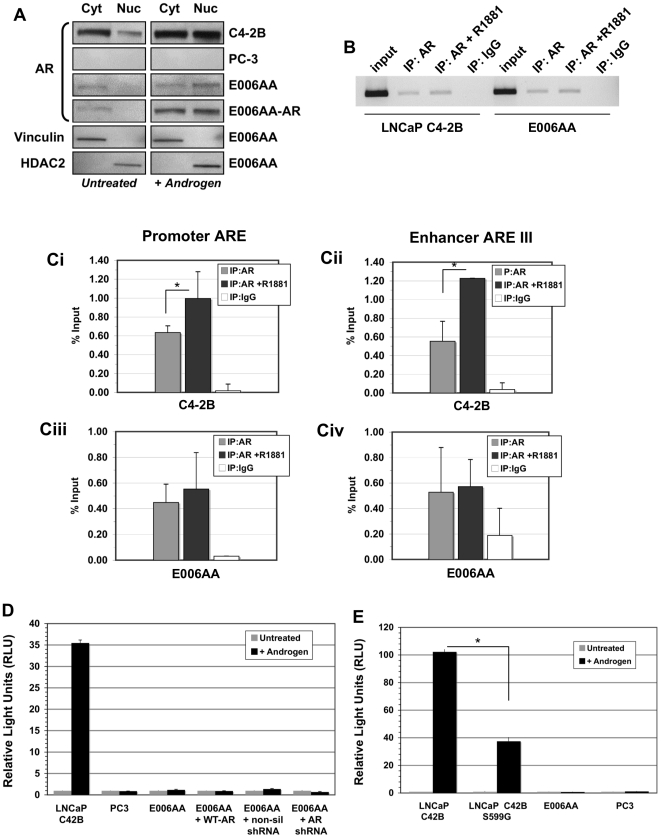
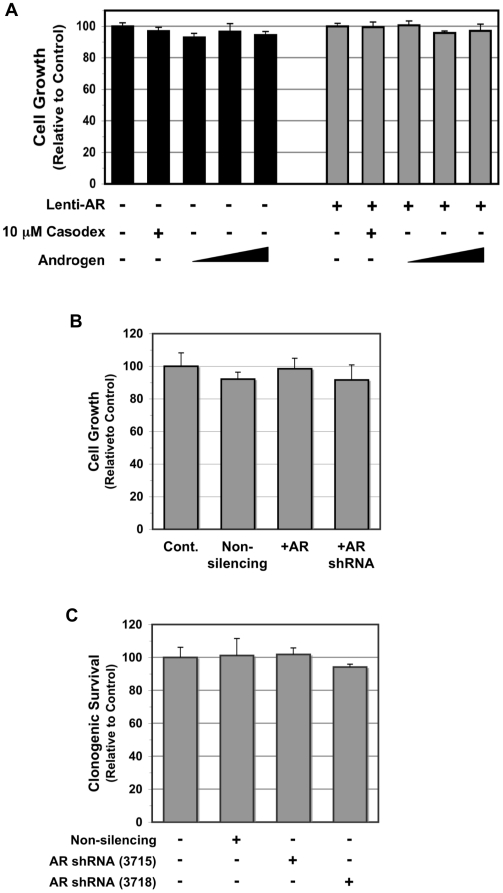
The conversion of androgen receptor (AR) signaling as a mechanism of growth suppression of normal prostate epithelial cells to that of growth stimulation in prostate cancer cells is often associated with AR mutation, amplification and over-expression. Thus, down-regulation of AR signaling is commonly therapeutic for prostate cancer. The E006AA cell line was established from a hormone naïve, localized prostate cancer. E006AA cells are genetically aneuploid and grow equally well when xenografted into either intact or castrated male NOG but not nude mice. These cells exhibit: 1) X chromosome duplication and AR gene amplification, although paradoxically not coupled with increased AR expression, and 2) somatic, dominant-negative Serine-599-Glycine loss-of-function mutation within the dimerization surface of the DNA binding domain of the AR gene. No effect on the growth of E006AA cells is observed using targeted knockdown of endogenous mutant AR, ectopic expression of wild-type AR, or treatment with androgens or anti-androgens. E006AA cells represent a prototype for a newly identified subtype of prostate cancer cells that exhibit a dominant-negative AR loss-of-function in a hormonally naïve patient. Such loss-of-function eliminates AR-mediated growth suppression normally induced by normal physiological levels of androgens, thus producing a selective growth advantage for these malignant cells in hormonally naïve patients. These data highlight that loss of AR-mediated growth suppression is an independent process, and that, without additional changes, is insufficient for acquiring oncogene addiction to AR signaling. Thus, patients with prostate cancer cells harboring such AR loss-of-function mutations will not benefit from aggressive hormone or anti-AR therapies even though they express AR protein.
雄激素受体 (AR) 信号转导的转换作为一种将正常前列腺上皮细胞的生长抑制转变为前列腺癌细胞的生长刺激的机制,通常与 AR 突变、扩增和过表达有关。因此,下调 AR 信号转导通常是治疗前列腺癌的方法。E006AA 细胞系是从激素-naive、局限性前列腺癌中建立的。E006AA 细胞在遗传上是非整倍体,在异种移植到完整或去势的雄性 NOG 但不是裸鼠中时生长情况相同。这些细胞表现出:1)X 染色体重复和 AR 基因扩增,尽管矛盾的是,这与 AR 表达增加无关,以及 2)AR 基因 DNA 结合域二聚化表面的体细胞、显性负性丝氨酸 599-甘氨酸功能丧失突变。使用靶向敲低内源性突变 AR、异位表达野生型 AR、或用雄激素或抗雄激素治疗,对 E006AA 细胞的生长没有影响。E006AA 细胞代表了一种新鉴定的前列腺癌细胞亚型的原型,该细胞在激素-naive 患者中表现出显性负性 AR 功能丧失。这种功能丧失消除了正常生理水平的雄激素通常诱导的 AR 介导的生长抑制,从而为这些恶性细胞在激素-naive 患者中产生选择性生长优势。这些数据强调了 AR 介导的生长抑制的丧失是一个独立的过程,而且,在没有其他变化的情况下,不足以获得对 AR 信号的致癌基因依赖性。因此,即使表达 AR 蛋白,携带这种 AR 功能丧失突变的前列腺癌细胞的患者也不会从积极的激素或抗 AR 治疗中获益。