Department of Biology and Biochemistry, University of Houston, Houston, Texas, USA.
PLoS Comput Biol. 2010 Jul 8;6(7):e1000848. doi: 10.1371/journal.pcbi.1000848.
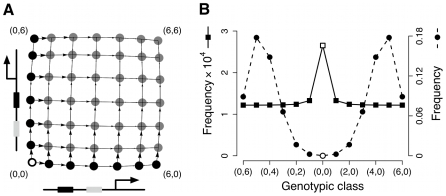
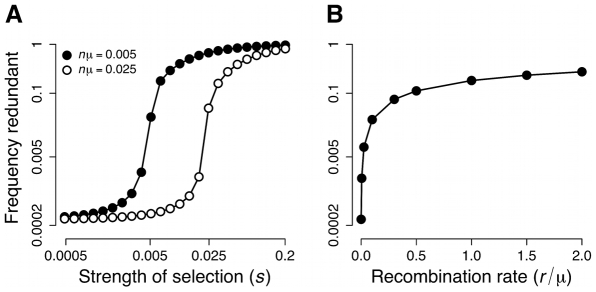
The promoter regions of many genes contain multiple binding sites for the same transcription factor (TF). One possibility is that this multiplicity evolved through transitional forms showing redundant cis-regulation. To evaluate this hypothesis, we must disentangle the relative contributions of different evolutionary mechanisms to the evolution of binding site multiplicity. Here, we attempt to do this using a model of binding site evolution. Our model considers binding sequences and their interactions with TFs explicitly, and allows us to cast the evolution of gene networks into a neutral network framework. We then test some of the model's predictions using data from yeast. Analysis of the model suggested three candidate nonadaptive processes favoring the evolution of cis-regulatory element redundancy and multiplicity: neutral evolution in long promoters, recombination and TF promiscuity. We find that recombination rate is positively associated with binding site multiplicity in yeast. Our model also indicated that weak direct selection for multiplicity (partial redundancy) can play a major role in organisms with large populations. Our data suggest that selection for changes in gene expression level may have contributed to the evolution of multiple binding sites in yeast. We conclude that the evolution of cis-regulatory element redundancy and multiplicity is impacted by many aspects of the biology of an organism: both adaptive and nonadaptive processes, both changes in cis to binding sites and in trans to the TFs that interact with them, both the functional setting of the promoter and the population genetic context of the individuals carrying them.
许多基因的启动子区域包含相同转录因子 (TF) 的多个结合位点。一种可能性是,这种多样性是通过表现出冗余顺式调控的过渡形式进化而来的。为了评估这个假设,我们必须将不同进化机制对结合位点多样性进化的相对贡献区分开来。在这里,我们尝试使用结合位点进化模型来做到这一点。我们的模型明确考虑了结合序列及其与 TF 的相互作用,并使我们能够将基因网络的进化纳入中性网络框架。然后,我们使用来自酵母的数据来测试模型的一些预测。模型分析表明,有三个候选非适应性过程有利于顺式调控元件冗余和多样性的进化:长启动子中的中性进化、重组和 TF 混杂。我们发现,在酵母中,重组率与结合位点多样性呈正相关。我们的模型还表明,对多样性的弱直接选择(部分冗余)在群体较大的生物中可能起主要作用。我们的数据表明,对基因表达水平变化的选择可能促成了酵母中多个结合位点的进化。我们的结论是,顺式调控元件冗余和多样性的进化受到生物体生物学的许多方面的影响:适应性和非适应性过程、结合位点的顺式变化和与它们相互作用的 TF 的反式变化、启动子的功能设置以及携带它们的个体的群体遗传背景。