Department of Computer Science, Rice University, TX, Houston, USA.
BMC Evol Biol. 2012 Aug 30;12:159. doi: 10.1186/1471-2148-12-159.
The amount of transcription factor binding sites (TFBS) in an organism's genome positively correlates with the complexity of the regulatory network of the organism. However, the manner by which TFBS arise and accumulate in genomes and the effects of regulatory network complexity on the organism's fitness are far from being known. The availability of TFBS data from many organisms provides an opportunity to explore these issues, particularly from an evolutionary perspective.
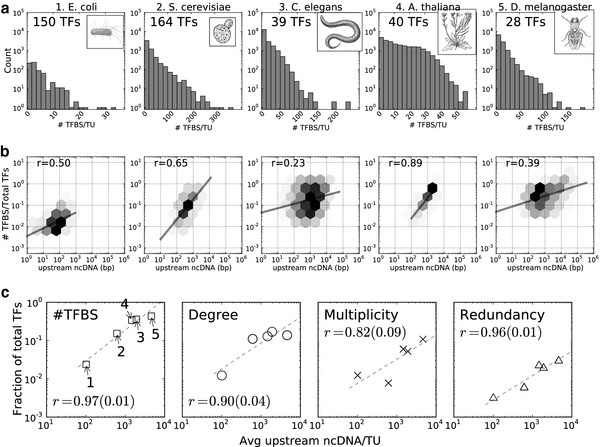
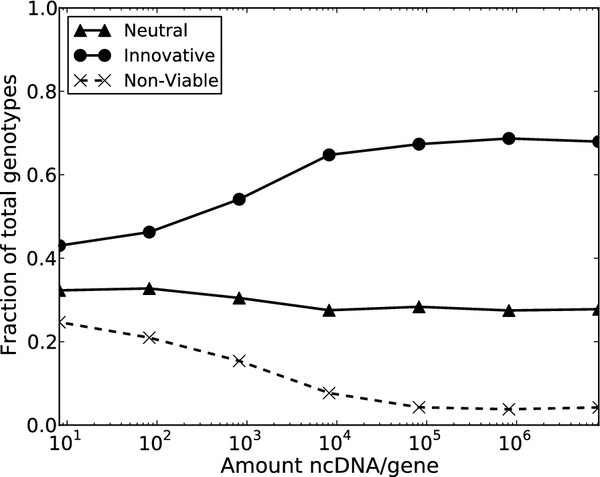
We analyzed TFBS data from five model organisms - E. coli K12, S. cerevisiae, C. elegans, D. melanogaster, A. thaliana - and found a positive correlation between the amount of non-coding DNA (ncDNA) in the organism's genome and regulatory complexity. Based on this finding, we hypothesize that the amount of ncDNA, combined with the population size, can explain the patterns of regulatory complexity across organisms. To test this hypothesis, we devised a genome-based regulatory pathway model and subjected it to the forces of evolution through population genetic simulations. The results support our hypothesis, showing neutral evolutionary forces alone can explain TFBS patterns, and that selection on the regulatory network function does not alter this finding.
The cis-regulome is not a clean functional network crafted by adaptive forces alone, but instead a data source filled with the noise of non-adaptive forces. From a regulatory perspective, this evolutionary noise manifests as complexity on both the binding site and pathway level, which has significant implications on many directions in microbiology, genetics, and synthetic biology.
生物基因组中转录因子结合位点(TFBS)的数量与生物调控网络的复杂程度呈正相关。然而,TFBS 在基因组中产生和积累的方式,以及调控网络复杂性对生物适应性的影响,目前还知之甚少。许多生物的 TFBS 数据的可用性为探索这些问题提供了机会,特别是从进化的角度来看。
我们分析了来自五个模式生物——大肠杆菌 K12、酿酒酵母、秀丽隐杆线虫、黑腹果蝇、拟南芥——的 TFBS 数据,发现生物基因组中非编码 DNA(ncDNA)的数量与调控复杂性之间存在正相关。基于这一发现,我们假设 ncDNA 的数量,加上种群大小,可以解释不同生物之间调控复杂性的模式。为了验证这一假设,我们设计了一个基于基因组的调控途径模型,并通过群体遗传模拟将其置于进化的力量之下。结果支持了我们的假设,表明中性进化力量单独就可以解释 TFBS 的模式,而对调控网络功能的选择并不能改变这一发现。
顺式调控组不是一个由适应性力量单独精心设计的干净的功能网络,而是一个充满非适应性力量噪声的数据来源。从调控的角度来看,这种进化噪声表现为结合位点和途径层面的复杂性,这对微生物学、遗传学和合成生物学的许多方向都有重要意义。