Physics Department and Center for Nonlinear and Complex Systems, Duke University, Durham, North Carolina, USA.
PLoS Comput Biol. 2010 Jul 8;6(7):e1000842. doi: 10.1371/journal.pcbi.1000842.
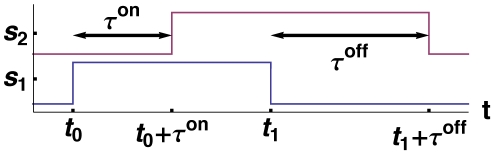
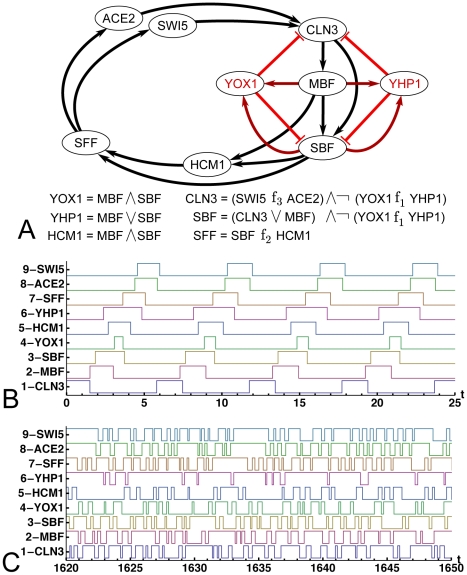
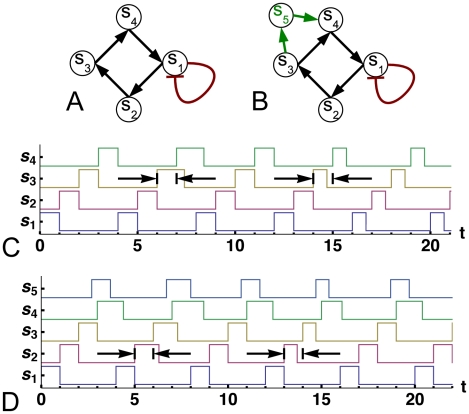
A recently published transcriptional oscillator associated with the yeast cell cycle provides clues and raises questions about the mechanisms underlying autonomous cyclic processes in cells. Unlike other biological and synthetic oscillatory networks in the literature, this one does not seem to rely on a constitutive signal or positive auto-regulation, but rather to operate through stable transmission of a pulse on a slow positive feedback loop that determines its period. We construct a continuous-time Boolean model of this network, which permits the modeling of noise through small fluctuations in the timing of events, and show that it can sustain stable oscillations. Analysis of simpler network models shows how a few building blocks can be arranged to provide stability against fluctuations. Our findings suggest that the transcriptional oscillator in yeast belongs to a new class of biological oscillators.
最近发表的与酵母细胞周期相关的转录振荡器为自主循环过程在细胞中的机制提供了线索和疑问。与文献中的其他生物和合成振荡网络不同,这个振荡器似乎不依赖于组成性信号或正自调节,而是通过在确定其周期的缓慢正反馈环上稳定传递脉冲来运行。我们构建了这个网络的连续时间布尔模型,该模型允许通过事件时间的小波动来模拟噪声,并表明它可以维持稳定的振荡。对更简单的网络模型的分析表明,几个构建块如何可以被安排来提供对波动的稳定性。我们的发现表明,酵母中的转录振荡器属于一类新的生物振荡器。